| Author |
 Replies: 21 / Views: 4,105 Replies: 21 / Views: 4,105 |
Page 2 of 2
|
|
|
|
Pillar of the Community
Canada
937 Posts |
Hi robmck
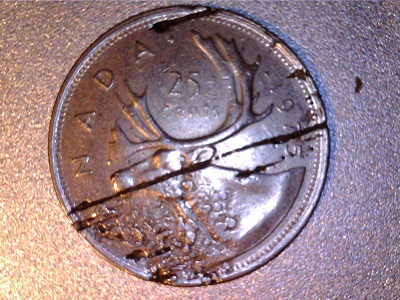
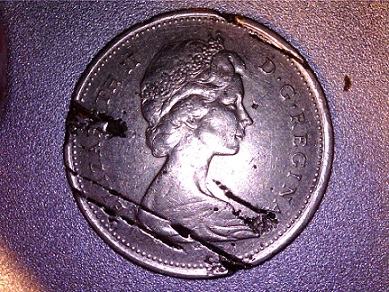
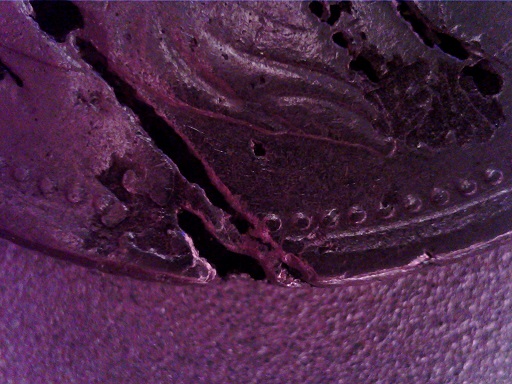
There used to be a process called "patenation", if I recall correctly, in which underground alkalyne salts and cyanides would dissolve certain minerals from ground ore, leaving other minerals behind and looking rather "spongely"-looking, similar to your coins. Gold and copper were often recovered in this manner dating from the time of the romans to as late as the 1600's, as these very porous ores ended up containing a much-higher grade of base metal, especially desirable in the days when refining techniques were not as good as we have today. If your coins have been buried at some time or exposed to certain environmental damage, then that might leave those unexplained holes. True, I may be wrong (won't be the first time!), but the reason I lean toward any explanation along these lines is that the holes in your coins don't look like any man-made/road rash/shop project gone wrong type of a deal. Notice how the holes are very organic-looking, as if the missing material was leached away naturally as opposed to being forcibly removed by some other method. I believe chwkboy and Scissel are correct when they say acidic/environmental damage, but I do believe that the metal was not mixed properly prior to the minting process, causing the striations, or else you would have holes in just random spots and blotches on the coin and would tend to see more surface damage. At any rate I would keep the coins, if for no other reason than they are rather neat-looking! Sweet find for the price you paid!
|
|
Pillar of the Community
Canada
2632 Posts |
Pennysaver- I completely appreciate what your saying and agree with you for the most part but these coins are 100% nickel leading me to believe this damage is not due to improper metal mix. But you never know, who really knows what was going on at the mint in the late 20s and 30s. Looks acidic from being buried and one of them was straight up and down thus causing the rim to go first....maybe lol
|
|
Pillar of the Community
Canada
937 Posts |
Hi pennyman
Yeah, I always thought that the nickels were 100% nickel too, so I hear what you're saying. I just couldn't figure out what else would cause those marks to be like that. I agree an acid or some such thing was the cause of it, but I don't know how pure "100%" actually was back then. I've got some nice "woody" pennies, which actually are an alloy, but didn't know if the same fluctuation of nickel could take place or not. I wish I had one, it looks pretty cool.
|
|
Pillar of the Community
Canada
2632 Posts |
Want to hear something weird..the metal nickel used to make coins did not come from this planet, its also one of the most corrosion resistant metals there is, although it will oxidize. Read this for yourself - http://en.wikipedia.org/wiki/Nickel |
|
Pillar of the Community
 Canada
872 Posts |
great conversation piece these turned out to be...nickels from space!! that's awesome! so the acidic environmental conditions comment sounds very plausible. and I agree that the way the metal is eaten away is very organic in some regards but is also inorganic in the way the striations run in the same direction. and the nickels being buried would probably explain the darker colour and the fact that there were three like this in a group. each of the 3 showed a different amount of progression in the amount of missing metal. if there was an impurity in the nickel, it would stand to reason that when they rolled the nickel into sheets, it would have been rolled in one direction which would have stretched the impurity into the striations. so the question is...if you buried 100 George V nickels in the right soil, would they all deteriorate in a similar fashion? or would only a few with impurities show the deterioration? |
|
Pillar of the Community
Canada
937 Posts |
Cool article, pennyman. I guess all our collections are rather "cosmic" now, eh?
Robmck: I'm guessing that only those nickels with impurities would show similar effects, although I've seen other types of minor surface damage on old nickels that I'm sure was caused by them being buried for years. Maybe do a test batch and dig it up in 50 years or so? (lol)
|
|
New Member
Canada
34 Posts |
|
|
Pillar of the Community
Canada
2786 Posts |
alien nickel, I like it 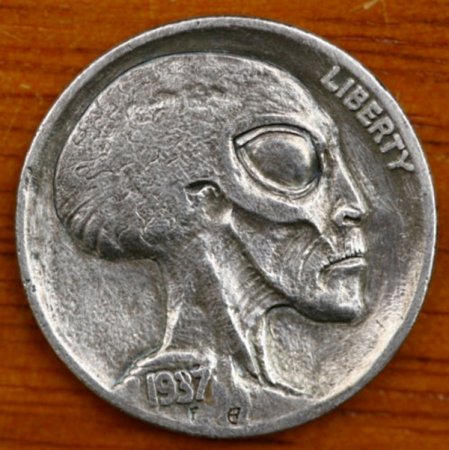 |
|
Valued Member
United States
381 Posts |
Quote:
alien nickel, I like it Where did you get that? Sweet coin! |
|
Moderator
 Canada
10477 Posts |
Corrosion (post mint damage). The lineation you see in the metal is probably from the rolling of the nickel plates into strips. Similarly, you see similar stripes from rolling blank strips with woodgrain toning (both sides are always parallel).
"Discovery follows discovery, each both raising and answering questions, each ending a long search, and each providing the new instruments for a new search." -- J. Robert OppenheimerContent of this post is licensed under a Creative Commons Attribution-NonCommercial 3.0 Unported License. See: http://creativecommons.org/licenses...0/deed.en_USMy eBay store
|
|
Forum Kid
Canada
1074 Posts |
|
|
Pillar of the Community
United States
840 Posts |
The termites were hungry.
doug
|
|
Pillar of the Community
United States
4233 Posts |
I was thinking shipworms.
|
|
Pillar of the Community
Canada
1049 Posts |
these coins have seen quite a few years in water, with it flowing over them non stop, I'm thinking in a river sitting in a small group of pebble on bedrock. Very similar to what I have detected (nickel coins) in the rivers over the years. The ones at the water line in sand or pebble don't seem to have linear corrosion as do the ones found in the currents. IMO.
|
|
Pillar of the Community
Canada
937 Posts |
Wade: Now if that "alien nickel" was a 1947, you'd really have something...
|
|
Page 2 of 2
|
Replies: 21 / Views: 4,105 |
Page 2 of 2
|








 First Page


 Posted 01/01/2014 5:47 pm