| Author |
 Replies: 18 / Views: 4,905 Replies: 18 / Views: 4,905 |
Page 2 of 2
|
|
|
|
Pillar of the Community
Hong Kong
1270 Posts |
It is H58. Hafner told it is 39.5 mm in diameter. Lucky Cuss, can you tell the diameter of your coin, just an additional datum to our forum. Thanks, Henry
|
|
Pillar of the Community
 United States
4883 Posts |
I also noticed that the die seemed to have been slightly oversized vis a vis the flan. The coin's diameter is irregular - 39.9 mm in height, 40.2 mm in width.
In hand, and under the best lighting, I can detect a few stray hairlines that could easily be attributed to the holder in which it had resided for many years, for the fields exhibit a granularity that's inconsistent with any significant polishing.
Colligo ergo sum
Edited by Lucky Cuss
06/12/2014 01:04 am
|
|
Pillar of the Community
2087 Posts |
For me the photos looked pretty accurate for the type. Its not an overly valuable variety but it is a 'key' to the 20th century history of the coin. When Mussolini talked Austria into giving Italy a 25 year right to produce the coin in 1935, the Johnson and Matthey contract was cancelled. Johnson and Matthey then approached the British government, who were very concerned at the Italian victory ( with regards the MTT) this lead to the UK striking the coin and Johnson and Matthey having lead over the supply of the Brit MTTs until the war office took control of production in 1939/40. Its a coin not so valuable in dollar terms but priceless in historical terms!
Edit: there is a second possibility to the identity of your coin. When the Italians gained the minting rights Vienna transferred all the tooling to Rome- One French researcher describes three varieties of Rome mint coins(Dr Hafner currently only describes 1). The first variety, according to Regourdy, being almost exactly the same as the Johnson and Matthey coin. You reported a larger diametre than I was expecting. Therefore yours might possibly be from Rome. First check the weight If 28.06grams or slightly less then it is likely it is Vienna. If its between 28.07 & 28.14 gms then it is likely to be Rome. Rome produced MTT's using the Lira silver alloy(835) instead of the Austrian 833 1/3 standard.
Edited by austrokiwi
06/11/2014 10:27 am
|
|
Valued Member
United States
58 Posts |
I am amazed with all the details people here have regarding coins. To me it's just a nice looking coin.
|
|
Pillar of the Community
United States
4883 Posts |
Quote:
If its between 28.07 & 28.14 gms then it is likely to be Rome. I'm getting a weight of 28.12 grams. But if it's in fact an H71, I'm not seeing the associated obverse die crack. However, am I understanding you correctly that Regourdy identifies an earlier subtype that may lack that characteristic? Colligo ergo sum
Edited by Lucky Cuss
06/12/2014 01:17 am
|
|
Pillar of the Community
2087 Posts |
Lucky Cuss: you got it exactly! Regourdy describes one that only differs from the Johnson and Matthey type by weight( which seems to be what you have), a second variety using the same dies but on larger 'normal' sized planchets, then the third is the die cracked one. UK national archives reflect similar contemporary observations. The Die crack was due to Italy trying to reinforce the principle they were the only legal producers...there was a political decision to keep on using the Vienna dies even when they cracked! The reason the sightly larger diameter suggested Rome to me is because that mint was less expert than Vienna. The MTT at that time was struck without a collar. Just a slight increase in striking pressure would expand the planchet. Dr. (hon)Hafner and I have been in contact as I prepare for a mini-seminar on the MTT in the second week of the ANA summer seminar. He will be producing an updated lexicon in the new year....He will even be using some of my discoveries to update the catalog. His honorary degree is, I suspect, in numismatics Quote:
I am amazed with all the details people here have regarding coins. To me it's just a nice looking coin. Liberty Belle: without the 'story' these coins are just metal discs to me! Edited by austrokiwi
06/12/2014 02:22 am
|
|
Pillar of the Community
France
1591 Posts |
austrokiwi : I hope you planned to discuss about the fake counterstamps on MTT appearing magically in some auction houses ... ? :D
I've sent a message to the ANE facebook account yesterday (there were spanish stamps involved - one is in the next auction) - in case it's worth something ...
|
|
Pillar of the Community
2087 Posts |
One of the last parts of the presentation will involve handing out copies of that December 2013 Auction catalog and asking participants to see if they can identify the base coins. I think that small exercise will achieve more than plain words will
|
|
Pillar of the Community
United States
4883 Posts |
A couple more I happened to stumble across today. I don't judge these to be very old at all, but I also again think they're not the exactly the same as those being currently minted. They do seem to me to be of a single type, despite having differences in appearance. #1 has a semi-prooflike quality to it, while #2 seems to have been struck with the dies (especially the reverse) in a more advanced state of wear. Both weigh 28.25 grams, but again their diameters are irregular. Each is 40.7mm in height, but #1 is 41.8mm in width, while #2 is 41.1 mm wide. They make for (I hope) an interesting comparison to each other and to the one with which I started this thread. #1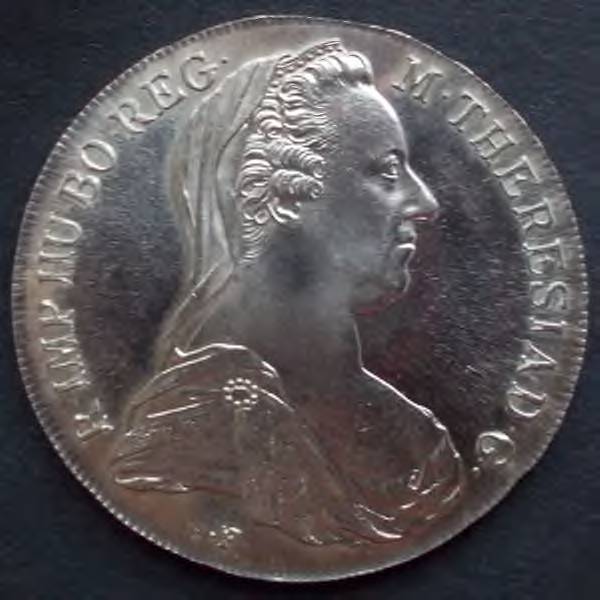 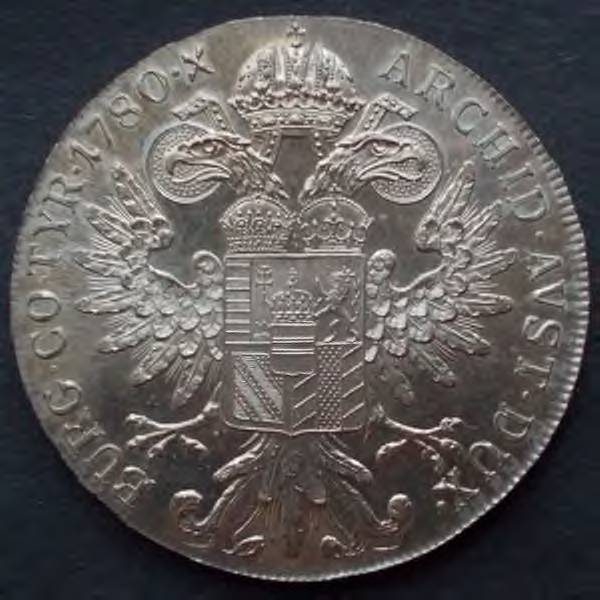 #2 #2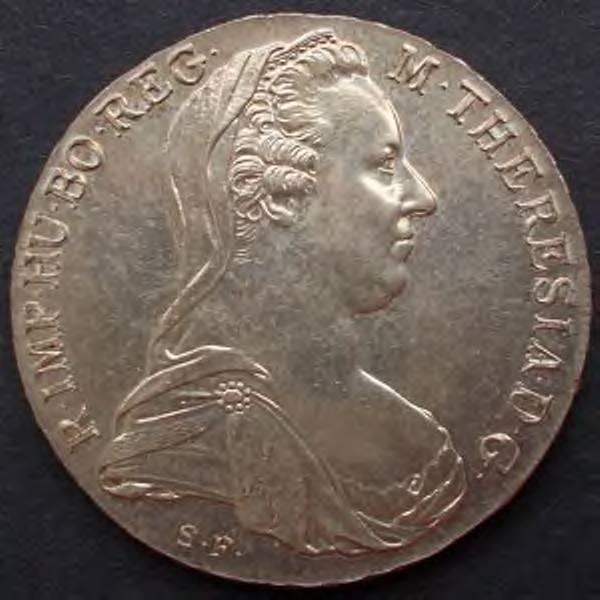 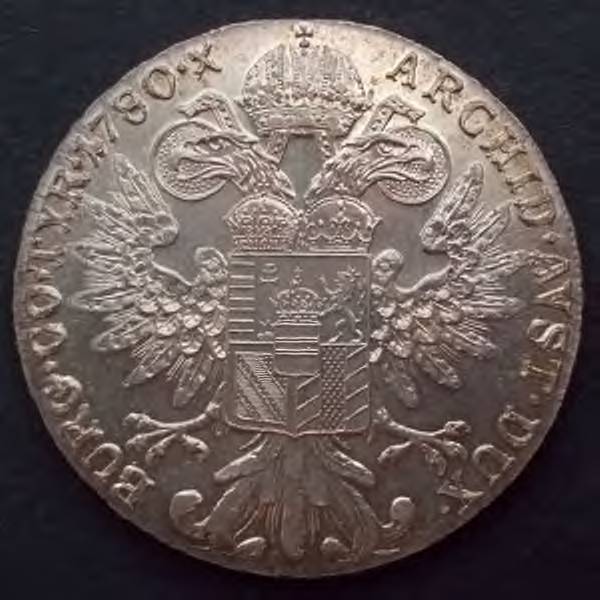 Colligo ergo sum
|
|
Pillar of the Community
Hong Kong
1270 Posts |
They looks H60 and/or H61 to me. Henry
|
|
Pillar of the Community
United States
4883 Posts |
Quote:
They looks H60 and/or H61 to me. Henry The diameter(s) being in excess of 40mm would seem to favor an H60 identification. Also, for whatever it's worth, #2 exhibits a die peculiarity, a stray dot in the central shield of the coat of arms, and just up and to its left, a less distinct and more irregular bump, neither of which should be there. 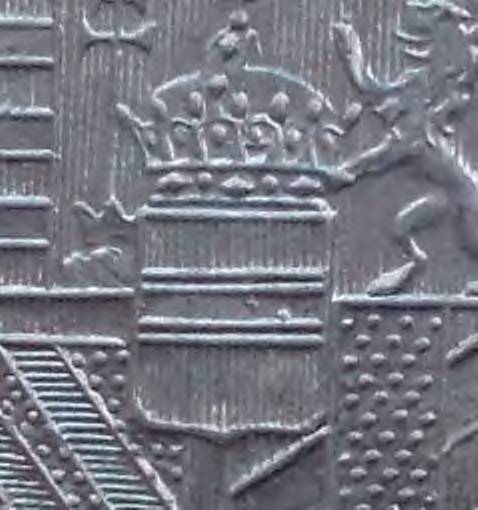 Colligo ergo sum
|
|
Pillar of the Community
Hong Kong
1270 Posts |
Lucky Cuss, the two dots in the central Austrian sheild is a mint mark to the Vienna Mint. More information of Modern Maria Theresa Thaler, please also read: https://goccf.com/t/139072 |
|
Pillar of the Community
2087 Posts |
Quote:
Lucky Cuss, the two dots in the central Austrian sheild is a mint mark to the Vienna Mint. Small clarification I believe it was an unobtrusive authentication mark. Vienna mint wasn't the only one to use it the Swiss Gold Abschlag( Abschlag sounds so much better than "off-metal-strike") has those dots, and I wouldn't be surprised if some Rome mint coins also had it |
|
Pillar of the Community
United States
4883 Posts |
Quote:
Lucky Cuss, the two dots in the central Austrian sheild is a mint mark to the Vienna Mint. Oh. Thanks for the link to the other thread (albeit I haven't gotten through all 26 pages of it yet). I hadn't realized there was such a comprehensive discussion already here, but I ought to have guessed as much. I do see that these dots and their significance are mentioned early on there. However, my #1 (the better struck specimen) does not have them. So exactly what does that indicate, if anything? Even if the dots do verify that a coin was struck at Vienna, it doesn't follow as a logical necessity that their absence means that a coin was struck elsewhere, even though that may be in fact what is the case. Edit: I should add that I'm now wavering on my previous thought that #1 and #2 are of the same type, despite the coincidence of their weights and similarity in dimensions. Colligo ergo sum
Edited by Lucky Cuss
06/18/2014 3:19 pm
|
|
Pillar of the Community
Hong Kong
1270 Posts |
Quote:
an unobtrusive authentication mark Yes, this is a more proper attribution than a mint mark. Thanks austrokiwi. |
|
Page 2 of 2
|
Replies: 18 / Views: 4,905 |
Page 2 of 2
|








 First Page


 Posted 06/11/2014 08:52 am


