| Author |
 Replies: 17 / Views: 2,079 Replies: 17 / Views: 2,079 |
Page 2 of 2
|
|
|
|
Valued Member
 United States
134 Posts |
probably someone here that just saw it....a little too high for Strike through error.....if that is what it was.
|
|
Valued Member
United States
134 Posts |
yes, I think there were 12 photos, and the reverse was fine..
|
|
Pillar of the Community
United States
2376 Posts |
It was a cool struck through .
|
|
Valued Member
United States
134 Posts |
It was very cool Stoneman, I was just wondering if it was a Strike Thru, good to know. Next time I'll make my max bid huge.
|
|
Pillar of the Community
United States
4809 Posts |
Ten - recommend an appropriate bid (which I take huge to mean). Work your lower bid to the upper limit that you are comfortable with...and where you aren't kicking yourself later. Good luck on the next one!
|
|
Valued Member
United States
134 Posts |
Thanks Rack, I don't think I would be kicking myself if I knew another error collector was willing to pay more than 50.00 for that coin, I would own it for max it may be worth today and sell it years later at a profit as it becomes more valuable in time. Better yet, I should not ask about coins I find to buy, I would probably get them cheap.
|
|
Moderator
 United States
23522 Posts |
I won't rule out a strikethrough but somebody might have to explain how the die can strike features evenly on a curved surface first.
|
|
Pillar of the Community
United States
2376 Posts |
SsD , which curved surfaces were you referring to.
|
|
Moderator
United States
23522 Posts |
The letters in TRUST bother me the most, but the 9 and 6 in the date are of interest as well. They're no longer on a plane, and therefore can't be struck by an essentially flat die. The coin looks more like it's delaminated than struck through for that reason, yet it's obviously not a lamination either. As of right now, PMD is the only explanation which makes sense but I'm willing to listen to intelligent thinking. |
|
Bedrock of the Community
United States
62064 Posts |
To me it looks exactly the way a struck through error should look. Probably the difference is that it is grease and debris in the mix. If this were a lamination, then it would be in a straight line. If it were PMD then the reverse would be affected. But I see a struck through coin. 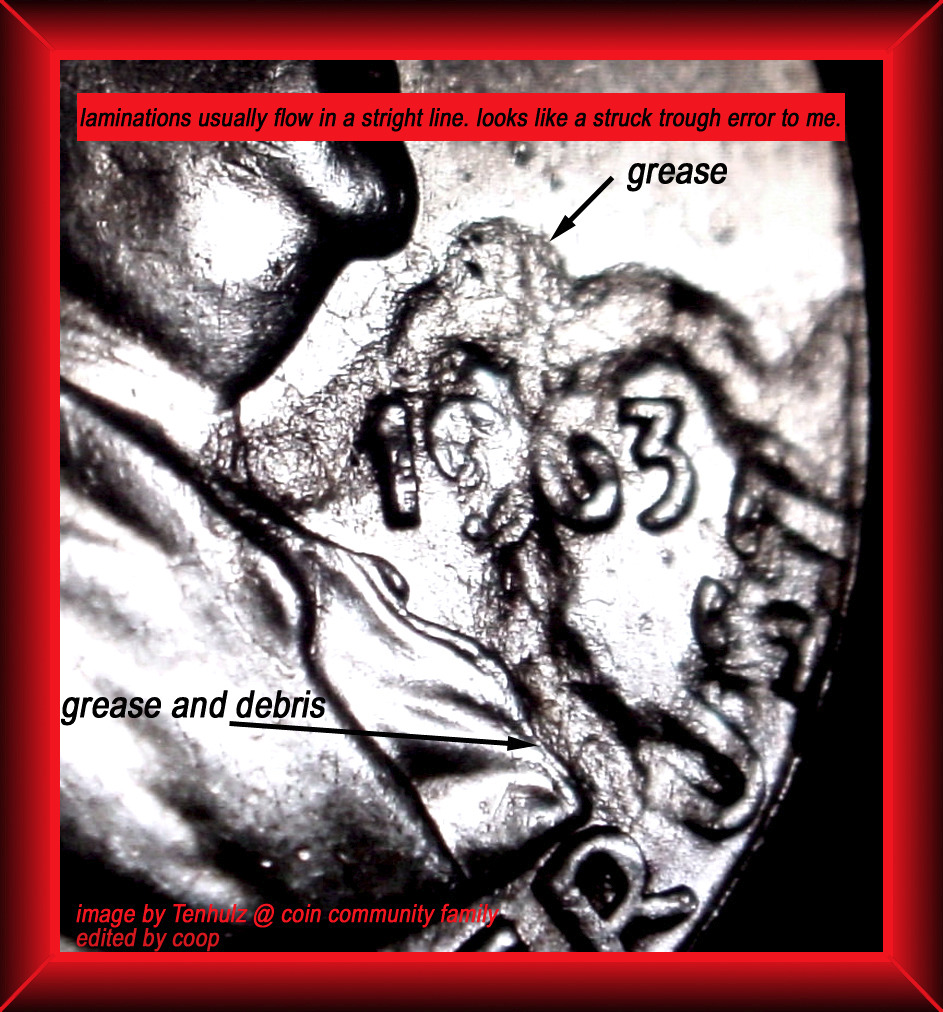 1 1Edited by coop
06/20/2015 3:51 pm
|
|
Valued Member
United States
134 Posts |
Thanks COOP, I was bidding on the coin, I suspected PMD or lamination, and wrote to seller, he wasn't 100% either. It went for 51.00, bet its worth more. I just loved that coin for the error and the fact that it was on a Ben! Thanks for the explanation! J Ten |
|
Moderator
United States
23522 Posts |
OK, I need an education here then. How does Grease Fill and disappear the field around the 1 without affecting the digit - the lower point of the die - at all? How do the laws of physics allow that? That's just one of half a dozen things that bother me about this one. |
|
Pillar of the Community
United States
7390 Posts |
My novice eye had those reservations too SD, in his previous post about it.
|
|
Bedrock of the Community
United States
62064 Posts |
It is Grease Fill with debris. Could be metal filings or string or something added to the mix that prevented the normal strike. (kind of like a dropped letter) |
|
Valued Member
United States
134 Posts |
After watching Coop's DVD on youtube, I have a much better understanding of error coins...Thanks COOP, loved the music as well. In SD's last question on prev. page, to me, it makes sense that the grease would stop at the raised 1 in the date and the fact that there was a piece of twine or string in area next to the number 1 the flow would be completely different.
|
|
Page 2 of 2
|
Replies: 17 / Views: 2,079 |
Page 2 of 2
|







 First Page

 Posted 06/19/2015 11:44 pm





