| Author |
 Replies: 21 / Views: 3,977 Replies: 21 / Views: 3,977 |
Page 2 of 2
|
|
|
|
Pillar of the Community
United States
1699 Posts |
The die was heavily polished. Rather than making the depression visually larger, it makes the design fade into the field.
|
|
New Member
 United States
13 Posts |
Ok I'm a complete idiot. How did it "fade into the field? it created a flat surface directly in front of the E and R leaving them there and creating a bridge between them. Ya know, never mind. lol Thanks though. Have a good one.
|
|
New Member
United States
13 Posts |
Ok. Thanks everyone. I do appreciate the attempt. but if three people here feel confident to answer die questions, yet don't even understand that what is raised on a coin is a depression in the die and a depression cant be polished to fill it in, because it IS depressed from the field of the coin, then I am clearly in the wrong place.
Have none of you ever played with clay or play dough? Remember the little molds are the exact opposite of what you molded from them? What's up on the clay in down in the mold?
Anyway, I do know how a die works, Ive designed no fewer than 300 of them for various industries (not coins). I will say I've never seen a die, any die, repaired like this however...if it is repaired.
I think I'll look for someplace where people do more than parrot things they've heard and actually know what they are talking about. Or, are at least can summon up the courage to look at a die photo right in front of them to see the truth. lol.
Have fun ya'll, I'm sure there's a lot of smart people here...I've just lost trust as I don't know who knows what they are saying and who just thinks they do. Ya know, just because a parrot says "E=MC2" doesn't mean he's Einstein. lol Toodles.
And, I can't find a place to cancel my account, so, boo me. LOL.
Edited by gwpoulos
10/04/2015 3:10 pm
|
|
Bedrock of the Community
United States
62064 Posts |
The "E" looks like the die was polished and now is showing the die flow lines again in that area. But the "R" looks like it is not showing die flow lines. So I'm leaning toward the "R" as being a slight Grease Fill in that area of the die. When looking at the normal "R", you can see how this could happen and prevent the strike from fully happening in that area. 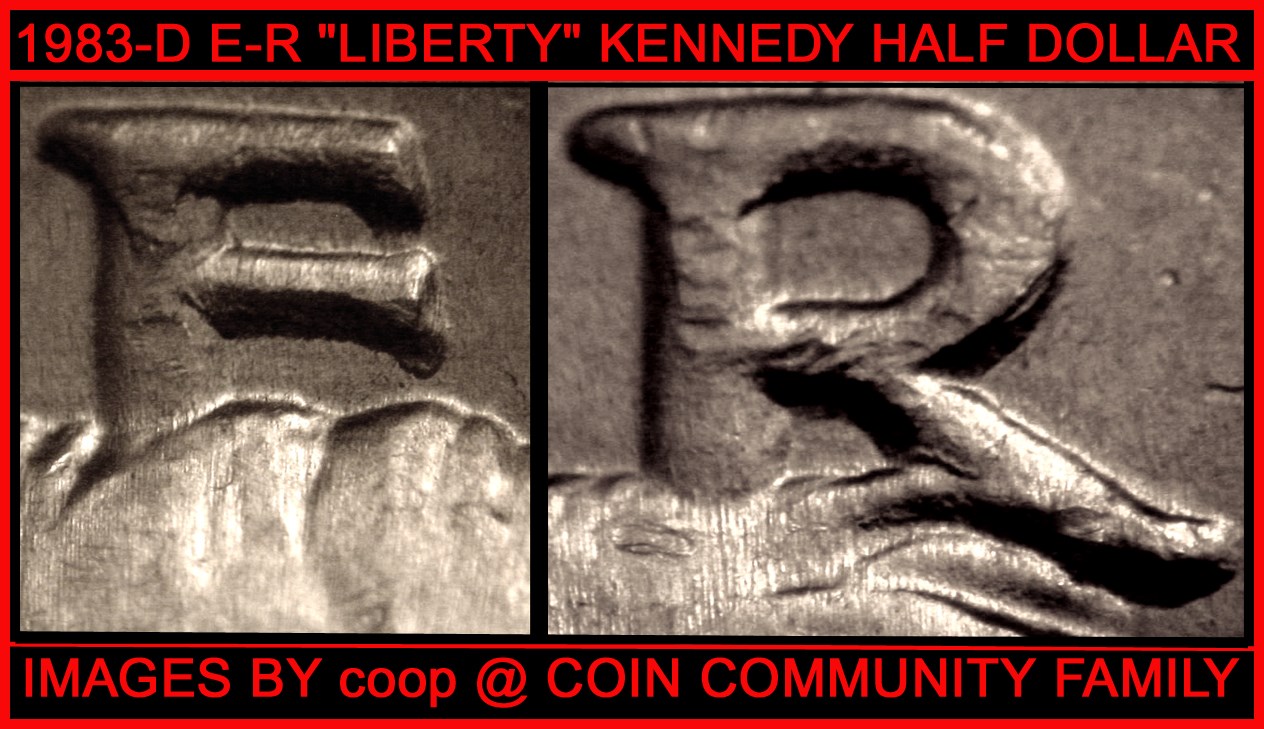 The heavy die polishing reduces the devices making the die more shallow and the coins devices thinner. We do see that happening also on this coin. But either way if adds no extra value to this coin. Just a wear/polish/slight Grease Fill. |
|
Pillar of the Community
United States
1699 Posts |
I could be wrong. Here was my thinking, though: Over polishing the dies created the 1966 No FG Kennedy halves (and the other No FG halves). The effect that I see in the "E" and "R" in the trueviews of the 1966 No FG halves (here: http://www.pcgscoinfacts.com/Coin/D...1636?redir=t) is very similar to what I see on the half dollar in your photos. I would also welcome clearer photos of the coin in questions - Maybe I'm just completely misreading the ones that you've posted. |
|
Bedrock of the Community
United States
12437 Posts |
Quote:
When raised lettering gets filled it gets weaker or can even disappear. Polishing it wont fill it in completely below all surrounding surfaces.
You are looking at it all wrong. Die polishing starts with the highest point, the fields, and works its way down until the die details begin to fade into the fields. The area missing detail due to excessive die abrading would be slightly lower than unaffected fields on other parts of the coin. This is a very common phenomenon that affects many coin designs- 3 Legged Buffalo nickel, "floating roof" on the Lincoln Memorial, and my personal favorite- the "broken nose" Mercury dime as seen below:  Quote:
My intuition says grease but it just looks too clean, like the die broke, was -filled in- with new metal, then smoothed n polished. Incorrect, coin dies are never repaired, only resurfaced via polishing. It would be impossible to satisfactorily repair a die to the point that it could sustain tens to hundreds of thousands of strikes using several dozen tons of striking pressure. The annual mintage for one denomination at one mint involves thousands of dies, it is simply not efficient to even attempt a significant repair that would inevitably fail. Quote:
I think I'll look for someplace where people do more than parrot things they've heard and actually know what they are talking about. Or you could just stick around because it is apparent that you do indeed have a few things to learn yourself... |
|
Pillar of the Community
United States
3360 Posts |
Quote:
using several dozen tons of striking pressure Is there available any information on the exact striking pressure used by the mint? |
|
Valued Member
United States
452 Posts |
If you think about the devices as a bowl, if you took a plastic bowl and cut it down one inch the rim of the bowl would look smaller around correct? When a die is polished, they are essentially "cutting the bowl."
|
|
Rest in Peace
United States
7075 Posts |
Just curious -- what happened to the B un LIBERTY?
Is that a die chip?
|
|
Pillar of the Community
United States
3644 Posts |
Ive read quite a bit past couple years but where I learned about grease errors,die deteriation and over polished dies was right here from this forum and I still have plenty to learn from them if you stick around you will too
|
|
Bedrock of the Community
United States
12437 Posts |
Quote:
Is there available any information on the exact striking pressure used by the mint? Van Allen and Mallis list the striking pressure for a Morgan dollar at 150 tons and I think I have seen the striking pressure for a Lincoln Cent listed at 25 tons with all other denominations in between. |
|
Pillar of the Community
United States
3360 Posts |
Thank you, biokemist6.  |
|
Bedrock of the Community
United States
62064 Posts |
Here is an image from a plate off a machine in SF mint for creating dies from the hubs. (probably proof settings) 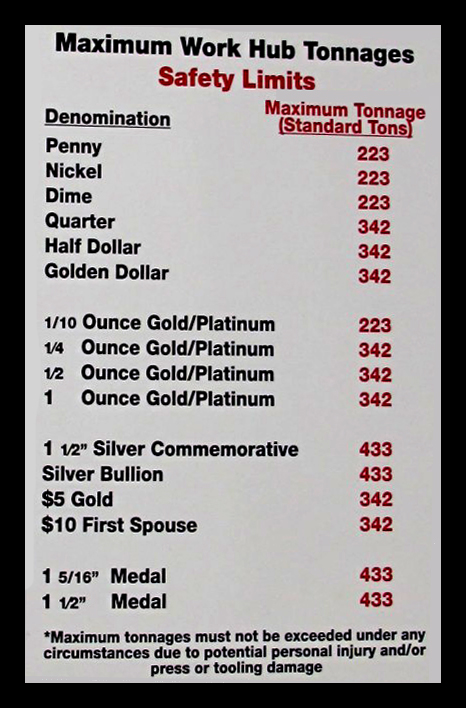 Edited by coop
10/07/2015 12:14 pm
|
|
Pillar of the Community
United States
3360 Posts |
Quote:
(probably proof settings) Please pardon my ignorance...would dies to mint proofs be different in composition than dies to make business strikes? The research I am doing for a paper on another subject identified only 2 different compositions for the steel in dies: Alloy 52100 for small diameter coins and Alloy L6 for quarter on up. My research did not uncover any difference between dies for proof strike and dies for business strike. That doesn't mean it doesn't exist though! I would be interested in where I might find more information on this question? |
|
Bedrock of the Community
United States
62064 Posts |
This was an image someone took at the SF mint on a machine. That about all I can tell you right now.
|
|
Page 2 of 2
|
Replies: 21 / Views: 3,977 |
Page 2 of 2
|






 First Page

 Posted 10/04/2015 2:00 pm


