| Author |
 Replies: 17 / Views: 6,924 Replies: 17 / Views: 6,924 |
Page 2 of 2
|
|
|
|
Pillar of the Community
United States
4963 Posts |
Quote:
They do some sort of test at the mint that leaves a circular impression, but I've never seen one this profound. I think it's damaged. I'm pretty sure that leaves a much smaller hole. The 1938 appears to be damaged. It looks like it took a hit which pushed in the rim. Unfortunately, both coin are probably damaged. They're still a 1938 and a War Nickel, though, so it's not a total loss.  Edited by Numisma
12/02/2016 08:12 am
|
|
Pillar of the Community
United States
3516 Posts |
 to CCF! Both coins are damaged. But one is 35% silver.Stay with us and you will learn a lot |
|
New Member
 United States
3 Posts |
Thanks guys. I really appreciate it. Working through a little collection my Dad gave me and learning a lot. I can see where this gets addicting! :)
|
|
Pillar of the Community
United States
5964 Posts |
Yes, hook, line and sinker. We are waiting for you to post another. lol
|
|
Pillar of the Community
United States
2775 Posts |
I agree with the 1942 being damaged after strike. I agree the 1938 reverse being damaged after strike. I agree the 1938 obverse looks like it was damaged after strike. But something tells me to check the edge of the coin for confirmation. If you get the time, could you show that area of the coins outside edge. Thanks, Doug. |
|
Pillar of the Community
United States
3363 Posts |
The diameter of a BB is 4.5 mm, so the strike would be less than that because it would not have indented the coin to its maximum diameter. The anvil effect (raised area) on the opposite side of the coin from the indention is verification that the indention was a strike after the coin left the mint. I am enclosing a photo of the size of a Rockwell Test mark on a coin: 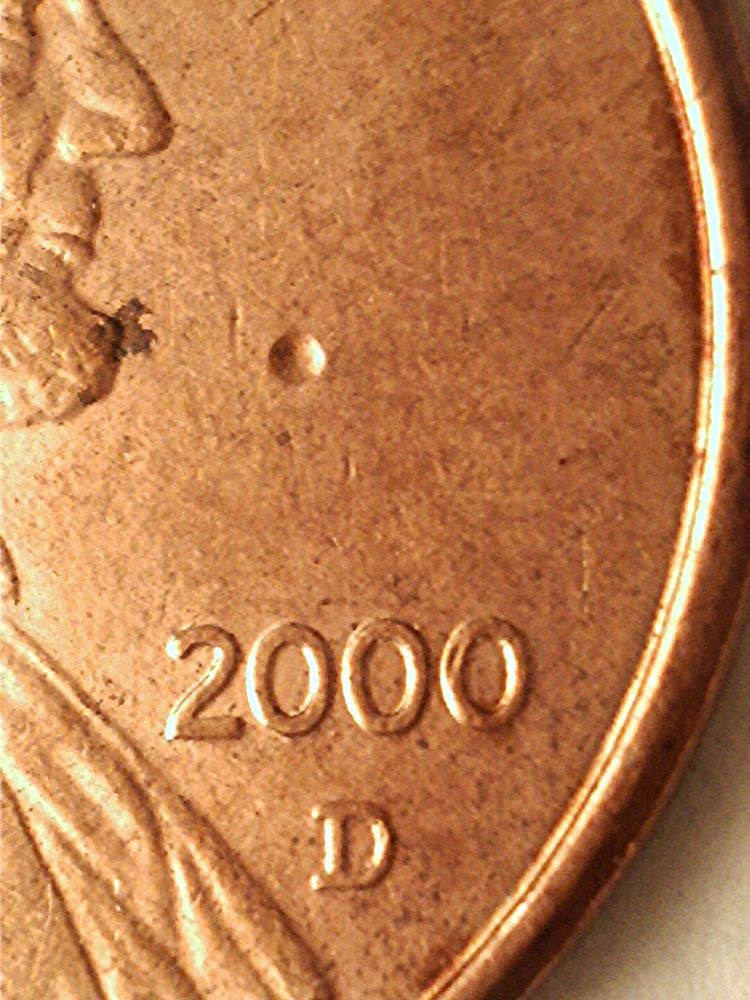 |
|
Bedrock of the Community
United States
94367 Posts |
Got a mystery? Just call CCF forensics! to the CCF! Edited by Coinfrog
12/02/2016 4:48 pm
|
|
Pillar of the Community
United States
5964 Posts |
As I said, it's too big to be the Rockwell test or a bebe. It's damage. Why do they call the raised damage "anvil effect"? If it was placed on an anvil, the other side wouldn't be raised.
|
|
New Member
United States
3 Posts |
Thanks all! I've listed the lot on ebay disclosing the damage. So much for my retirement. CoinMasters, get ready. Breaking out the wheat pennies  |
|
Pillar of the Community
United States
3363 Posts |
|
|
Pillar of the Community
United States
5964 Posts |
Wheat Pennies! Thanks for the link Pete. As I read it, I understood the Anvil Effect refers to the indented side. The name fits much better now. |
|
Pillar of the Community
United States
3363 Posts |
Quote:
As I read it, I understood the Anvil Effect refers to the indented side. The "anvil effect" does not refer to the indented side. On a hardness testing machine, the anvil is the portion of the machine upon which the subject to be tested is placed. If the pressure of the test is too much or the subject is too thin, it will cause the rise on the opposite side of the indention which will push against the anvil and invalidate the results of the test. This is called "anvil effect". So the raised area is usually referred to as the "anvil effect". This is a precurser paper to the link I provided earlier. Here is a quote which defines it along with the reference to the source of the quote (a Thesis written on "Anvil effect" (the paper concerns the testing of sheet metal)): Quote:The anvil normally is harder than the sheet metal to be tested. It is likely that the anvil will influence the test readings, as the thickness of the sheet metal may be insufficient to support the applied load. Such an influence is defined as the anvil effect, http://oaktrust.library.tamu.edu/bi...f?sequence=1 Here is a concise definition: Quote: Anvil Effect In an indentation hardness test, the bulge formed on the anvil side of the specimen which indicates that the hardness determination is of questionable accuracy. http://www.vincentmetals.com/compon...ew,glossary/ Edited by Pete2226
12/04/2016 1:58 pm
|
|
Pillar of the Community
United States
3363 Posts |
When I was researching for the paper I wrote on Rockwell Hardness Testing, I had a Rockwell Test performed on some Lincoln Cents. Here is one of the photos I took of the process. The arrow is pointing to the anvil. The Lincoln Cent can be seen on the anvil with the indenter poised for the test. 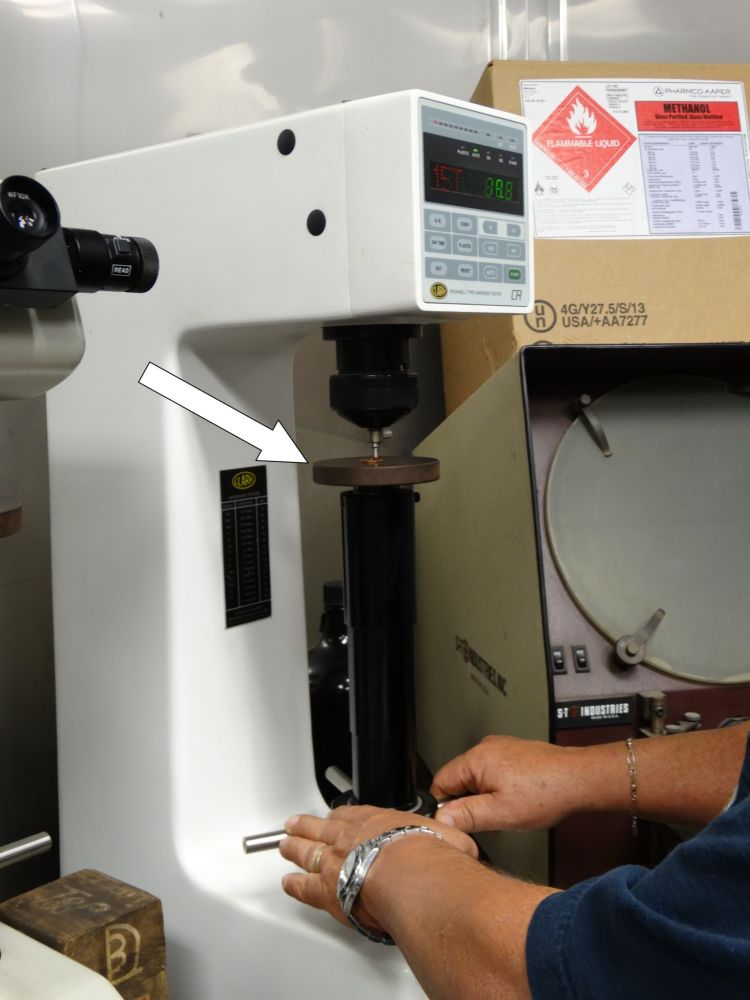 |
|
Pillar of the Community
United States
5964 Posts |
Oh yes, Now I remember, you did write that research. As I recall you received an award of recognition for that. A very good contribution to our hobby.
I miss a link here and there, it is indeed the raised side. Do you know if there is a hole in the anvil to facilitate the bulge and test only the desired metal? I think there must be. Thank you for your time Pete.
|
|
Pillar of the Community
United States
3363 Posts |
Quote:
Do you know if there is a hole in the anvil to facilitate the bulge and test only the desired metal? There is no hole. If a bulge shows up, too much pressure has been used and the test is invalidated. |
|
Page 2 of 2
|
Replies: 17 / Views: 6,924 |
Page 2 of 2
|






 First Page


 Posted 12/02/2016 08:15 am





