| Author |
 Replies: 20 / Views: 9,673 Replies: 20 / Views: 9,673 |
Page 2 of 2
|
|
|
|
Pillar of the Community
United States
1335 Posts |
why didn't he just make them in gold
|
|
Rest in Peace
United States
10625 Posts |
Yeah, these are not errors in my opinion. I call it mint sports.
|
|
Pillar of the Community
United States
7730 Posts |
Probably just the "tip of the iceberg" that former mint employee snagged (or created) during his employment at the mint.
I suspect this is just a test by the family to see what the Mint will do when pieces like this, with a questionable ownership status, show up in the marketplace.
|
|
Bedrock of the Community
United States
17884 Posts |
Quote:
why didn't he just make them in gold Where do you get the planchets? Remember ownership of gold was restricted at the time. |
|
Pillar of the Community
United States
5964 Posts |
Good stuff CCFP.  |
|
CCF Advertiser
United States
1533 Posts |
Based on the court decision re: the 1933 Saints, I wouldn't feel comfortable as an owner of a 1913 Liberty nickel, a proof bust dollar, or any number of errors or patterns. High profile cases make for bad law. |
|
Forum Dad
 United States
24228 Posts |
|
|
New Member
United States
19 Posts |
I agree that you really can't call these errors if someone intentionally made them. Also since the dad was a die setter for the U.S. Mint its even more suspicious.
|
|
Valued Member
Netherlands
74 Posts |
I'm just wondering though: it says the last one is struck on a Netherlands 25 cents planchet. However that coin doesn't look like silver to me, and the Netherlands 25 cents that were struck in Philadelphia are silver... (also the weight doesn't really match: official weight is 3.575 for the 25 cent, the ones I have all weigh in around 3.55-3.57g, so 3.52 for an MS coin is too low).
What am I missing here?
|
|
Bedrock of the Community
United States
17884 Posts |
They also didn't strike any coins for the Netherlands until 1944. Curacao 25c is a more likely candidate, same alloy and size as the Netherlands piece but they were struck in 1943. Surinam (Netherlands Guiana) 25c would be another possibility. Again same size and alloy but actually struck at the mint in 1943. The color could be because it is a low fineness alloy, 640 fine. But they really need to do an XRF test and list the composition, because if it LOOKS like copper it could just be on a thick planchet and not a foreign planchet at all. (Although a thick planchet copper 1943 cent would still be impressive, a double error.)
|
|
Bedrock of the Community
United States
10284 Posts |
Wondering what the family of former US Mint employee Albert Michael Pratt has not submitted yet in case these get confiscated. You would think they would have been a bit more anonymous if they wanted to get away with this.
|
|
Bedrock of the Community
United States
10065 Posts |
I hope they give back the 1933 gold pieces if these cents are allowed to be in the hobby. But its likely the number/value of the 1933s that caught the government's attention. I like the idea of odd coins like this, but I prefer consistency.
How much squash could a Sasquatch squash if a Sasquatch would squash squash? Download and read: Grading the graders Costly TPG ineptitude and No FG Kennedy halveshttps://ln5.sync.com/dl/7ca91bdd0/w...i3b-rbj9fir2 |
|
Valued Member
Netherlands
74 Posts |
Quote:
They also didn't strike any coins for the Netherlands until 1944. Curacao 25c is a more likely candidate, same alloy and size as the Netherlands piece but they were struck in 1943. Surinam (Netherlands Guiana) 25c would be another possibility. Again same size and alloy but actually struck at the mint in 1943. The color could be because it is a low fineness alloy, 640 fine. But they really need to do an XRF test and list the composition, because if it LOOKS like copper it could just be on a thick planchet and not a foreign planchet at all. (Although a thick planchet copper 1943 cent would still be impressive, a double error.) There are Dutch 25 cent coins struck in Philadelphia with the year 1943 as well, see photo. The Curacao and Surinam 1943 coins are the same coin, and their only difference with the Dutch one is the mint master mark (acorn vs palm tree). The planchets for all three would have been the same as well. As for the colour: I've never seen a Dutch silver 25c piece that didn't look like silver. They might only be 640 fine, they never look as dark as the Lincoln. I'm not claiming the Lincoln therefore couldn't be a low grade silver, I'm just saying I consider it highly unlikely that it's the Dutch 25c planchet. 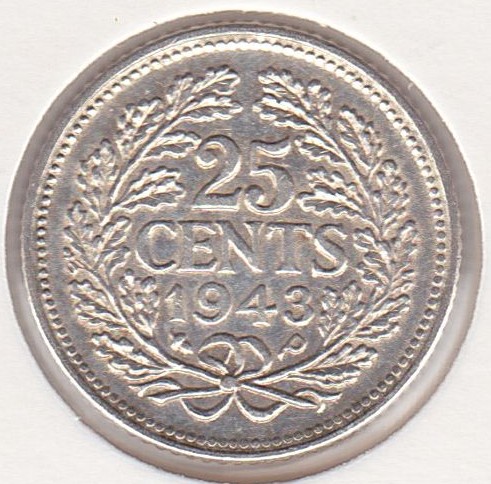 |
|
Pillar of the Community
Norway
1358 Posts |
Agreed with qxy, I guess it was a Philadelphia planchet, if it actually was Dutch. Both the silver 25 cent and the 1 cent have a 19 mm diameter, unlike the Dutch war time 25 cent, which was 26 mm and made of zinc. And that also puzzles me. The 'error' coin seriously doesn't look like silver to me, certainly not .640, as it should be. And I sweriously doubt that it's an erroneous planchet too. I therefore thus doubt that it's a Dutch planchet.
When it comes to comparing with a 1933 gold coin... I think it's different, as there's actually a law against owning those coins (or privately owned gold) for 1933, while there isn't one for these coins. I think these should be more or less compared with the also highly suspicious 1913 Liberty Head nickels, for example.
|
|
Bedrock of the Community
United States
17884 Posts |
Quote:
There are Dutch 25 cent coins struck in Philadelphia with the year 1943 as well, see photo. They may have been dated 1943 but mint records show that no 25C for the Netherlands homeland were struck until 1944. |
|
Page 2 of 2
|
Replies: 20 / Views: 9,673 |
Page 2 of 2
|







 First Page


 Posted 05/06/2017 08:01 am





