| Author |
 Replies: 20 / Views: 4,457 Replies: 20 / Views: 4,457 |
Page 2 of 2
|
|
|
|
Pillar of the Community
United States
505 Posts |
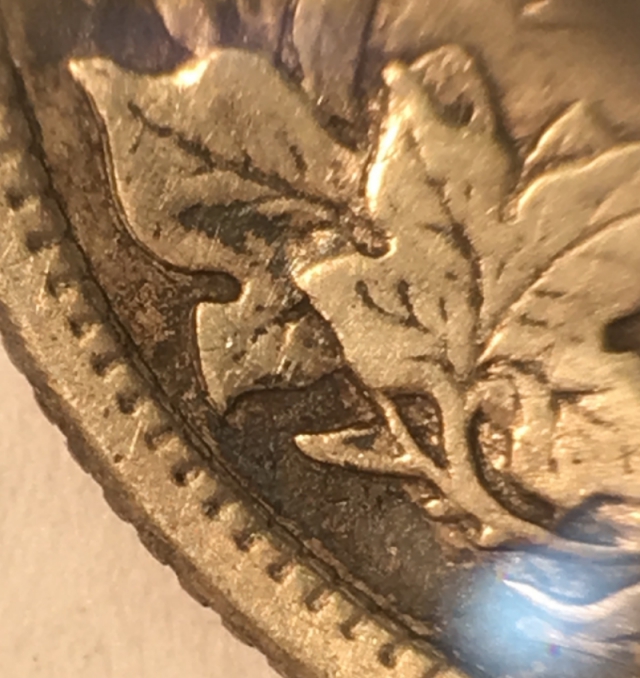
No, it's not MD. It is a RPM...one that we can't seem to find Info on but a RPM nonetheless. Separation is too great to be MD, especially since no other devices are affected. Plus the MM is the correct size, I.e. not reduced by flattening.
|
|
Valued Member
United States
121 Posts |
I've seen examples of Machine Doubling with smearing far larger than we're seeing here. |
|
Pillar of the Community
United States
505 Posts |
No step down and no reduction in device leads me to believe that no, this is not MD. I don't have the coin in my hand, but in some of the pictures the doubling seems quite round. Additionally, I'm seeing other facets inside the MM that tells me the same thing.
|
|
Pillar of the Community
United States
4409 Posts |
The only book I know that might shed some light on this is David Lawrence's The Complete Guide to Barber dimes of course this work was published years ago. -MV |
|
Valued Member
 United States
193 Posts |
Thanks for the responses everyone! They are most helpful. I still think that it is indeed a true RPM; at least I hope it is.  Quote:MeadowviewCollector > The only book I know that might shed some light on this is David Lawrence's The Complete Guide to Barber dimes of course this work was published years ago. Thanks for the information!  I will also have to take a look at the latest edition of the Cherrypicker's Guide to see if there are any Barber dimes for 1909 listed. My edition does not have any examples for that year. |
|
Valued Member
United States
121 Posts |
|
|
Pillar of the Community
United States
505 Posts |
@Itchy, I'm trying to stay humble here but I'm very familiar with MD. Nevertheless, I just read your referenced article. It's was a fine article but alas, it's nothing new to me. It has not initiated any change in my mind and has not swayed my confidence in this being a RPM. Truthfully, your article actually reinforced my notion that this is a RPM.
|
|
Valued Member
United States
121 Posts |
@Redifin, the article reference wasn't intended for you since your mind is made up. I thought that the other readers might benefit from the information in the article.
|
|
Pillar of the Community
United States
505 Posts |
|
|
Bedrock of the Community
United States
10065 Posts |
@Redifin This thread has me interested in your dime. I am being inquisitive, not argumentative. You said: Quote:
No step down and no reduction in device leads me to believe that no, this is not MD. In all of your pics, it seems them left side of the O is more thin than the right side. I went online for more pics of the O MM on a 1900 dime and saw both sides of the O on non-doubled MMs look uniform in width. However, I also am not aware of how much variance can be from one die to another as far as the mm characteristics go. Here is a mint mark I believe to be MD and its spread is very wide:  The MM is also the only thing affected on my quarter - and I don't understand how this is physically possible either. The first and second pic you have posted appears to show a flat steplike-structure the same as my quarter does. However, your third picture is not as shelf-like. I know its difficult to always have the camera pic up what is seen in hand. I would like to see what Coop has to say concerning this and also have someone tell me how the bounce that makes Machine Doubling can only affect a mint mark. How much squash could a Sasquatch squash if a Sasquatch would squash squash? Download and read: Grading the graders Costly TPG ineptitude and No FG Kennedy halveshttps://ln5.sync.com/dl/7ca91bdd0/w...i3b-rbj9fir2 |
|
Valued Member
United States
121 Posts |
@Earle42: You are correct that one should usually see Strike Doubling on more than just a mint mark. In fact, this is a key diagnostic I look for. On the original Barber dime in this discussion, additional Strike Doubling is also visible on nearby devices (easily noticed on the left side of the ribbon to the left of the mintmark). Regarding your 64D quarter, the doubled mintmark is clearly Strike Doubling. However, since there is no photo of any nearby devices I can't comment on whether the Strike Doubling is confirmed by them. Edited by ItchyN
09/10/2017 7:04 pm
|
|
Bedrock of the Community
United States
10065 Posts |
I think I have a decent handle on Strike Doubling having talked with coop many times on this subject on this forum. Also since getting back into the hobby around 6 years ago I have looked at over 200,000 halves and other coins under a microscope while identifying and searching for varieties. I have seen a lot of MD and actual DDOs and DDRs. This quarter of mine did surprise me b/c I only saw this extreme doubling on the MM itself. It interests me that only one section of a coin can be affected - and greatly, while another area of the same coin surface is not. But then again the changes to the metal itself when being forced to conform to the dies' design so quickly and under such high pressure is complicated anyway. How much squash could a Sasquatch squash if a Sasquatch would squash squash? Download and read: Grading the graders Costly TPG ineptitude and No FG Kennedy halveshttps://ln5.sync.com/dl/7ca91bdd0/w...i3b-rbj9fir2 |
|
New Member
United States
6 Posts |
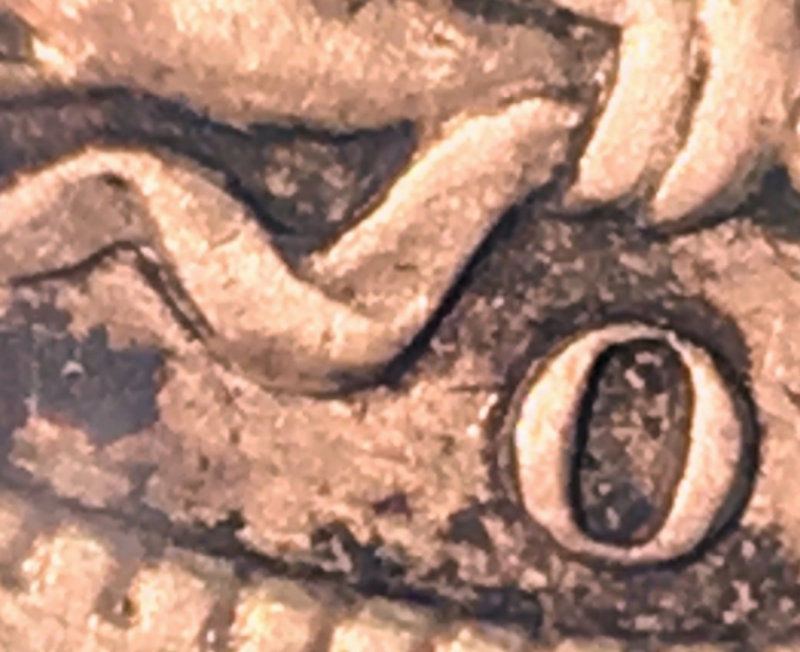 Here's one I found ,but, has doubling all up the left side. I have more pics I'm working on. |
|
New Member
United States
6 Posts |
|
|
Bedrock of the Community
United States
79968 Posts |
 To CCF coinbsr! Errers and Varietys.
|
|
Page 2 of 2
|
Replies: 20 / Views: 4,457 |
Page 2 of 2
|




 First Page


 Posted 09/08/2017 03:28 am