| Author |
 Replies: 16 / Views: 2,217 Replies: 16 / Views: 2,217 |
Page 2 of 2
|
|
|
|
Moderator
  United States
23731 Posts |
I believe this was an official issue from the time of Hormizd IV, counter marked later by the Hephthalites.
|
|
Moderator
United States
34565 Posts |
Very nice--love the double-countermarks!
"If you climb a good tree, you get a push."
-----Ghanaian proverb
"The danger we all now face is distinguishing between what is authentic and what is performed."
-----King Adz
|
|
Moderator
United States
23731 Posts |
|
|
Pillar of the Community
United States
7067 Posts |
Nice one, Ron. I'm glad you found the time to post it. Neat countermarks.
|
|
Moderator
United States
23731 Posts |
|
|
Pillar of the Community
 Spain
2752 Posts |
Very nice coin Ron!
Especially like the reverse details of the alter and attendants..
I don't know much about counter marking..Why was this done?
Paul
|
|
Moderator
United States
23731 Posts |
Paul, I assume that they had a lot of these coins left from Hormizd IV and rather than melt them down and make new dies, they just counter marked the old coins.
|
|
Pillar of the Community
United States
6130 Posts |
Here's mine, for comparison: 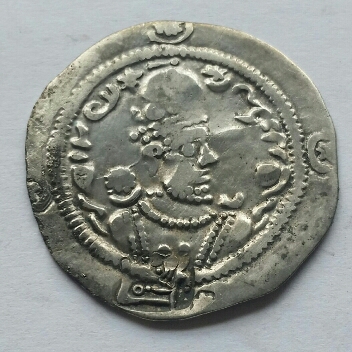 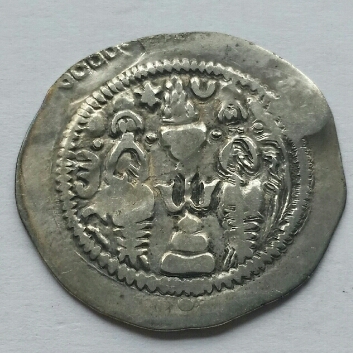 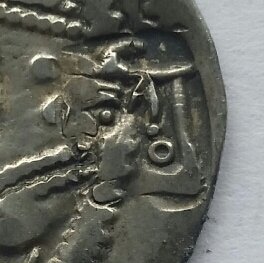 Traditionally, countermarks would have been done to certify a coin to circulate in a certain area, although curiously some of these central Asian types are never found without countermarks. Edit to add: The Bactrian countermark on these is pretty easily identifiable as Greek: ΦOPO https://www.zeno.ru/showphoto.php?photo=156173Edited by Finn235
03/20/2018 4:04 pm
|
|
Moderator
United States
23731 Posts |
The obverse counter mark on yours is much clearer than mine, I think it is also an official issue and not imitated.
|
|
Pillar of the Community
United States
1554 Posts |
These countermarks are found on local imitations. The most obvious "tell" is that on the reverse, the arms of one or both figures are crossed the wrong way. The imitations always carry the BLH (Balkh) mint mark and the frozen date "11" (AD 389/90), the year in which the Turks captured Balkh from the Sasanians.
|
|
Moderator
United States
23731 Posts |
Kushanshah,  to the community |
|
Pillar of the Community
United States
1554 Posts |
Thank you for the welcome. You can find a number of these coins on Zeno https://www.zeno.ru/showgallery.php?cat=12898, described there as "Western Turk yabghus". The attribution to Phromo Kesaro is considered speculative but it gets a lot of play in the trade. φορο in the Greek language means "tax" or "tribute". Though the Greek alphabet was adapted to write the Bactrian language, Greek loan words are said to be rare. Coincidence? Edited by Kushanshah
03/28/2018 12:01 am
|
|
Moderator
United States
23731 Posts |
Thanks for the info, seems you are familiar with this type. I take it from your user name you might also be one of us few eastern empire collectors?
|
|
Pillar of the Community
United States
1554 Posts |
Yes, I've owned a number of these through the years. The name Kushanshah is more stream of consciousness at the time I registered than anything to do with current interests. At one time or another, I've been a serious collector of Hunnic coins, Islamic coins, Roman Imperial, English hammered, Lincoln cents, etc.
|
|
Moderator
United States
196778 Posts |
to the Community, Kushanshah! |
|
Page 2 of 2
|
Replies: 16 / Views: 2,217 |
Page 2 of 2
|





 First Page


 Posted 03/19/2018 8:08 pm


