| Author |
 Replies: 114 / Views: 16,566 Replies: 114 / Views: 16,566 |
|
|
|
|
Pillar of the Community
United States
4085 Posts |
CSI: Coin Community
Impressive detective work here!
|
|
Valued Member
United States
392 Posts |
USSID, yes very interesting thread. The experts on the forum really know their stuff.
|
|
Pillar of the Community
5464 Posts |
Quote:
USSID, yes very interesting thread. The experts on the forum really know their stuff. Yes, the experts here have forgotten more about coins then I would ever be able to retain. Edited by USSID18
12/08/2018 6:42 pm
|
|
Pillar of the Community
United States
4409 Posts |
Quote:
What did the hub article you mentioned have to say, related to this counterfeit? I am fairly certain the article wasn't about counterfeits at all, and was discussing hub changes. I will try to dig out the journals from this year and locate the article I've mentioned. Will take time as I've got some stuff I need to get done first. -MV |
|
Pillar of the Community
United States
4233 Posts |
Thanks MV. I'm curious to know whether the fact that there are actually three reverse types for Barber dimes has been documented, because as we see here it is an important factor in identifying counterfeits. Before digging into this, I knew nothing about Barber dimes, and the only one I own is a 1902 damaged VG8 worth less than $5. But now I can readily see that mine is correct - left leaf vein points to notch, thick ribbon, branching vein well above overlapping leaf, large rectangular kernels. The left vein and thick ribbon I can pick out on Heritage images all the way down to G4 and sometimes AG3. If you see these pre-1900, it's fake. 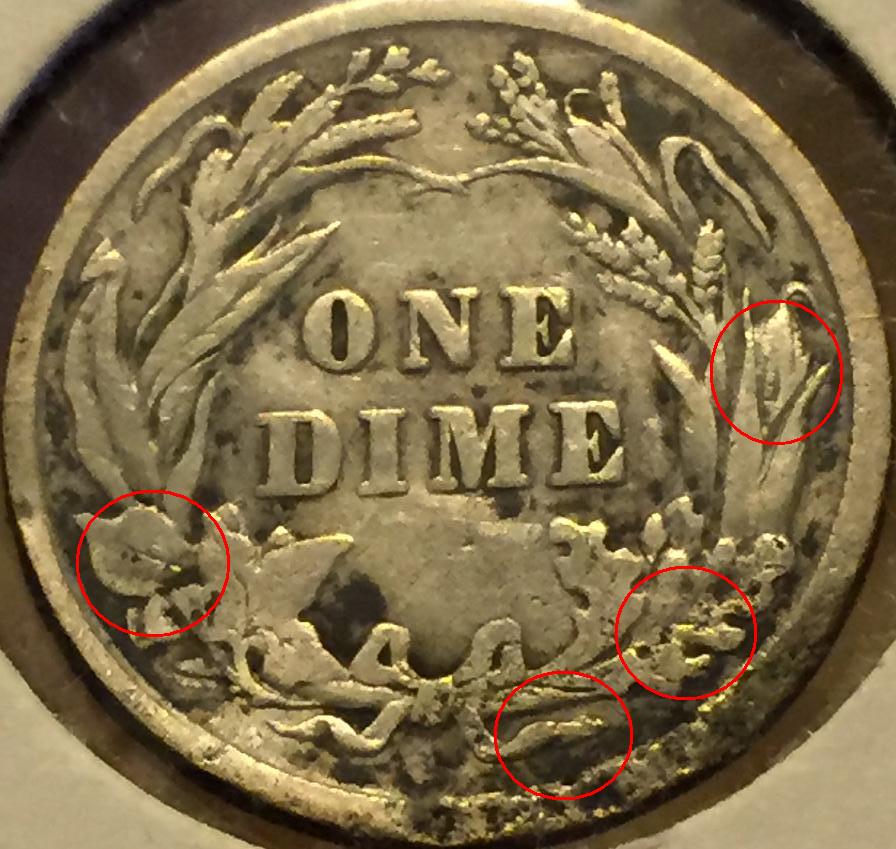 There are currently 7 sellers on the unmentionable site with 1895 dimes, and 6 of them have the wrong reverse. I realize threads like this run the risk of making them smarter, but if they have to retool and throw out all their inventory, maybe that's a small win. |
|
Pillar of the Community
United States
4409 Posts |
I hadn't forgotten about this thread. It took me a while to re-locate the journals dealing with the hub changes. I thought the article was in one from 2018 when in fact it was last year's---  I said journals because the author had one page in Vol. 28, #1. My copy is currently lost in the mess that is my reference section. The author also had further work in Vol. 28, #3. Fortunately, my copy was easily located must have been close to the top of the pile. I'll continue in another post. -MV |
|
Pillar of the Community
United States
4433 Posts |
|
|
Pillar of the Community
United States
4409 Posts |
Vol. 28, #3 " Barber dime Reverse Design Varieties of 1901-1905" Summing the article/information up: Type 1 reverse hub used from 1892-1900; and some date and mint mark combinations 1901-1905; also called "old reverse" Type 2 reverse hub used 1901-1916; also called "new reverse" Dimes from all three mints in 1901 come with either reverse type San Francisco minted dimes between 1902 and 1905 come with either reverse type Hopefully this is beneficial to help keep someone from getting ripped off. I am not ashamed to say that at first glance I thought it was authentic and would have been taken. Until others started pointing out inconsistencies on the obverse-- Silverwolf's image brought to mind the hub changes. Once that light bulb came on and I did further research I knew for a fact it was counterfeit. -MV |
|
Pillar of the Community
United States
4233 Posts |
Thanks for following up, MeadowviewCollector. I have communicated with BCCS about obtaining the back issue you mentioned, and there is interest in an article regarding the third reverse design, which would be a few months if it happens. It appears from your description of the hubs article, and from John at BCCS, that the "old" and "new" reverse nomenclature is still in use. I'm convinced there is really a "Type 1A" from 1900-1905. I think the bottom line regarding counterfeits for novices like me is learning to recognize the "thin ribbon" ("old") versus "thick ribbon" ("new") on the reverse. The majority of counterfeits I've seen so far have the thick ribbon on pre-1901 coins, which is flat out wrong regardless of whether a third reverse design gets accepted. Then learn to recognize the difference in the prominent vein of the leftmost leaf, to decide whether a "thin ribbon" reverse is truly 1892-1899. Sometimes I find it difficult to decide thin or thick ribbon on a worn or poorly faked coin, but the left leaf vein remains prominent. I'll attach some images to try to further clarify my "Type 1A". Left leaf - 1895-O vs 1901-S (these differences are the same going from 1899 to 1900, I just picked 1895 and 1901 because of image quality) 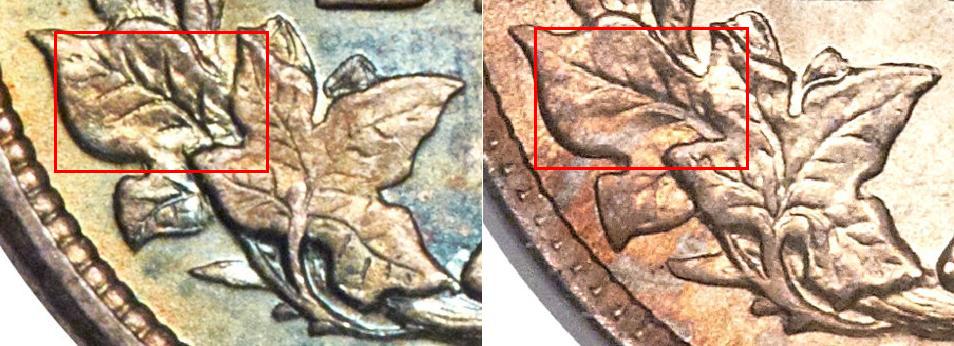 Right leaf 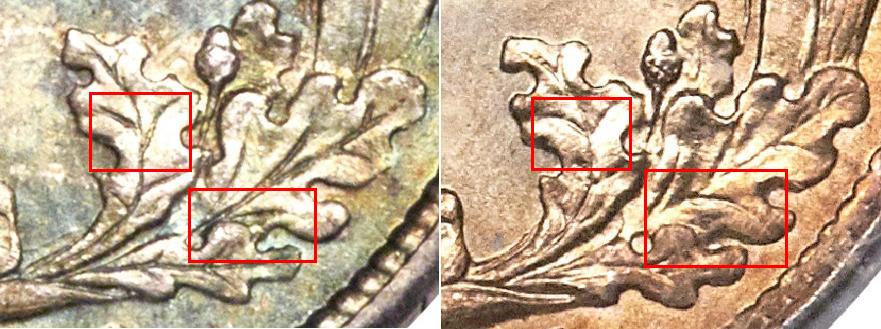 Kernels 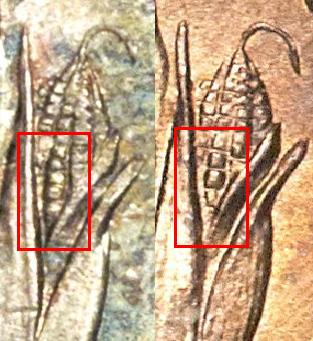 Edited by kbbpll
12/18/2018 12:56 pm
|
|
Pillar of the Community
United States
2540 Posts |
The three leaves in the hair are all different from the PCGS coin
|
|
Pillar of the Community
United States
533 Posts |
OK I am just a beginner here and I see everyone picking apart all the little bits but the basic thing that hit me was the curve of the base of the neck. I put the two coins together in paint and drew circles that matched the curves and then put them together at the bottom and the "fake" is a heck of a lot more curved. Is this relevant? Shouldn't they be the same curve? I mean it just stuck right out at me. You can see the different curves as lines down below 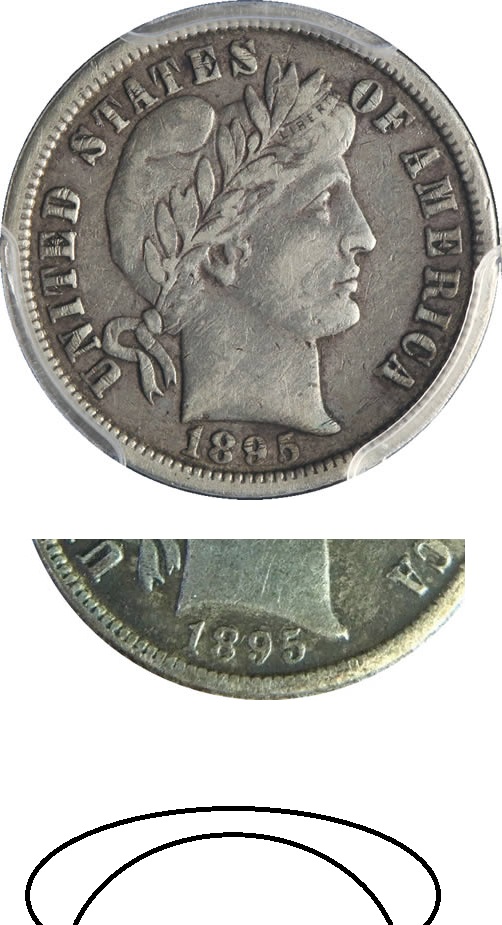 |
|
Pillar of the Community
United States
4233 Posts |
Good eye jaxenro, but I think it's just the lighting and the crappy counterfeit die. There's a shelf at the bottom of the bust where Barber's initial is; depending on the coin it can be a sharper or smoother transition between the rounder curve at the shelf and the flatter curve at the true bottom of the bust. Here's the other obverse image of the OP's fake versus a 1904, hopefully illustrating what I mean. The OP fake still has the flatter bottom, just hard to see. (The 1904 side got slightly squished while resizing, sorry). 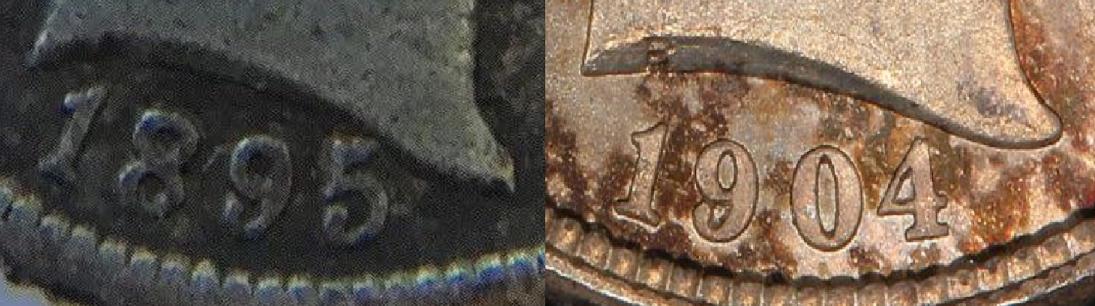 |
|
Bedrock of the Community
United States
17884 Posts |
Another identifying feature is the 5 in the date. 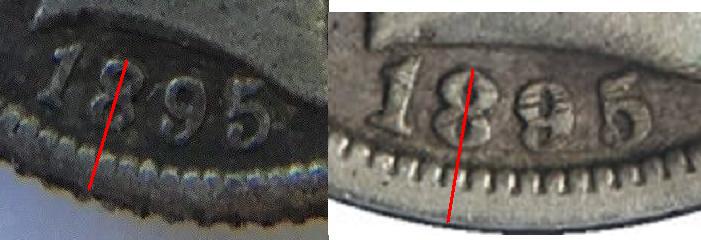 On the real one (the one on the right) the 5 is nearly closed with the upright almost touching the ball. Also the upright is straight and a straight line down the left edge of the upright almost passed through the center of the ball. On the fake the 5 is open, the upright "kicks out" to the left at the bottom, and a straight line down the left edge would pass through the left edge of the ball. The inside of the loops of the 8 and the top of the 9 on the fake are just about round, on the genuine they are ovals. Edited by Conder101
12/24/2018 07:59 am
|
|
Pillar of the Community
United States
533 Posts |
The nine especially stands out on the real one the oval inside the top of the nine is about a 1:2 ratio oval on the fake a perfect round
|
|
Pillar of the Community
United States
4233 Posts |
Those are all really good points about the date. It looks "chidish" when you really focus on it. Honestly though I'd just learn to recognize the left leaf vein and thick ribbon on reverse, since from what I've seen on the no-no site it immediately eliminates 90% of the pre-1900 fakes, as with this one. Here's certified F12 1899-O versus 1900-O demonstrating how you can quickly spot the transition markers on well worn coins. 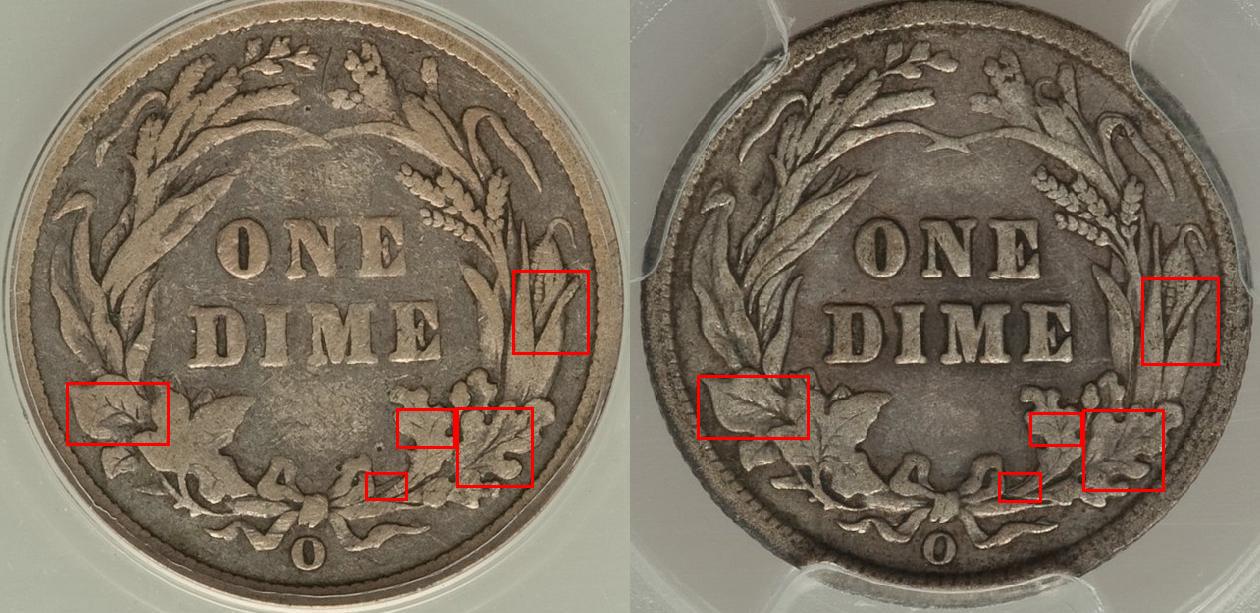 And here's OP reverse, for "eye training". :) 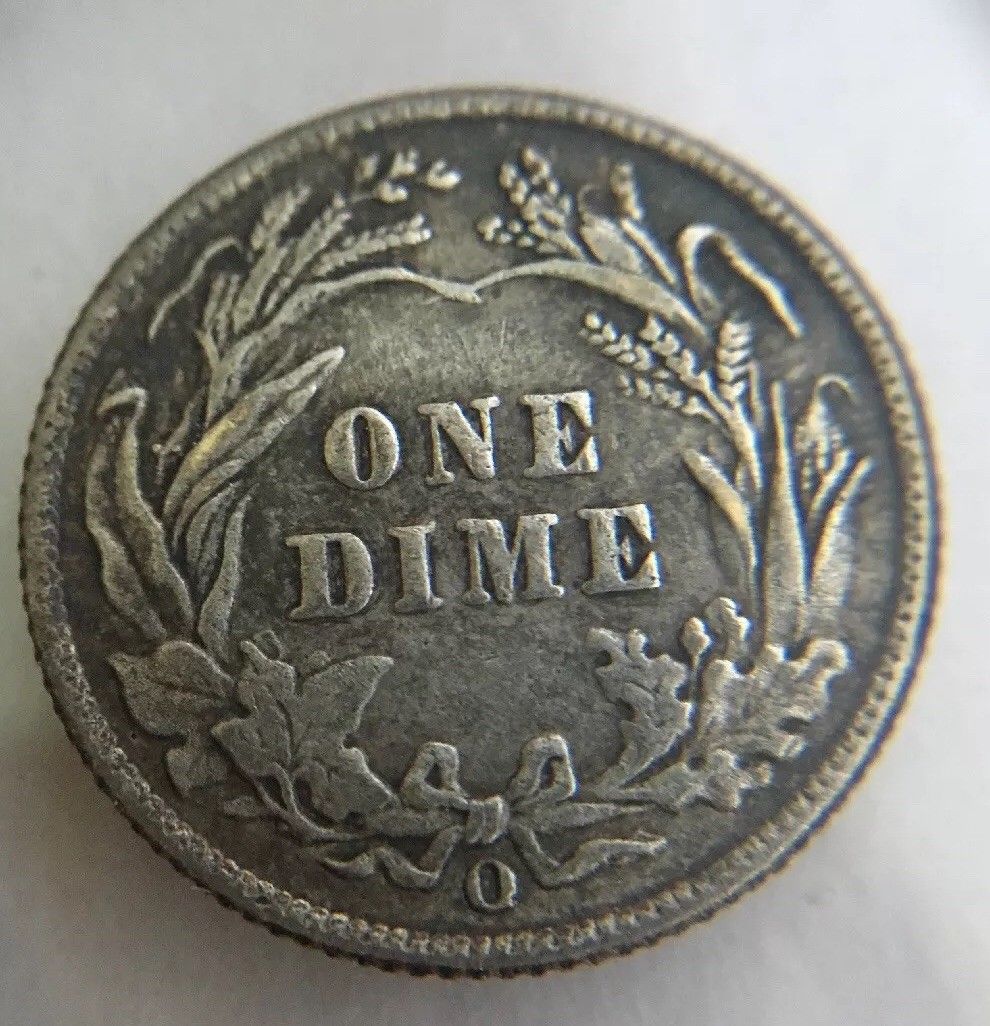 |
|
|
Replies: 114 / Views: 16,566 |
|





 First Page
 Previous Page


 Posted 12/08/2018 6:17 pm





