| Author |
 Replies: 114 / Views: 16,568 Replies: 114 / Views: 16,568 |
|
|
|
Bedrock of the Community
United States
17884 Posts |
Quote:
Thanks for that analysis. If I'm understanding you correctly, you conclude that this is a once legit coin with an altered date. More likely they created a hub from a post 1901 dime and removed the date from the hub. Once they do that they can create undated dies and add whatever date they wish. They have done that with several older coin series. |
|
Pillar of the Community
United States
4233 Posts |
@Jadey - Condor101 has said what I meant much better than I did. I think they took a real post-1901 coin, made hubs, then "altered" the date to produce their counterfeit dies. I should not have said "altered date", which means changing the date directly on a real coin. One thing I notice on the date is that the denticles don't line up the same (fake on left, real on right). 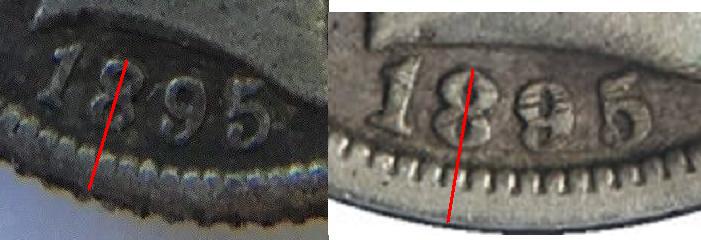 I agree with the "mushy appearance and other characteristics" as well, which is often a gut-reaction judgement that is correct in most cases once you've seen enough of them. However, this is also often not enough evidence to condemn someone's coin, so we should always strive for more specifics. I'm curious if the changes to the reverse made in 1900 are documented somewhere? Edit: aha, it's right there on the NGC page for 1901. Quote:
New obverse and reverse hubs were introduced for the dime this year, but the distinctions are quite minor and of interest only to series specialists. 1901(P) dimes used dies from the new obverse hub exclusively, but both the old and new reverse are known for this date. I hate to disagree with the experts on this, but clearly the reverse die changed in 1900 - the vein markers noted above are present on the NGC reverse image for 1900. https://www.NGCcoin.com/coin-explor...coinid-14822Might be fun to look around for examples of the "old" reverse on 1901 (or even 1900?) because I have not seen any on Heritage. Edited by kbbpll
12/06/2018 11:12 am
|
|
Pillar of the Community
United States
4433 Posts |
Well done, kbbpll ....
IMHO, the date on the genuine coin looks more plump, well rounded. Also, the top point of the "1" points to the "B" -Barber's initial.
|
|
Pillar of the Community
 United States
906 Posts |
Very nice work kbbpll. Thanks for the education everybody.
|
|
Pillar of the Community
United States
1361 Posts |
I'm guessing the coin did turn out to be a fake, but we haven't heard boo from Redshed?
|
|
Pillar of the Community
United States
1613 Posts |
This was the first series I began with an intent of completing, and is minus that elusive '94s, in the late seventies. Although an "expert" by no means, and having looked at and handled hundreds of Barber dimes, this one appears genuine. Cleaned, but genuine. ANA member - PAN Member - BCCS Member There are no problems only solutions - the late, great John Lennon
|
|
Bedrock of the Community
United States
17884 Posts |
Quote:
One thing I notice on the date is that the denticles don't line up the same (fake on left, real on right).
This is only useful if they only used one obv die that year, or if they did use more than one, you can compare the suspect coin to each and prove that it doesn't match any of them. Dates were punched into the individual dies (using a four digit logotype punch) until 1916 so the placement can differ slightly on each die. I don't know if more than one obv was used for the 1895 O dimes. Comparing date position is a good clue but it isn't definitive unless all dies are known. |
|
Pillar of the Community
United States
4233 Posts |
Ballyhoo - the reverse on OP coin does not exist prior to 1901. See page 6, and below. Condor101 - I agree, but it's one more detail to check. MeadowviewCollector - thanks for pointing me to Barber Coin Collectors' Society. What did the hub article you mentioned have to say, related to this counterfeit? Thanks to MeadowviewCollector, I found https://archive.org/details/compgui...awr/page/n11 "The Complete Guide to Barber dimes" by David Lawrence (1991). I think the NGC information posted previously was taken from this book, and it sent me down the rabbit hole, because of the cryptic NGC comment regarding 1901: "both the old and new reverse are known for this [1901] date" https://www.NGCcoin.com/coin-explor...oinid-14824. I could not find an example of my conception of the "old" reverse anywhere on Heritage or PCGS for 1901. Lawrence mentions "new" and "old" reverses several times, in the context of the "old" reverse appearing on 1901, 1903, and 1905 coins. This would really complicate things as far as Counterfeit Detection. Then I realized that Lawrence is referring to "thin right ribbon" and "thick right ribbon" - "the right ribbon below the bow is thicker with an extra fold". Aha! I believe there are actually three reverse designs for the Barber dime: #1 - original leaf veins and corn kernels, thin ribbon, 1892-1899 #2 - modified leaf veins and kernels, thin ribbon, 1900-ca.1905 #3 - #2 with thick ribbon, 1901-1916 I think the transition to #2 in 1900 went unnoticed, because the changes to the veins and kernels was so minor on a tiny coin, and therefore "old" to Lawrence refers to both #1 and #2. #1 - original leaf veins and corn kernels, thin ribbon, 1892-1899  #2 - modified leaf veins and kernels, thin ribbon, 1900-ca.1905  #3 - same as #2, but with thick ribbon, 1901-1916  #2 again - the fact that the same year and mint has two different ribbons is noticeable  Markers differentiating #1 from #2  Markers differentiation #2 from #3  Interesting that there appears to be an obverse Type 1 in 1901-O.  |
|
Pillar of the Community
5464 Posts |
Looks like this guy NumismaticExpert, BetterThanYou, or whomever he is started quite a thread!
|
|
Pillar of the Community
United States
4085 Posts |
CSI: Coin Community
Impressive detective work here!
|
|
Valued Member
United States
392 Posts |
USSID, yes very interesting thread. The experts on the forum really know their stuff.
|
|
Pillar of the Community
5464 Posts |
Quote:
USSID, yes very interesting thread. The experts on the forum really know their stuff. Yes, the experts here have forgotten more about coins then I would ever be able to retain. Edited by USSID18
12/08/2018 6:42 pm
|
|
Pillar of the Community
United States
4409 Posts |
Quote:
What did the hub article you mentioned have to say, related to this counterfeit? I am fairly certain the article wasn't about counterfeits at all, and was discussing hub changes. I will try to dig out the journals from this year and locate the article I've mentioned. Will take time as I've got some stuff I need to get done first. -MV |
|
Pillar of the Community
United States
4233 Posts |
Thanks MV. I'm curious to know whether the fact that there are actually three reverse types for Barber dimes has been documented, because as we see here it is an important factor in identifying counterfeits. Before digging into this, I knew nothing about Barber dimes, and the only one I own is a 1902 damaged VG8 worth less than $5. But now I can readily see that mine is correct - left leaf vein points to notch, thick ribbon, branching vein well above overlapping leaf, large rectangular kernels. The left vein and thick ribbon I can pick out on Heritage images all the way down to G4 and sometimes AG3. If you see these pre-1900, it's fake. 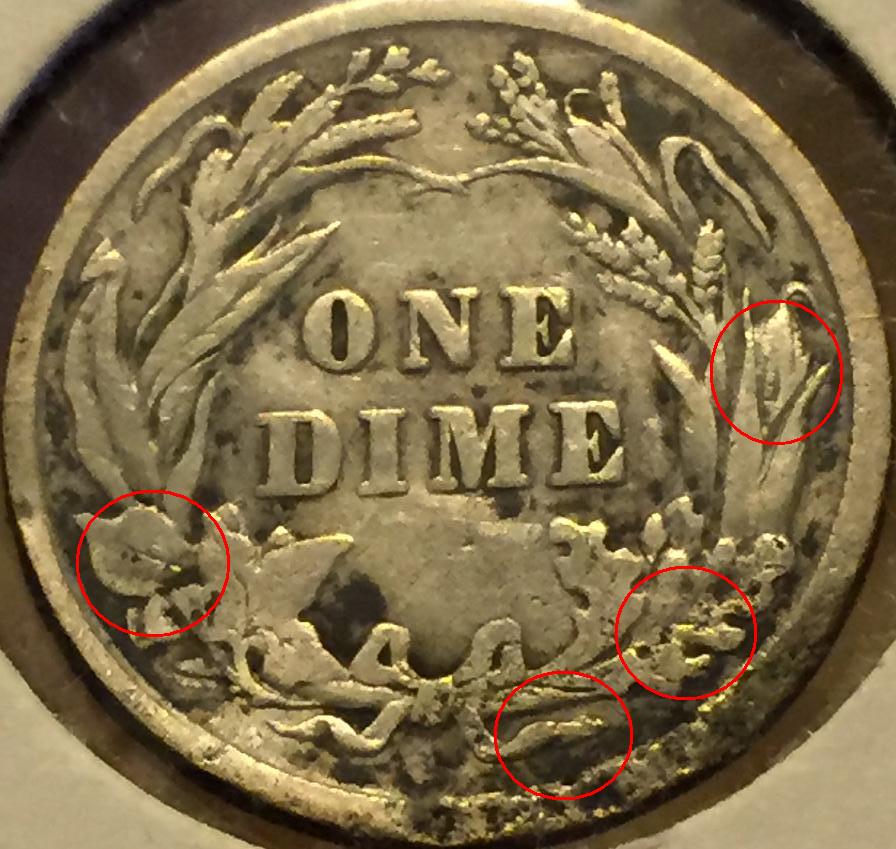 There are currently 7 sellers on the unmentionable site with 1895 dimes, and 6 of them have the wrong reverse. I realize threads like this run the risk of making them smarter, but if they have to retool and throw out all their inventory, maybe that's a small win. |
|
Pillar of the Community
United States
4409 Posts |
I hadn't forgotten about this thread. It took me a while to re-locate the journals dealing with the hub changes. I thought the article was in one from 2018 when in fact it was last year's---  I said journals because the author had one page in Vol. 28, #1. My copy is currently lost in the mess that is my reference section. The author also had further work in Vol. 28, #3. Fortunately, my copy was easily located must have been close to the top of the pile. I'll continue in another post. -MV |
| |
Replies: 114 / Views: 16,568 |








 First Page
 Previous Page


 Posted 12/06/2018 10:54 am


