| Author |
 Replies: 114 / Views: 16,562 Replies: 114 / Views: 16,562 |
|
|
|
Pillar of the Community
United States
1361 Posts |
There's always at least one in the bunch. This person rubbed me the wrong way, but I didn't step into his mess. I look forward to Redshed's rebuttal, if he wasn't too offended by the "arrogant expert".
|
|
Bedrock of the Community
United States
10982 Posts |
I'm late to this party but will also say congratulations to Coinfrog!  As to the OP, I thought the coin looked questionable at a glance and would want it authenticated for sure. It does have the mushy devices, pinholes and color of a cast copy. |
|
Pillar of the Community
United States
4409 Posts |
Quote:
Has this information been published somewhere as a means to help identify counterfeiting? If not, then you sound like the perfect person to write that up!! SPP-Ottawa, It was JimmyD's image back on page 2 pointing out two differences---the one that triggered me was the leaf - S which I recalled reading about new hubs being introduced around the turn of the 20th century. In fact, I believe a Barber Coin Collectors' Society article published in one of the journals this year may have talked about the hub(s). Anyway, the information about the hubs has been known for 25+ years at least. Why it isn't "common knowledge" could be that Barber dimes are rather plain compared to the later Mercurys. Most collectors are content with a single example. Or the size makes it harder to see the fine details. I don't know if someone has written specifically about using the hub differences as a method of detecting counterfeits. A couple of great resources about Barber coins can be found on the BCCS website under Education & Resources The three books written in the 1990s are found here http://www.barbercoins.org/Links.shtmlContemporary Counterfeit images http://www.barbercoins.org/CCounterfeits.shtml |
|
Bedrock of the Community
United States
94367 Posts |
Thanks for this. Why I ever offer an opinion about a subject I'm ignorant about is beyond me, but I keep doing it.  |
|
Moderator
 Canada
10476 Posts |
Never stop learning Coinfrog.... that is what is awesome about this hobby!!
"Discovery follows discovery, each both raising and answering questions, each ending a long search, and each providing the new instruments for a new search." -- J. Robert OppenheimerContent of this post is licensed under a Creative Commons Attribution-NonCommercial 3.0 Unported License. See: http://creativecommons.org/licenses...0/deed.en_USMy eBay store
|
|
Bedrock of the Community
United States
12477 Posts |
A little late, but congrats Mr. Frog on 30,000! I should have mentioned this earlier, but  to @redshed and I do hope you get back to us with the verdict!  In Memory of Crazyb0 12-26-1951 to 7-27-2020
In Memory of Tootallious 3-31-1964 to 4-15-2020
In Memory of T-BOP 10-12-1949 to 1-19-2024
Edited by spru
12/03/2018 10:34 pm
|
|
Pillar of the Community
United States
3479 Posts |
I too am late to welcome Redshed. So to our community my friend! I'm happy you took the time to respond. Don't let one Donkey make you think less of us. They never last long. I should have done this first before trying to rehab our short-lived 'expert'. |
|
Pillar of the Community
United States
4233 Posts |
I'll break my silence on here, first of all to say that the way this thread progressed is exactly why I stopped posting. I am no expert on Barbers or any other coin. What I've learned with counterfeits though is to pay more attention to the reverse. Like graders, it doesn't get as much attention. Here is a PCGS VF25 CAC on the left to compare. I deliberately picked this one due to obvious weak strike, and similar wear. Annotations (image #2) from top center, counterclockwise: 1. Crossing on the left, of the right leaf tip, is almost missing on the fake. 2. Leaf above "O" in ONE is pointed, and extends beyond line drawn through inner left of "O", on a real one. This is what I first noticed on OP coin, where the tip is rounded and shorter. 3. Smoking gun. The most distinct center vein in this leaf, on a real one, originates in the middle of the lower left lobe of the leaf overlapping it. This vein originates in the next lobe up of the overlapping leaf in the fake. 4. This little piece of stem or whatever to the right of the ribbon is clearly evident on worn examples, yet is missing on the fake. 5. The middle row of kernels in the corncob is pretty distinct even on worn examples. When I say "fake" and "counterfeit", it is my non-expert judgement. Perhaps there is another reverse die having these characteristics, but a dozen or so examples on Heritage tells me 1-3 above are some clear markers that to me differentiate the OP's coin from every other I've looked at so far on Heritage. 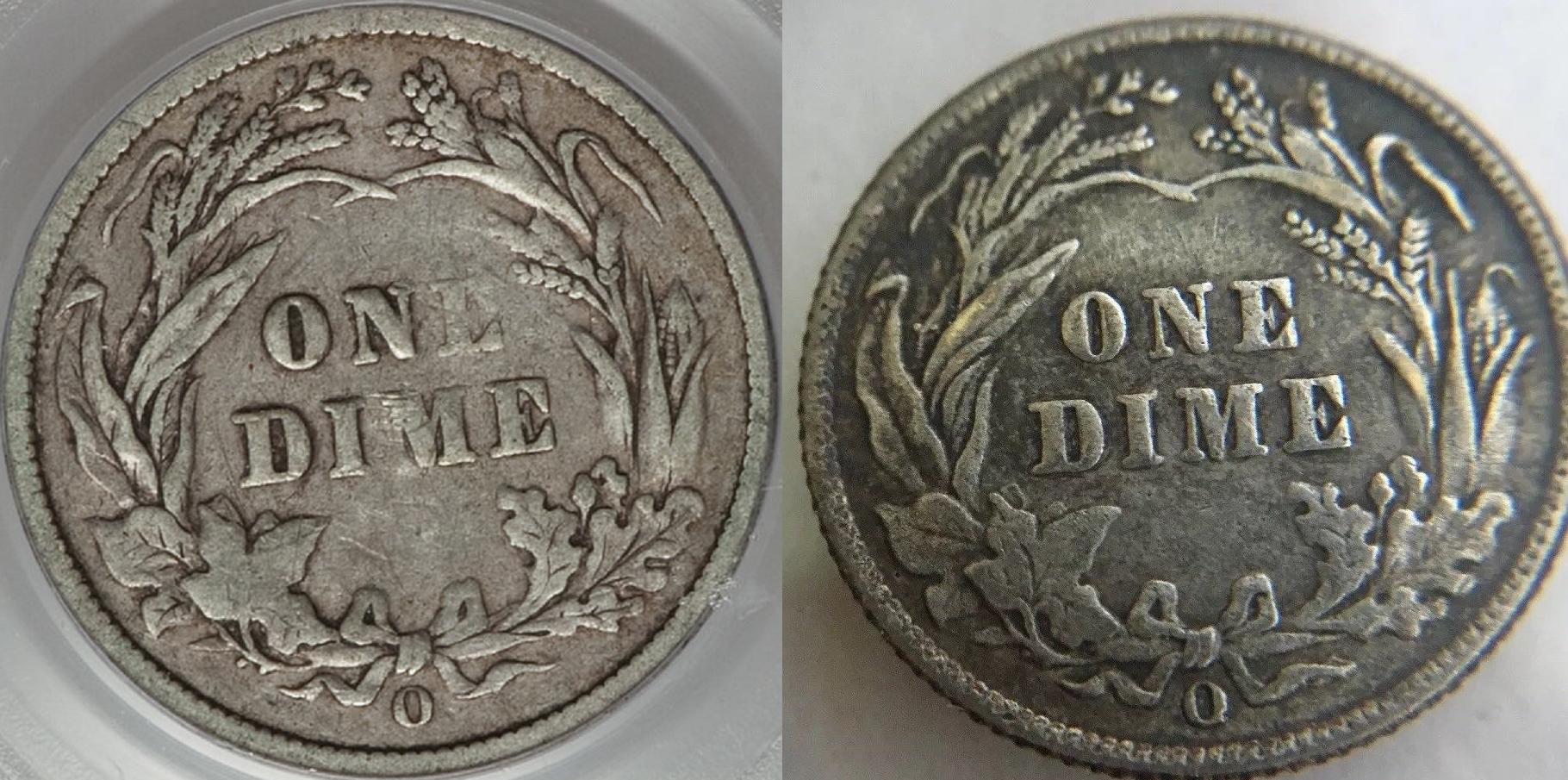 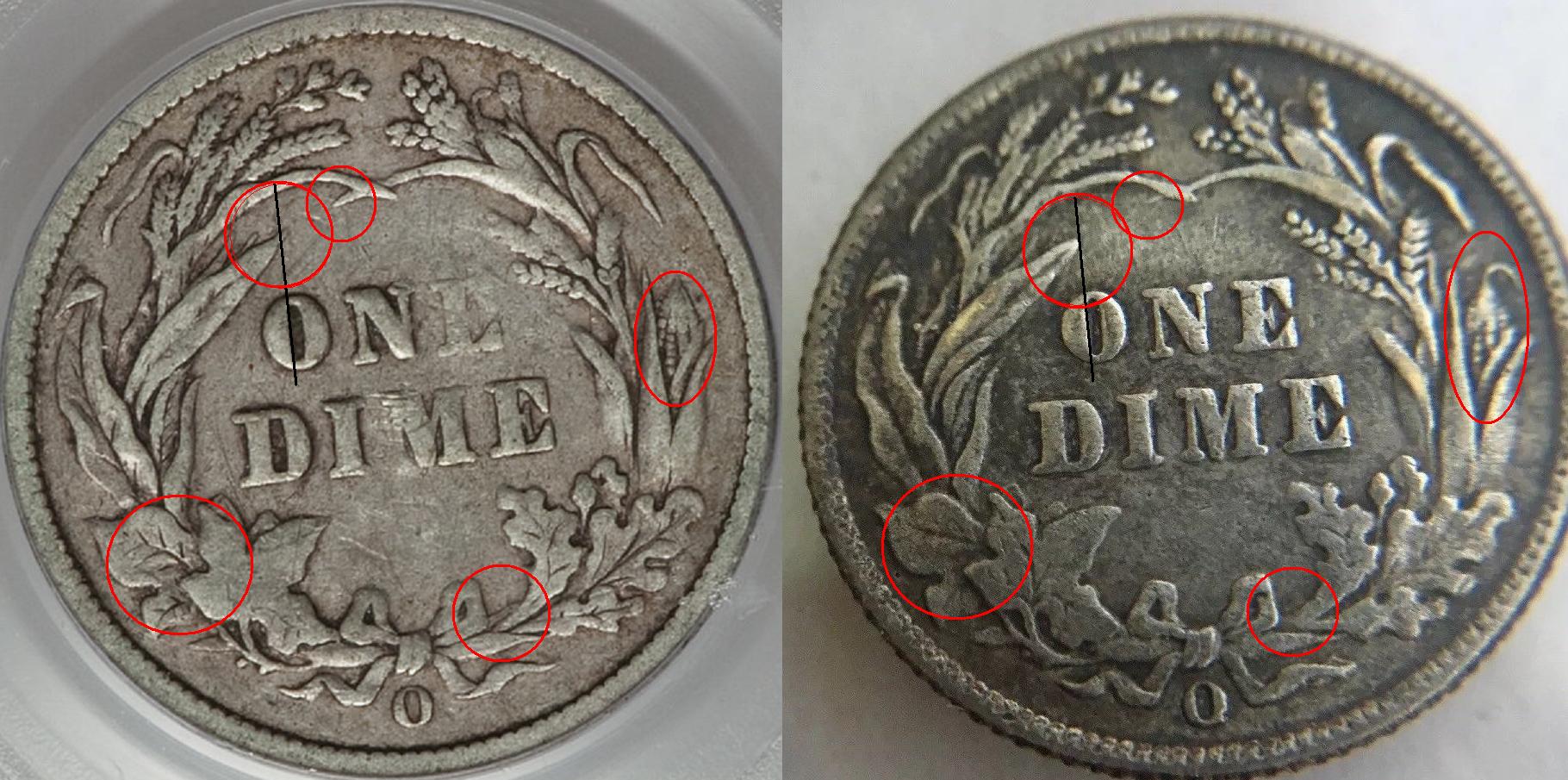 |
|
Pillar of the Community
United States
4433 Posts |
Great post, kbbpll !! This also-non-expert is glad to see you back !!
|
|
Bedrock of the Community
United States
17884 Posts |
Quote:Why it isn't "common knowledge" could be that Barber dimes are rather plain compared to the later Mercurys. Most collectors are content with a single example. Or the size makes it harder to see the fine details Also because Barber coins just aren't as widely collected and are even less widely collected now than they were 25 to 30 years ago. |
|
Pillar of the Community
United States
4233 Posts |
Sorry for reopening this, but sometimes I have to get to the bottom of it, and I do like detective work. Perhaps someone finds this useful down the road. I had noticed a couple other differences in the veins of the leaves on the reverse, which got me thinking. Is it a real coin, just retooled? But as noted, the obverse is wrong. Did the counterfeiter retool the reverse of a master coin prior to making a transfer die? But counterfeiters are lazy! Turns out, as far as I can tell, the reverse did in fact change, in 1900. Given that the obverse changed in 1901, my conclusion is that this is a post-1901 O mint coin counterfeited with an altered date. Below is a 1895-O PCGS MS66 on the left, versus a 1901-O PCGS MS64 on the right. (Edit: to really see, you'll have to enlarge the image.) Details: 1. As noted above, the center vein on 1895 originated mid-lobe on the overlapping leaf. On the 1901 it has a more horizontal direction and originates between lobes of the overlapping leaf. 2. The two branching veins appear staggered from the main vein on the 1895. On the 1901 they appear to branch from the main vein at the same spot. 3. This vein originated almost below the overlapping leaf on the 1895. On the 1901 it originates well above the overlapping leaf. 4. There are more, and rounded, kernels in the center of the cob on the 1895. There are fewer, and rectangular, kernels on the 1901. You can see these other differences on the comparison image posted previously. Some real authority on the Barber dime series has undoubtedly already noticed the reverse die change. It's interesting to me that the reverse changed in 1900, and the obverse changed in 1901. 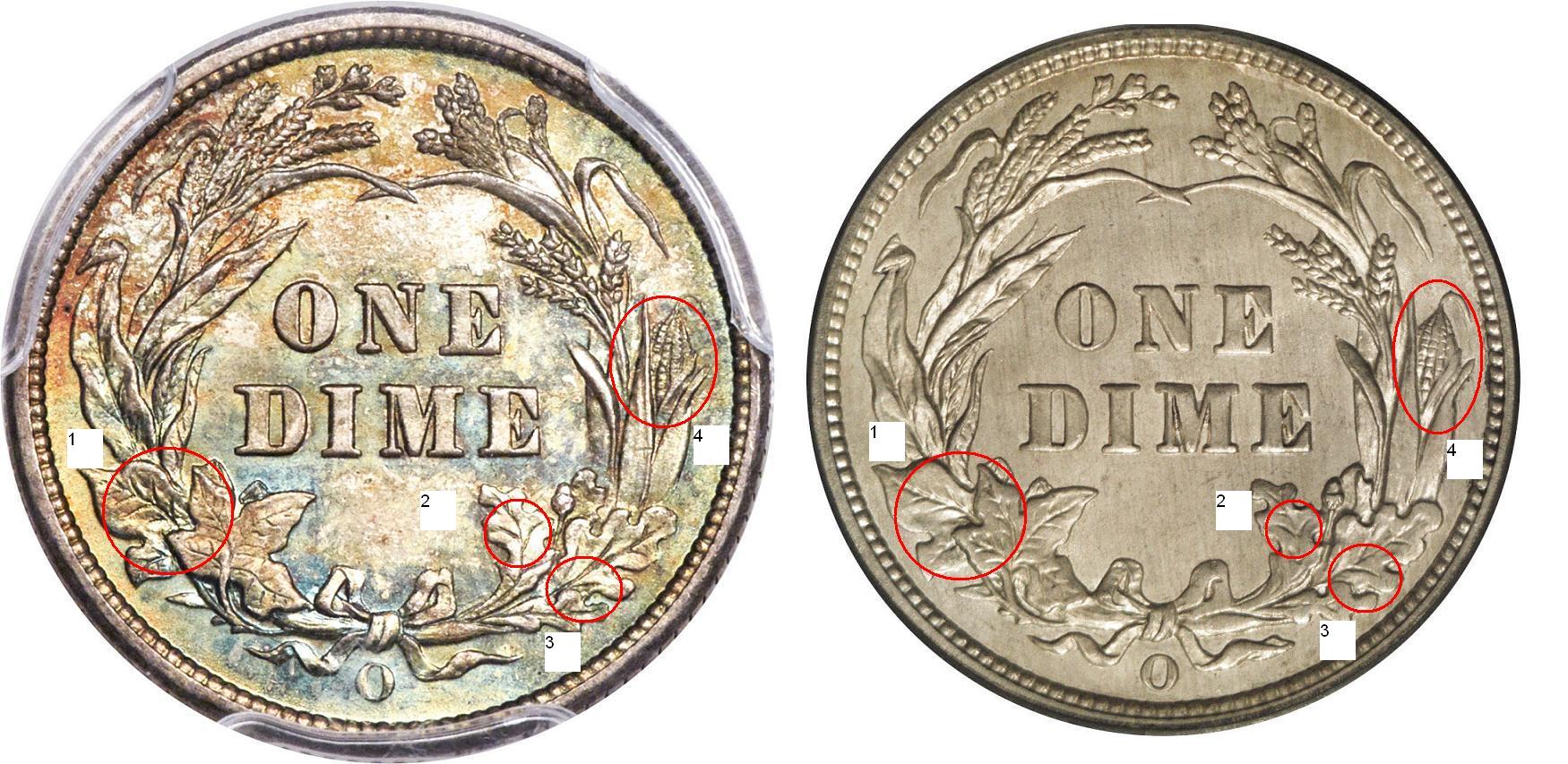 Edited by kbbpll
12/05/2018 3:21 pm
|
|
Bedrock of the Community
United States
94367 Posts |
Fascinating. Must admit I've learned a lot here, including how sophisticated today's collector has to be when buying even semi-key dates that aren't holdered.
Edited by Coinfrog
12/05/2018 4:35 pm
|
|
Valued Member
United States
392 Posts |
Great thread. Sounds like I missed some excitement. At least I can offer congrats to Coinfrog on his milestone of posts.
|
|
Pillar of the Community
 United States
906 Posts |
Quote:
kbbpll
Given that the obverse changed in 1901, my conclusion is that this is a post-1901 O mint coin counterfeited with an altered date. @kbbpll Thanks for that analysis. If I'm understanding you correctly, you conclude that this is a once legit coin with an altered date. Whats interesting is that the OP and others have suggested it is fake because of its mushy appearance and other characteristics. Quote:Quote:
NumismaticExpert
After seeing enough authentic examples over many years, I can usually spot fakes instantly.Overall this coin has a mushy look to it, from the lettering to the date, and the edges are too sharp. Quote:
ExoGuy
It has a similarly mushy appearance to the subject piece (Edit-the subject piece being the counterfeit specimin 1894-S he posted) Quote:
llewellin
In addition to the detailed analysis from MV, the coin generally has several features common among fakes, namely its "mushy" detail and very poor relief of devices, that cannot be explained by normal wear for the condition. Second, it has an unnatural uneven black toning around the devices that is applied to fakes to make them appear aged. Finally, the rim and denticles appear too thin and/or irregular compared to a genuine coin. What are your thoughts on that the mushy appearance and other characteristics mentioned? |
|
Pillar of the Community
United States
4433 Posts |
I suspect that, despite the silvery color of my fake "1894-S," it has little, if any, silver content. The lighter, possibly softer-than-silver metal may have contributed to its poor strike. It is about 10% underweight which, to my experience seems consistent with most of the modern day fakes; these, often running 10-20% under. I expect that, if tumbled and otherwise subjected to artificial wear, this otherwise, seemingly uncirculated fake would be far more deceptive.
|
| |
Replies: 114 / Views: 16,562 |






 First Page
 Previous Page


 Posted 12/03/2018 7:12 pm


