| Author |
 Replies: 22 / Views: 4,324 Replies: 22 / Views: 4,324 |
Page 2 of 2
|
|
|
|
Bedrock of the Community
United States
94367 Posts |
I believe this is the only denomination of gold certificate that has been cancelled - all others are still legal tender and worth face value as I recall.
Edited by Coinfrog
04/01/2021 6:17 pm
|
|
Valued Member
United States
143 Posts |
An $1,100 profit would be a nice swing if you could just trade it for FV....but still a cool note!
|
|
Pillar of the Community
 United States
3344 Posts |
Thanks everyone for the info. An interesting note.
"Nummi rari mira sunt, si sumptus ferre potes." - Christophorus filius Scotiae
|
|
Pillar of the Community
United States
992 Posts |
I recently passed on a graded one for $2800.
|
|
Pillar of the Community
United States
743 Posts |
I find the obligation on the front of this certificate interesting. Note that it states "... Payable in GOLD COIN in his office to the order of Federal Reserve Bank of N.Y. [illegible, or?] Federal Reserve Agent at N.Y., New York, April [illegible] 1919." On the back is what appears to be two indorsements (yes, that is spelled correctly). The first is too faded for me to make out. Perhaps it is an indorsement by the Federal Reserve agent when it was transferred to the Bank of Montreal. The second indorsement is by the Bank of Montreal. I presume this was made when the Bank of Montreal redeemed the note from the Assistant Treasurer of the United States.
The "payable .. to the order of" language and the indorsements on the back suggest this certificate functioned more as a check-like negotiable instrument than it did as ordinary currency. Does anyone have any knowledge of how these certificates actually functioned in commerce?
|
|
Pillar of the Community
United States
743 Posts |
Also, I do not see any statement on the certificate that states it is to be considered "legal tender." Was it ever actually "legal tender" even before it was cancelled?
|
|
Pillar of the Community
United States
743 Posts |
I see that several posters have referred to the item in the OP as a "note." Strictly speaking it is a "certificate" and not a "note." Have you ever noticed that the more modern silver certificates never have the word "note" anywhere on them?
|
|
Pillar of the Community
United States
7396 Posts |
These certificates where used for inter banking transfers. For example you need to move $10000 in gold coin, it's much easier using an inter bank transfer certificate rather than moving the actual coin.
They were not "technically" legal tender for the average person to use (10000 was A LOT of money in the 1890-1910). These are like the 1934 $100000 GC.
Read this that I posted a few months ago:
"
In the case of the gold certificates, the US Treasury is acting as nothing more than a safe deposit box. They take double eagles (or other gold), lock them up in a vault, and have the BEP print up a gold certificate which they spend. If anyone shows up to redeem, then gold is drawn from the certified stock and paid out. The number of gold certificates is exactly equal to the amount of gold stockpiled and held against them. There was, in theory, no way for a gold certificate to go bad.
Federal reserve notes rely on fractional reserve banking. The federal reserve might hold bonds, commercial paper, gold - lots of different things and - against that collateral - the federal reserve issues federal reserve notes. The US Treasury guarantees the performance of the fed in gold and if you show up and demand gold they will pay you in gold (from a small pool of gold held for just this purpose) and submit a request for payment to the treasury from the fed. The fed can then either cough up gold to the treasury, or the treasury might accept other collateral. However, via this mechanism the circulating balance of federal reserve obligations can greatly exceed the amount of the gold available to redeem all of them at once. If too many people show up with FRN's to redeem for gold it is possible for the fed to fail.
I will also note that the promises printed on these notes are just very terse summaries of what the underlying laws actually say. Oh - and the laws can be changed at any time. The U.S. had a heck of a time figuring out how to default on those gold certificates ... but it was no problem devaluing the FRN's ..."
|
|
Pillar of the Community
United States
743 Posts |
hfjacinto: You said that "... if you show up and demand gold they [the U.S. treasury] will pay you in gold ... ." While this may have been true at one time, this option has not been available to U.S. residents, at least, since the mid 1930s. The U.S. Treasury continued to redeem U.S. dollars for gold in official international transactions after that but even this practice ended in the early 1970s.
Also, as a side note, you mentioned fractional reserve banking. Did you know that since March 2020 the reserve requirement has been lowered to zero percent?
|
|
Pillar of the Community
United States
7396 Posts |
You asked what Gold Certificates were, I answered your question. If you knew the answer why did you ask?
|
|
Pillar of the Community
United States
743 Posts |
hjacinto: I found it interesting that the gold certificate in the OP seemed to function a little differently than more modern gold certificates such as the series 1928 notes. The 1928 series certificates functioned as ordinary day-to-day currency and included a statement that they were legal tender. In contrast, the 1919 certificate included "... payable ... to the order of ..." and apparently required an indorsement when transferred. I certainly wouldn't consider it to be ordinary currency. You are correct, of course, that $10,000 was a whole lot of money in 1919 and no one would take a $10,000 certificate to the grocery store to buy groceries. I agree with you that they were probably used mostly for large bank transfers but I see no reason that an eccentric millionaire could not have ended up with one in his or her private possession (although that probably never happened). Perhaps if some members of this forum have any pictures of the indorsements on the back of other gold certificates like the one in the OP then maybe we could learn more about the history of their use.
|
|
Pillar of the Community
United States
4707 Posts |
I will add this, there are some that are not hole (pin) cancelled, but cancelled with red ink instead. All of the ones I have seen are endorsed by the Bank of Montreal. 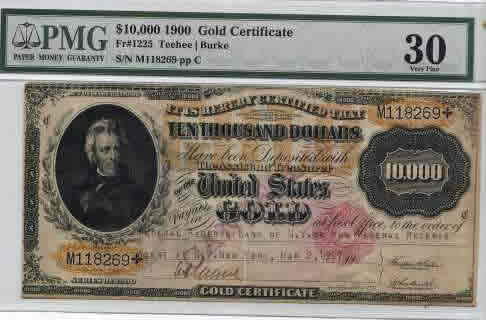 Edited by jimbucks
04/03/2021 8:22 pm
|
|
Pillar of the Community
United States
7396 Posts |
These were not issued for public usage. I actually have found very little information on these under than the fire and how they came to be. Every google search states that they were for interbank transfers.
Now if you had one could you cash it? I guess will never now ;)
|
|
Pillar of the Community
United States
7396 Posts |
Actually as part of my research I found that several high value certificates were issued to very rich people and not all of these 1000-10000 gold certificates were cashed so chances (while very slim) that there are a few large note gold certificates that are still legal tender. I assume if any ever surface they will be worth north of 7 figures.
|
|
Pillar of the Community
United States
4707 Posts |
All of the 1900 $10,000 gold notes are cancelled. There are other large denomination gold notes that are still legal tender, but not 1900.
|
|
Page 2 of 2
|
Replies: 22 / Views: 4,324 |
Page 2 of 2
|







 First Page


 Posted 04/01/2021 6:22 pm





