| Author |
 Replies: 33 / Views: 3,811 Replies: 33 / Views: 3,811 |
Page 3 of 3
|
|
|
|
Moderator
 United States
107673 Posts |
I just E-mailed Mr. Diamond, asking if he can give us his impression of this coin here in this forum site.
|
|
Valued Member
 United States
426 Posts |
Here's his response I asked to make sure that it indeed is still considered by him we'll see.  |
|
Valued Member
United States
426 Posts |
@dearborn Mikes understanding of it its still a Cud. I'll say an early die stage of the Cud which is connected to the rim which in turn is pretty neat actually.  |
|
Pillar of the Community
United States
2752 Posts |
It is my understanding that if a die break contacts the design rim directly, it is considered a Cud. There are two types of Cuds: (1) those that replace the design rim (carry off the die's rim gutter) and (2) those that do not replace the design rim (meaning the rim gutter is intact). Error coin writer and researcher.
|
|
Moderator
United States
107673 Posts |
Thanks Mike, I learned something new today. Just when you think you have an understanding of Cuds, this changes the game. @gorham_collector: I concede, I truly didn't believe that this (your coin) was a Cud. Thanks for posting it. |
|
Valued Member
United States
426 Posts |
Thanks again mike
It's alright Dearborn I learned something I started questioning once people kept saying die chip so I took a closer look it's what collecting is all about
|
|
Pillar of the Community
United States
2752 Posts |
All definitions of Cuds say it is a die break that extends from the rim into the field. None of the definitions get into whether the design rim needs to be replaced in order to qualify as a Cud. So I have to cast as wide a net as possible when deciding whether a particular die break is a Cud. Like everyone else, I'm stuck with the terminology and definitions that my predecessors came up with. Error coin writer and researcher.
Edited by mikediamond
11/24/2021 8:54 pm
|
|
Bedrock of the Community
United States
10635 Posts |
I bow to Mike's expertises, but this is akin to a rare duck that looks like a duck, sounds like a duck but officially it's considered a cow. If this was placed on ebay as a Cud, you better be ready to accept returns. Mike, thank you as always for the education.  |
|
Pillar of the Community
United States
3363 Posts |
I have tried to illustrate what I think Mike is saying.  |
|
Bedrock of the Community
United States
62064 Posts |
|
|
Valued Member
United States
426 Posts |
Die Cud before it's a rim Cud? A rim Cud is different then a " Die Cud". Imo I haven't heard those terms. Anyways the rim Cud starts at the end of the rim and goes into the coin the original Cud I posted is an early die stage of this Cud below. Which is just a Cud it's not a rim Cud and wouldn't be considered one. 
|
|
Pillar of the Community
United States
2752 Posts |
The term " Die Cud" is not used by hobby authorities. All Cuds are on the die, so the term " Die Cud" is redundant. Perhaps some people use it in contrast to "collar Cud", but that too is unnecessary. A rim Cud can progress to a full Cud, but this is by no means inevitable. And not all Cuds carry off the entire rim gutter, instead limiting themselves to the internal margin of the rim gutter. The latest photo by gorham_collector shows a proper Cud, trivial as it may be in size. Error coin writer and researcher.
|
|
Pillar of the Community
United States
3363 Posts |
Quote:So this one is a Die Cud, before it is a rim Cud? There is no relation between the 2. One is not an earlier stage of the other. Both can be an earlier stage of a Cud. In this photo of a die that produces a Rim Cud, it can be seen that the inner wall of of the Rim Gutter is substantially intact. 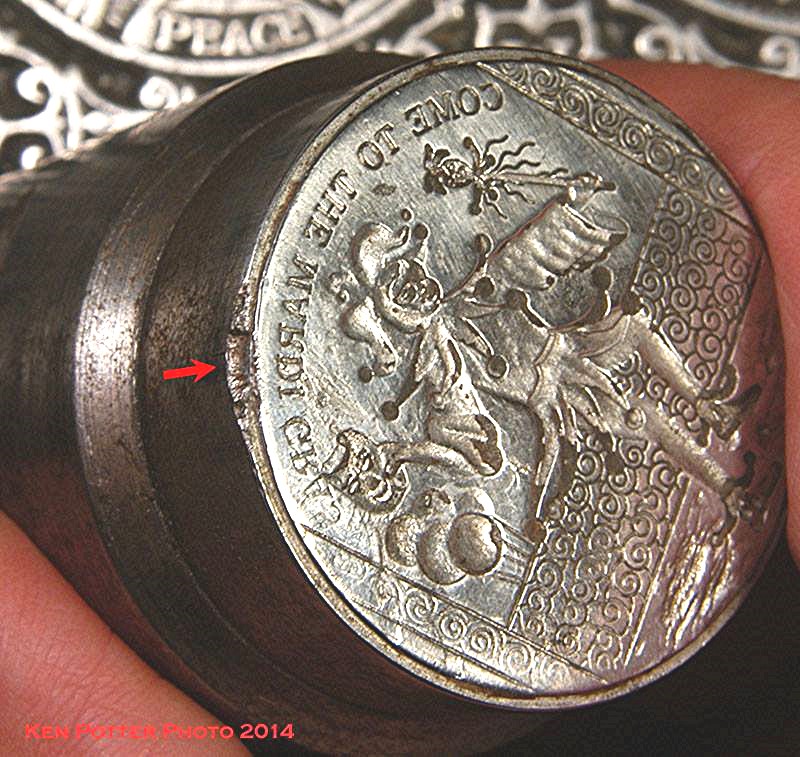 |
|
Valued Member
United States
426 Posts |
@pete2226 is this Pete apple from Facebook this is Matthew Vallee
|
|
Pillar of the Community
United States
3363 Posts |
|
|
Page 3 of 3
|
Replies: 33 / Views: 3,811 |
Page 3 of 3
|






 First Page
 Previous Page


 Posted 11/24/2021 3:32 pm





