| Author |
 Replies: 19 / Views: 3,153 Replies: 19 / Views: 3,153 |
Page 2 of 2
|
|
|
|
CCF Master Historian of USA Commemoratives
 United States
12493 Posts |
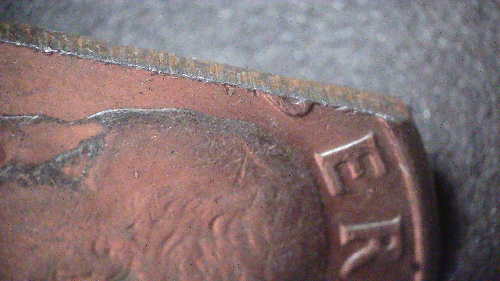
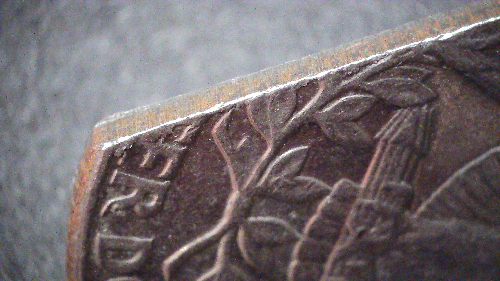
Based on the images provided, this clip does not appear to be a legitimate US Mint error.
A coin with a clip should show evidence of the Blakesley Effect - a weakness of strike at the rim opposite the clip area. The opposite rim on this coin appears fully-formed without weakness.
Additional images may prove differently, but that's what my eyes see in what has been presented.
Collecting history one coin or medal at a time! (c) commems. All rights reserved.
|
|
Bedrock of the Community
Canada
21854 Posts |
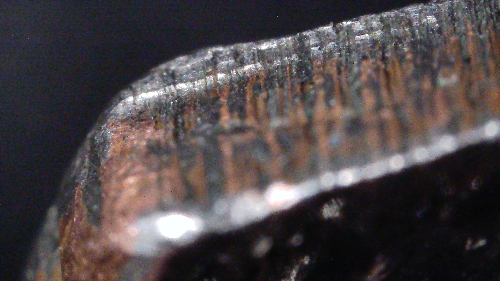
Not a clip, the rims aren't dovetailed plus you can see extra metal
along the edge that would not occur with a genuine clip.
|
|
Moderator
United States
34531 Posts |
I'm on team shed job for this one too, although it would be nice to see an edge view of that "clip".
"If you climb a good tree, you get a push."
-----Ghanaian proverb
"The danger we all now face is distinguishing between what is authentic and what is performed."
-----King Adz
|
|
Pillar of the Community
United States
5866 Posts |
I agree this is PSD. (I see no "Smith Effect" on the edges of the rim either as they disappear into the cut edge.) Words of encouragement are one of the major food groups.
We need to consume them regularly to thrive and grow.
|
|
Pillar of the Community
United States
6193 Posts |
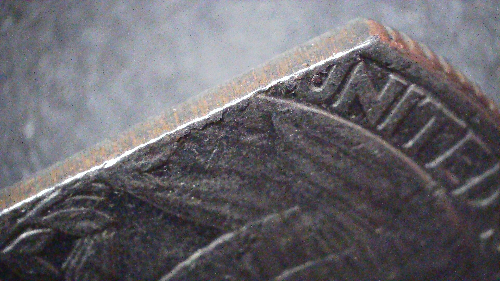
Other than looking at the edge, the coin is missing all of the three things one would normally give a quick check for. There appears to be no distortion of the lettering near the clip, no Blakesley Effect and no Smith Effect. Many large clips show little or no Blakesley, but having none of those three I strongly lean toward a faked clip. As a side note, most larger straight clips don't seem to end up quite that straight as the metal deforms a bit differently across the clip as it crosses areas with devices and fields.
|
|
Pillar of the Community
United States
797 Posts |
I agree, this appears to be PMD. |
|
Moderator
United States
105115 Posts |
I don't see any 'smith' or blakesley effects on this one. Quote:
most larger straight clips don't seem to end up quite that straight as the metal deforms a bit differently across the clip as it crosses areas with devices and fields. that and the fact that when the planchet is struck, the metal will expand into the empty area that is not contained by the collar. |
|
Pillar of the Community
United States
7174 Posts |
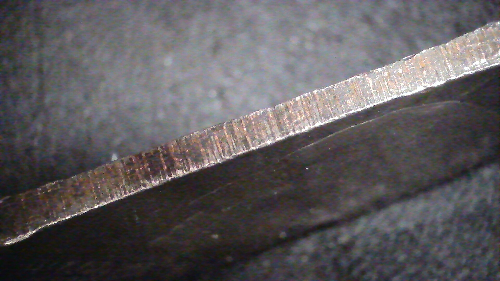
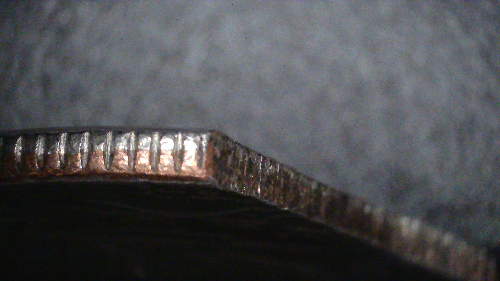
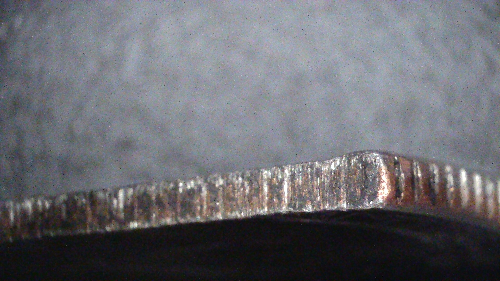
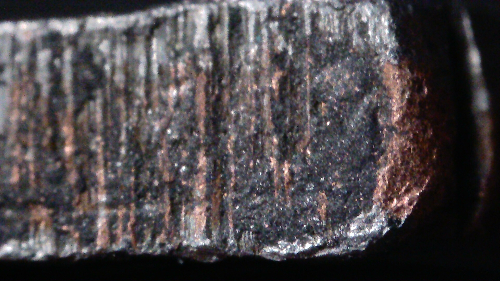
All the tells of a coin that was sheered. As stated above, metal from the cut still above the surface of the coin, would have been pressed level with surface. Devises struck up fully at the cut, they should have trailed off into the cut. To straight, metal would have [smooshed] into the cut.
|
|
Valued Member
 United States
257 Posts |
|
|
Moderator
United States
34531 Posts |
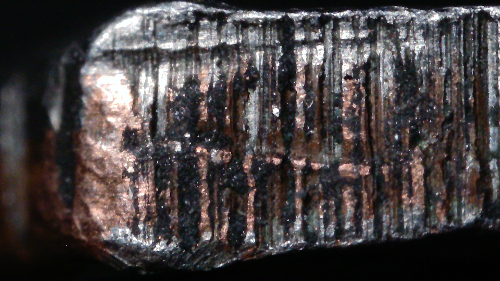
Really good edge pics @cap. Nothing here makes me think it happened at the mint.
"If you climb a good tree, you get a push."
-----Ghanaian proverb
"The danger we all now face is distinguishing between what is authentic and what is performed."
-----King Adz
|
|
Pillar of the Community
Canada
6244 Posts |
This coin show a strait vertical cut. The rolls are trimmed by circular cutters and not vertical. Here attached it is an blade cutter for vertical cut. Sorry the coins was cut after left the mint  Please look at the same pattern of the blade and the side of the coin. The mint has the blades sharp in rotative motions and are diamantes. |
|
Bedrock of the Community
United States
94367 Posts |
|
|
Moderator
United States
15850 Posts |
Indeed Frog - I appreciate all the detailed explanations.
|
|
Valued Member
United States
257 Posts |
Thank you all for the information and advice on this one.
|
|
Moderator
United States
105115 Posts |
I agree - looks like it was cut by a bandsaw.
|
|
Page 2 of 2
|
Replies: 19 / Views: 3,153 |
Page 2 of 2
|






 First Page


 Posted 11/23/2022 10:50 am