Quote: US bullion coins command a significant premium above bullion coins from other countries and private bullion rounds. It would therefore still be profitable to make fake ASEs and AGEs from genuine full-weight silver and gold.
That seems to get into a dangerous area of risk vs. reward. Don't the ASE coins carry a U.S. currency denomination right on the coin? I believe that technically makes them legal tender, which in turn might mean that faking one is currency counterfeiting. We have some ferocious criminal penalties for that crime, and the U.S. is a big country with enough resources to track down and prosecute people.
It would seem way, way less risky for criminals to fake coins from a less hazardous country, particularly if it's going to be for minimal profit.
Also, if you can make a .999 silver coin with sufficient accuracy to mimic an ASE, then you probably have enough skill and proper equipment to issue your own beautiful coinage and sell it risk-free as bullion.
I like the security features of the Britannia, Maple Leaf and Spain 1 oz gold. I wish the US Mint would do something similar than the lame easy to copy edge missing reed on silver eagle and 1 oz gold eagle. There are a lot of fake silver eagles, preventing them from being imported has not been very successful. A hard to copy security feature would be welcome IMO. The silver eagle is either the highest or near the highest selling bullion coin in the world. Maybe the US Mint just doesn't care or see a need to change.
I've yet to see any reports of any fake Britannia or Maple Leaf with the newer security features they have.
Quote: (a) copying what other countries do is un-American;
Sad, but true. We still circulate the cent (penny), as well as both one and two dollar notes. And do not even get me started on our failure to adopt the metric system.
Quote: That seems to get into a dangerous area of risk vs. reward. Don't the ASE coins carry a U.S. currency denomination right on the coin? I believe that technically makes them legal tender, which in turn might mean that faking one is currency counterfeiting. We have some ferocious criminal penalties for that crime, and the U.S. is a big country with enough resources to track down and prosecute people.
It would seem way, way less risky for criminals to fake coins from a less hazardous country, particularly if it's going to be for minimal profit.
Yes, a fake bullion legal tender coin is 100% breaking US anti-counterfeiting laws. But the threat of being caught by the US government doesn't stop the Chinese fake-masters. Making fake US coins isn't even illegal in China, nor is offering them for sale on Alibaba - which is why the Forty Thieves websites make zero effort to stop them. If Americans want to buy them and import them into the US, that's the buyer's problem.
As for "minimal profit", well they make plenty of profit from selling fake Morgan dollars (which are also legal tender and therefore illegal under US law) and selling them in street markets around the world for a couple of bucks each. If they can make a couple hundred bucks profit per coin just by making a fake ASE using genuine gold, why wouldn't they? The only disadvantage is the increased overhead in having to buy an ounce of genuine gold. Of course, they could probably make a few extra bucks profit by using .950 gold, and making it weigh slightly less than an ounce - I'm not confident your typical bullion purchaser would notice either of those differences, especially if the fake ASE was decked out in a fake US Mint box with a fake COA (none of which are all that hard or expensive for Chinese fake-makers to replicate).
Don't say "infinitely" when you mean "very"; otherwise, you'll have no word left when you want to talk about something really infinite. - C. S. Lewis
Quote: The roll-clad bimetallic composition used for US circulating coins is a pretty effective anti-counterfeiting measure all on its own.
Hadn't thought of that, but it's indeed (likely) pretty hard to fake; that red stripe on the edge is a dead giveaway of a real US clad coin (or, I guess, of some foreign clad coins, but those usually don't look all that much like US coinage), and 25 cents is probably less money than a counterfeiter would have to spend (per coin) to replicate it.
As for latent images, I know I've seen some... they're pretty, but they're usually "did you know this neat fact about this coin" instead of "this is how you tell that this coin is real". Anti-counterfeiting features don't work very well when most of the people using the coins don't actually know that the features even exist to be checked. Granted, I don't have a lot of experience with circulating coins that are actually worth enough to be counterfeited.
Quote: I'm not confident your typical bullion purchaser would notice either of those differences, especially if the fake ASE was decked out in a fake US Mint box with a fake COA (none of which are all that hard or expensive for Chinese fake-makers to replicate).
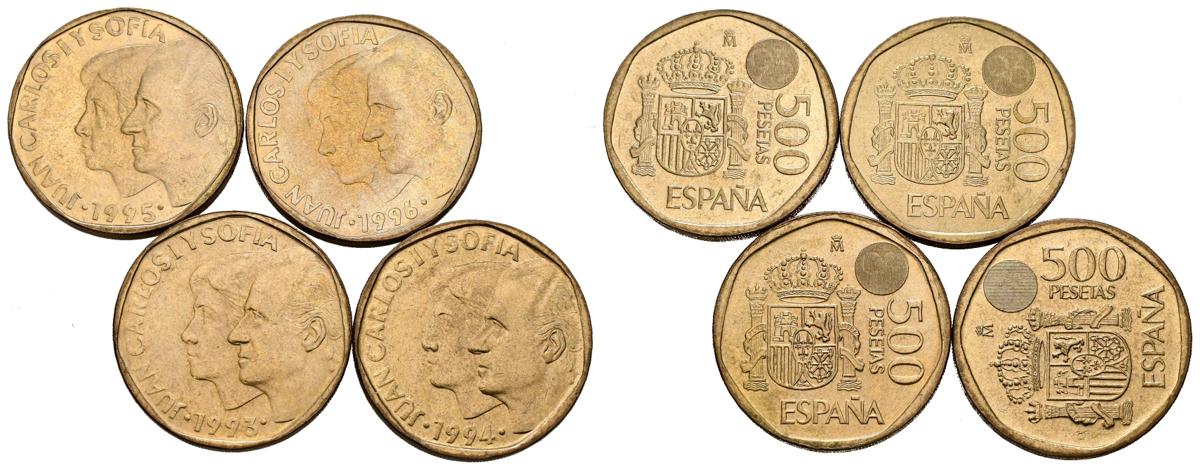
Someone has said that anti-counterfeiting measures wear out quickly and cannot be used on circulating coins. The Spanish Royal Mint-FNMT has been using latent images on circulating coins since it invented the system in the 1990s.
The point is that when there were only krugerrands and eagles you could not choose a gold ounce with an anti-counterfeiting system because there were none, but today, if I have to spend 2000 dollars on a gold coin and I can choose, I prefer an ounce that gives me more guarantees of its authenticity and is easier to verify.
I didn't say they "can't be used", I said they "don't work well", because they're easily damaged after heavy circulation. Lots of countries do use them (Spain, Britain, Taiwan and Japan, for starters). I just don;t think they're as effective an anti-counterfiet device as they perhaps "ought to be"., for the two reasons I indicated.
The first is circulation wear. Suppose we take that Spanish 500 pesetas, and wear it down to VF condition. Is the latent image then still usable as an anti-counterfeit measure? I think it wouldn't be. Latent images are popular with Mints, because Mints almost never see their own coins in worn-down condition.
The second is the handling required to see the image. I've handled British, Canadian, Japanese and Taiwanese latent-image coins, and it always takes me a good 30 seconds or so to hold the coin just right in good light to see the images - and I'm specifically looking for them. A casual coin user may not have the skill, time or adequate lighting to do so. While accurately replicating the latent images is difficult for the counterfeiter, making it "good enough to pass at first glance" is much easier.
Don't say "infinitely" when you mean "very"; otherwise, you'll have no word left when you want to talk about something really infinite. - C. S. Lewis
In Europe in the 21st century (and most of the 20th century) coins are withdrawn from circulation long before they are too worn out, the same happens with banknotes.
Look at the photograph of these coins and the first one I put you, they are circulated and the double latent image of the FNMT is still valid. It all depends on the quality of the metal with which the coin is made. Even if the latent image has scratches, it is still visible. You have to crush it to remove it.
On the other hand, 999.9 gold bullion coins like the Bull Bull Doubloon or the Caballo Doubloon or the Buffalo or 22k the American Eagle are not made to circulate much and in most cases will always be in a plastic capsule. On the other hand, I don't know what the latent images from Taywan or Japan will look like, but the FNTM images (which invented the system) look good, especially the current quadruple image. It is true that you have to move the coin in four directions to see the four images, but for that reason, you are always seeing one of the latent images.
Look this video about the Dubloon Caballo, you will see the cuadruple latent imagen from the first second.
Another problem with the latent image for circulation coins is die wear. As the die wears through use the quality of the latent image suffers. For most countries this probably isn't too much of a problem because their coinages are lower and they change out their dies more frequently. But for the US with our extremely large mintages and the fact that we use our dies so much longer die wear could very will be a limiting factor.
What they use a laser to cut the latent image into each coin individually? Do that with several hundred million coins? I could see them cutting the individual dies, but in the US with each die striking a million coins, sometimes more, I would think die wear would still be a problem.
I don't know if laser is used but anti-counterfeiting measures would be rather pointless for low melt value of USA circulating coinage IMO. I'm not aware of much counterfeiting of clad dimes, quarters, halves or modern nickels, cents. But on USA non-circulating gold/silver coins/bullion I would like to see better counterfeiting measures like Canada and United Kingdom. The ASE is being counterfeited a lot.
Disclaimer: While a tremendous amount of effort goes into ensuring the accuracy of the information contained in this site, Coin Community assumes no liability for errors. Copyright 2005 - 2026 Coin Community Family- all rights reserved worldwide. Use of any images or content on this website without prior written permission of Coin Community or the original lender is strictly prohibited. Contact Us | Advertise Here | Privacy Policy / Terms of Use






 First Page


 Posted 08/27/2023 7:59 pm