| Author |
 Replies: 21 / Views: 2,907 Replies: 21 / Views: 2,907 |
Page 2 of 2
|
|
|
|
Pillar of the Community
United States
3366 Posts |
UK sovereigns and French 20Fs also use copper as the secondary metal with the gold. English guineas used an equal mixture of silver and copper for the alloy, according to this 1776 report: The English Standard for gold is 22. carats of fine gold + 2. carats alloy. I.e. 1/12 alloy of silver and copper in equal parts.https://founders.archives.gov/docum...1-01-02-0214"Two minutes ago I would have sold my chances for a tired dime." Fred Astaire
|
|
Pillar of the Community
 United States
4623 Posts |
-----Burton 50+ year / Life / Emeritus ANA member (joined 12/1/1973) Life member: Numismatics International, CONECA Member: TNA, FtWCC, NETCC, EveryCountry (online) coin club Owned by three cats and a wife of 40+ years (joined 1983) Author: 3rd Edition of the Sample Slabs book, https://www.sampleslabs.info/ |
|
Pillar of the Community
United States
6456 Posts |
I think I read somewhere that native California gold typically contained over 90% gold, mixed with silver and copper. Each batch of gold used for coinage would be adjusted down to 90% fineness by adding copper. The resulting coins would all have correct gold content plus variable levels of silver and copper.
|
|
Bedrock of the Community
United States
10982 Posts |
Completely normal. BStrauss3 makes a strong point above.
|
|
New Member
 Australia
45 Posts |
have any other members had similar results? I think the better xrf machines can detect the more minute percentages too
|
|
Pillar of the Community
Portugal
765 Posts |
89.4 Au in a double eagle is a deviation I would not expect. Modern mints use to be very precise in gold content. But the coin certainly seems genuine. I can believe it is within the error of the machine.
|
|
New Member
Australia
45 Posts |
i found a shop that has a "cheaper generic brand " XRF machine and this is the results for the double eagle,,,,its not detecting any silver at all unlike the Thermo Fisher Scientific xrf machine that shows 0.3% Ag. mmm interesting maybe the Thermo Fisher Scientific XRF is more powerful and can detect the smaller trace elements or the generic chinese XRF is just calibrated better or somthing? for my curioisity I'm going to get all my coins tested with the generic XRF and see how they go :) 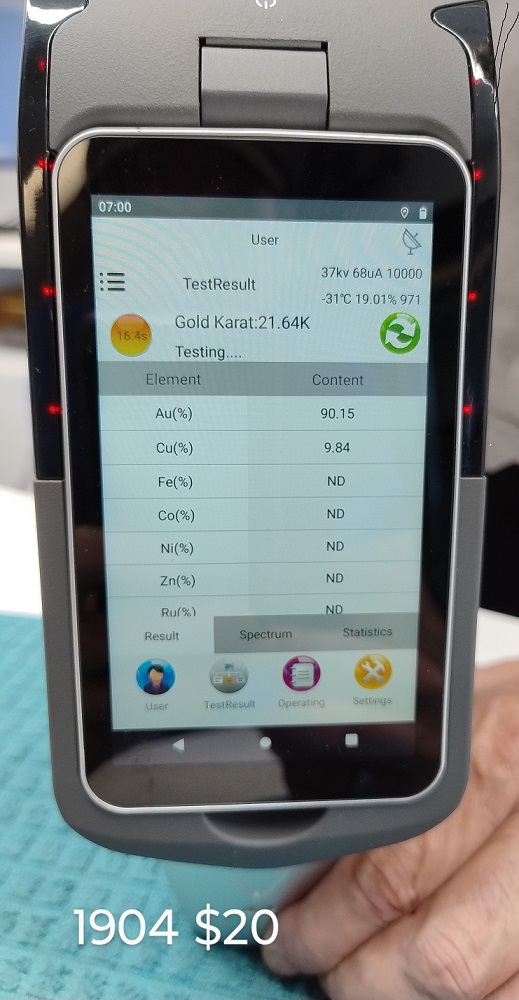 |
|
Pillar of the Community
United States
4623 Posts |
-----Burton 50+ year / Life / Emeritus ANA member (joined 12/1/1973) Life member: Numismatics International, CONECA Member: TNA, FtWCC, NETCC, EveryCountry (online) coin club Owned by three cats and a wife of 40+ years (joined 1983) Author: 3rd Edition of the Sample Slabs book, https://www.sampleslabs.info/ |
|
New Member
Australia
45 Posts |
that was a very interesting read! cheers for that Bstrauss
|
|
Pillar of the Community
United States
1785 Posts |
Why You're Seeing Silver in XRF Results
- Trace Element Inclusion: Even though the official alloy is 90% gold and 10% copper, small amounts of silver (typically <0.5%) can appear due to:
- Residual silver in refining processes
- Cross-contamination from equipment or crucibles
- Intentional inclusion to improve workability or color balance
- Historical Mint Practices: U.S. mints in the 19th and early 20th centuries didn't always refine metals to modern purity standards. Silver was often present in native gold sources and wasn't always fully removed.
- XRF Surface Sensitivity: XRF primarily analyzes the surface layer (typically 10-100 microns deep), so if silver is more concentrated near the surface due to diffusion or cleaning residues, it may show up disproportionately.
What Other Researchers Have Found:
- Many collectors and researchers using XRF have reported similar silver traces in genuine coins. For example:
- A 1909-D $5 Indian Head tested by a forum user showed 0.2% Ag — nearly identical to your result.
- Liberty Head $20 coins have been documented with 0.3-0.4% Ag in XRF scans, especially when tested with handheld devices.
- These findings are generally considered normal and within tolerance, especially when weight and dimensions match mint specs.
John Lorenzo, Numismatist
Edited by colonialjohn
07/15/2025 3:21 pm
|
|
Pillar of the Community
United States
6955 Posts |
Quote:
Silver was often present in native gold sources and wasn't always fully removed. I know it's an old thread, but I think that point is a strong one. The Mint probably wasn't going to waste a ton of effort separating out every last bit of silver from adequate quality gold. Veins of gold often occur in the same host rock as silver. Also worth pointing out: coins changed hands between nations back in the day. Melting foreign gold coins into the alloy for striking U.S. gold coins was probably an accepted practice. Possibly some of those coins were an alloy of gold and silver instead of gold and copper. |
|
Moderator
 United States
197600 Posts |
Interesting.  |
|
Pillar of the Community
United States
3848 Posts |
I tested a large handful of raw $20s with a Thermo Scientific Niton XL2 XRF analyzer, both Liberty Heads and Saint Gaudens type. All but 2 Saint Gaudens had recorded 0.2%-0.9% trace silver.
Suffering from bust half fever. Want to learn how to attribute early half dollars by die variety? Click Here: http://goccf.com/t/434955Shoot me a PM if you are looking to sell bust halves. |
|
New Member
Australia
45 Posts |
awesome replies guys! lots of good info :)
|
|
Pillar of the Community
United States
4623 Posts |
If you look at the mint director's reports, there are two pieces of interesting data.
One is the amounts of gold (and silver) deposited at the mint and assay offices - millions of dollars in foreign gold coin.
The other are assays of foreign coins commonly in "circulation".
-----Burton 50+ year / Life / Emeritus ANA member (joined 12/1/1973) Life member: Numismatics International, CONECA Member: TNA, FtWCC, NETCC, EveryCountry (online) coin club Owned by three cats and a wife of 40+ years (joined 1983) Author: 3rd Edition of the Sample Slabs book, https://www.sampleslabs.info/ |
|
Page 2 of 2
|
Replies: 21 / Views: 2,907 |
Page 2 of 2
|





 First Page


 Posted 02/22/2025 7:38 pm


