I previously discussed some of the history, controversy and design elements regarding the 1924 Huguenot-Walloon commemorative half-dollar here:
http://goccf.com/t/118339. Tonight, I am following up on that discussion with a few interesting tidbits about the proposed coin as it was discussed in Congress.
Read More: Commems CollectionTidbit #1The original bill, submitted by Representative Fred Benjamin Gernerd (R-PA), for the Huguenot-Walloon coin did not include a designated sponsor that would be authorized to request the coins from the US Mint, be responsible for paying for them or for taking delivery of the them. As written, the bill would have enabled anyone to request the coins from the Mint as long as they had the funds to pay for them.
The lack of a specified sponsor was not an oversight, however, as Rep. Gernerd patterned his bill after the one that was authorized for the 1920 Pilgrim Tercentenary half-dollar â€" it too lacked the name of an authorized sponsor.
This issue was discussed by the House Committee on Coinage, Weights, and Measures during the Hearing it held on the proposed bill. Ultimately, the bill was amended and included the Fifth National Bank of New York as the authorized agent. This in itself was a bit unusual, as the Bank was not the sponsor of the memorial coin; it was simply the bank of record for the unincorporated Huguenot-Walloon New Netherland Commission, the group set up by the Federal Council of Churches of Christ in America, the coin's true sponsor, to plan and oversee the Huguenot-Walloon Tercentenary. In any case, the Fifth National Bank agreed to serve as the Commission's agent for the purchase and receipt of the coins and found itself as part of the approved legislation.
Tidbit #2At the time the coin was proposed in Congress, the designs under consideration for the coin were different from what ultimately appeared on the coin (at least on the reverse). When questioned during the Committee Hearing about the designs intended for the coin, Rev. John Baer Stoudt, Director of the New Netherland Commission, suggested that the coin "would have the arrival of the
New Netherland on one side and the purchase of Manhattan by Governor Minuit on the other." The
New Netherland was the ship that brought the original Walloons to America, and Peter Minuit was the third governor of the New Netherland colony.
As collectors of the series are aware, the issued coin did feature the
New Netherland on the reverse, but it had the conjoined portraits of Admiral Gaspard de Coligny of France and William the Silent of the Netherlands on its obverse. (See my previous post [link above] for a brief discussion of these two figures.) The published reports of the Huguenot-Walloon New Netherland Commission do not include a discussion of why the originally considered scene of Governor Minuit purchasing Manhattan Island from the local Native Americans was replaced by the portraits of Coligny and William the Silent. It is possible, however, that the Minuit/Manhattan design came under a fire as being too "New York City focused" with its history considering the fact that the Walloon's first settlement was actually further up the Hudson River at present-day Albany, NY.
Tidbit #3The US commemorative coin program was still in its relative infancy in 1924. Though the number of proposed issues was most definitely increasing, they had not yet become the "serious threat" to the integrity of the nation's coinage that they would soon become â€" at least in the opinion of the Treasury Department. So, the Huguenot-Walloon coin received no objection from the Treasury. In fact, in his letter to the House Committee, Secretary of the Treasury Andrew Mellon indicated that he would "take pleasure in instructing the Director of the Mint to cooperate with the Committee in charge of the proposed coinage."
Over the next five years, the Treasury would gradually change its opinion on commemorative coins and would begin to voice its opposition to the striking of such coins. Its resistance eventually led to the first veto of a US commemorative coin bill in 1929, as President Herbert Hoover sided with the Treasury and blocked the approval of the Gadsden Purchase coin.
Following is the example of the 1924 Huguenot-Walloon half-dollar in my collection.
1924 Huguenot-Walloon Half-Dollar â€" Obverse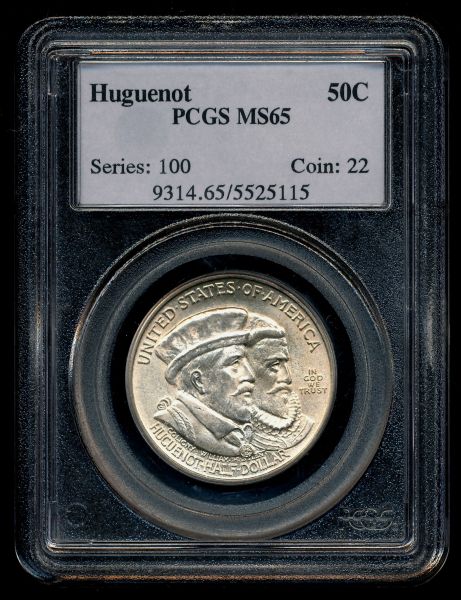 1924 Huguenot-Walloon Half-Dollar - Reverse







 Posted 09/20/2013 10:23 pm


