I'll mention some of my observations about this. I edited one your pics E&Vs as a visual aid (very fancy

).
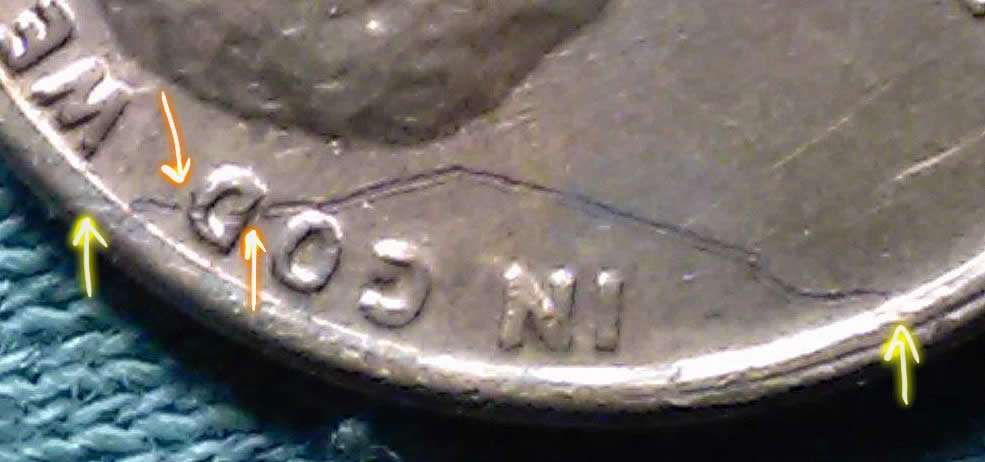
About the D: as opposed to being struck-through, a scratch or gouge has a linear direction - an origin point, a direction of travel and a termination point. The Orange arrows show the break in the line on
both sides of the D. I believe that if this were a scratch, it would make contact with the letter on one side (first in the direction of travel) and a break would happen on the other side (the implement skipping after the high point).
The Yellow arrows, I believe, show the same line continuing onto the rim at both ends. Because of the angle of the shot, it looks to be consistent with a piece of thin wire approaching the rim, being pressed
vertically up the inner edge of the rim and then continuing its original path/shape.
Think about using an implement such as a ballpoint pen to create this. With the amount of downward force needed to create that impression, how likely is it that you could travel
over a raised letter without the pen deciding to travel
around it instead.
That could be achieved by a quicker motion but, the directional changes in the field argue against that. Also, at the terminal point (whichever end) approaching the rim, the implement would most likely travel along the inner edge of the rim and not up and over again.
I believe this is struck through a wire brush bristle and in striking, it broke at the highest pressure sheer points which is likely no matter what metal it was made of.
In Memory of Crazyb0 12-26-1951 to 7-27-2020
In Memory of Tootallious 3-31-1964 to 4-15-2020
In Memory of T-BOP 10-12-1949 to 1-19-2024
Edited by spru
08/05/2017 01:01 am








 First Page
 Previous Page


 Posted 08/04/2017 11:23 pm


