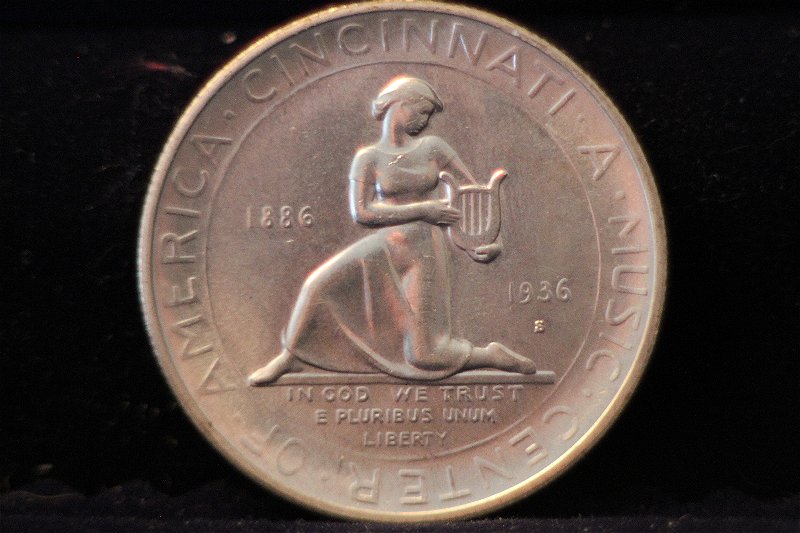
If there is one half dollar among all the commemorative coins of the classic series that collectors question the appropriateness of, it has to be the 1936 Cincinnati Music Center coin which purports to recognize "the fiftieth anniversary in 1936 of Cincinnati, Ohio as a center of music, and to commemorate Cincinnati's contribution to the art of music in the United States for the past fifty years." The purpose of this post is not to rehash this story, you can read more about it in one of my earlier posts here:
1936 Cincinnati Half Dollar. My purpose in this post is to describe how the issue's potential for abuse could have been worse!
Thomas G. Melish was the distributor of the Cincinnati half dollar, and, by most accounts, appears to be the sole member of the Cincinnati Musical Center Commemorative Association of Cincinnati, Ohio - the sponsor of the coin as listed in the Cincinnati half dollar bills. He also promoted the 1936 Cleveland Centennial / Great Lakes Exposition commemorative half dollar for the Cleveland Centennial Commemorative Coin Association; another Association in which many believe he was the only member.
Read More: Commems CollectionNo doubt working on behalf of Melish, newly-elected Representative Joseph Andrew Dixon (D-OH) introduced a bill in the House on January 12, 1937 (75th Congress), that proposed 30,000 Cincinnati half dollars be struck (the coin's original legislation authorized 15,000). The new bill had a twist: the bill stated that the coins should be dated "1936" with a small "1937" added, ostensibly to reflect the year of striking. The bill was written as if it was the first bill to propose a Cincinnati half dollar, and made no reference to the Public Law that was already on the books authorizing the coin. The bill was referred to the House Committee on Coinage, Weights, and Measures where it went nowhere. I find it interesting that Melish worked with Dixon, a first-term Representative, to introduce the bill for him - did he figure an eager new Representative would work harder to convince his colleagues of the bill's merits? Or maybe, that as a new member of Congress, he would not see its folly?
Maybe realizing his misstep regarding overlooking the already-authorized coin (or maybe being told of it!), Dixon introduced a new bill on January 18, 1937 for the same purpose, but this time presented it as an amendment to the previously enacted legislation. As it was amending the coin's 1936 Act, it needed to increase the coin's authorized production and account for the 15,000 coins already struck in 1936 at the Philadelphia Mint and the Denver and San Francisco Branch Mint facilities. So, the amendment called for 45,000 coins with 30,000 of the coins being dated "1936" with a small "1937" (i.e., the new coins) and the other 15,000 being dated "1936" but without the small date (i.e., the coins already struck). As with the previous bill, the new one was referred to the House Committee on Coinage, Weights, and Measures where it died without action (e.g., no Hearing was called).
A companion bill was introduced in the Senate by Senator Robert Johns Bulkley (D-OH) in April and was referred to the Senate Committee on Banking and Currency; it was never reported out. Bulkley was the Senator responsible for the original Cincinnati coin bill (74th Congress).
Of course, Melish was hoping to wring a few more dollars out of collectors in 1937 with a new variety of his Cincinnati coin. The amendment bills might have stood a chance if 1936 was an actual anniversary year for music in Cincinnati and the proposed coins would have had a primary "1937" date and a small "1936" to call to mind the anniversary - like was done on the 1935-38 Boone Bicentennial half dollars. Or, it might have worked if "1936" had been incorporated into the design of the original coin vs. just representing the date struck - as was the case when a small "1921" was added to the Pilgrim half dollar when a second batch was issued in 1921 (the original coin incorporated the dual dates "1620-1920"). How about the Gettysburg half dollar as a model considering it features a "1936" date even though it was not struck until 1937? Not a good example, as the coin's legislation was approved in 1936 and mandated the "1936" date on the coin regardless of the year it was struck - the Cincinnati bill was not even introduced until 1937 and, as written, called for the coins struck under its authorization to basically be backdated - a no no. The Cincinnati companion bills, as proposed, smacked of being a money grab and Congress had become weary of such attempts by coin sponsors. It is not a surprise that the coin proposal failed.
So, we as commemorative coin collectors, have had to make do with just the three-coin set (P-D-S) of 1936 Cincinnati half dollars. Woe is us!

Here's my 1936 Philadelphia strike of the Cincinnati. Unfortunately, my scans wash out the coin's attractive luster and flashy surfaces. They do show the coin's clean surfaces, however.


Here's a link to a previous post I did on the first 200 coins struck for the Cincinnati issue and the notarized holder in which they were delivered:
Cincinatti Three-Coin Holder.







 Posted 08/26/2020 1:37 pm