| Author |
 Replies: 20 / Views: 2,725 Replies: 20 / Views: 2,725 |
|
New Member
United Kingdom
10 Posts |
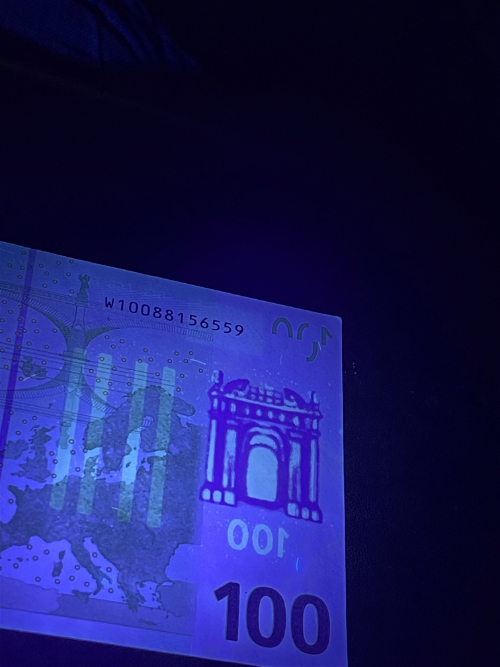
Good morning everyone and thank you in advance for any information or advice given in response to my question. I am new to this forum and would love some help from anyone out there with far greater knowledge than myself and I appreciate being allowed to join this community. I have in my possession a first issue €100 banknotes with a W country code on the prefix. After trying myself to acquire the information, all I can find is that the letter W was set aside for when Denmark join the Eurozone which they haven't as yet. My question is, would this banknote have been printed for Denmark just in case they decided to join before the notes were officially released. Is it one that maybe wasn't put out for general circulation. It's in absolutely fabulous condition. Again, many thanks in advance. Kindest Regards Graham 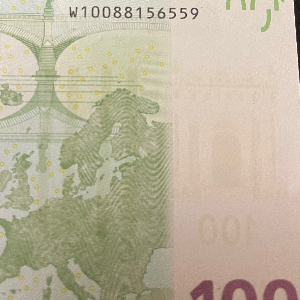 Edited by nipper260968
01/05/2022 11:40 am
|
|
|
|
Moderator
 United States
56855 Posts |
|
|
Moderator
United States
197031 Posts |
 to the Community! |
|
New Member
 United Kingdom
10 Posts |
Sorry it took some time to figure out on the mobile phone but managed to post a picture. I'm awaiting a reply from danmarkbanke as well after emailing them after getting advice from the Danish Embassy
|
|
Moderator
United States
197031 Posts |
Quote:
Sorry it took some time to figure out on the mobile phone but managed to post a picture. No problem, thank you!  |
|
Pillar of the Community
Canada
2649 Posts |
|
|
Pillar of the Community
Germany
995 Posts |
This is indeed a very interesting find of a first series €100 note.
The letter of the serial number, here ''W,'' is indeed the country code. Initially, the letter ''W'' was assigned to Greece. However, that was changed. Greece got ''Y'' and ''W'' was assigned to Denmark.
As Greece joined the Euro very late (after cooking their books, but that is another story) it is possible that production of ''greek'' €100 began before the letter was changed.
It would be very interesting to know where this note was printed. This information can be found on the right of the star at the 9 o'clock position. Look very closely. A magnifiying glass helps. It should be a letter (the printer), then three digits (the number of the printing plate), then a letter and a number (indicating the position on the printing plate).
The country prefixes were abandoned for the second series.
The letter ''W'' now stands for the company Giesecke & Devrient GmbH and their printing facility in Leipzig. The one in MUnich was closed a few years ago.
Edited by redlock
01/05/2022 3:04 pm
|
|
New Member
United Kingdom
10 Posts |
I understand what you're saying Walk2dwater, but my banknote is not the Europa or 2nd series. It's the 1st series banknote of which the W was not used because it had been set aside for Denmark. I've been on the website you have suggested and I there are no answers there for me
|
|
New Member
United Kingdom
10 Posts |
Thank you redlock. I have spent the past few days checking out everything you have said and I'm still at a loss as to where this banknote originates from. I received a reply from the Danish Embassy telling me to contact the Danmarkbanken of which I have done. I'm now awaiting a reply from them. I have checked all the known security features using macro lenses and a UV light and they're all there. The note is genuine. I'm still very curious as to know is origin. Thank you everyone so far for your replies. I will keep you all informed as to the reply I may receive
|
|
Pillar of the Community
Canada
2649 Posts |
If it is indeed a Duisenberg note (you've only posted a small crop -impossible to verify the signature), then that sounds like it is a remarkable find Graham. My SCWPM also shows ' W' as a reserved prefix for Denmark (along with other prefixes for other countries). It makes me wonder if a in-house test-note was produced & it somehow slipped outside the printing facility. I would encourage you to check out the printer code. The small text off the arch has an initial & I would also post your query on EuroBillTracker. (I doubt the Danish embassy would know & you don't want government officials trying to recover your note). 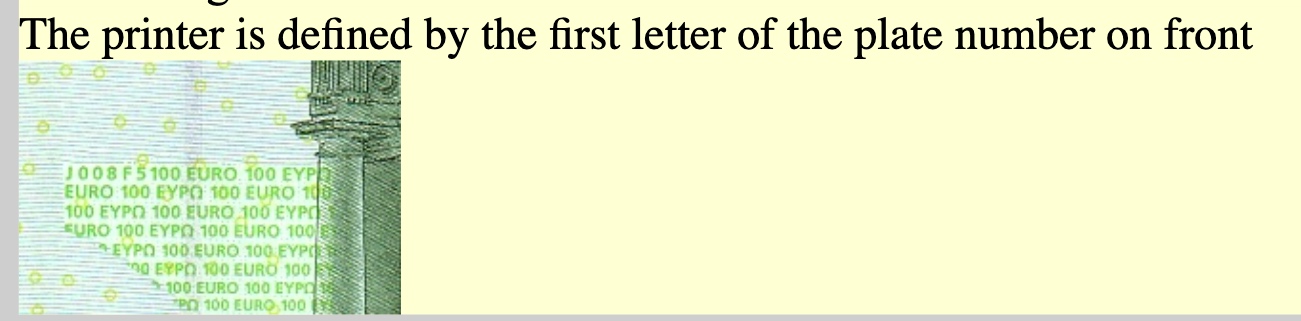 BTW: I found the above image (a screenshot) off the Bank Note Museum: http://www.banknote.ws/COLLECTION/c...NTRAL%20BANK& the EuroBillTracker link I provided earlier has info on printer codes. Edited by walk2dwater
01/05/2022 5:16 pm
|
|
New Member
United Kingdom
10 Posts |
The printer code on the note is P003G2100 and the image I posted was well cropped. Wasn't quite sure how to post the whole picture but if you give me an email address then I will happily send the pictures I have taken including the ones under UV
|
|
New Member
United Kingdom
10 Posts |
Actually that would be P003G2 for the printer code and position number I believe
|
|
New Member
United Kingdom
10 Posts |
Ok so I signed up on the Euro Tracker website and put in all the information which was all accepted including the Printer Code, apart from the serial number. It states that the serial number is invalid. So there is something about this banknote that really doesn't make sense to me. I have looked very carefully again at the note and it has every security feature that is either visible or hidden so I'm dumbfounded as to where is has originated from.
|
|
New Member
United Kingdom
10 Posts |
|
|
Pillar of the Community
Germany
995 Posts |
Quote:
Actually that would be P003G2 for the printer code and position number I believe Here, P stands for Giesecke & Devrient. Thus, this note was either printed in Munich or Leipzig. Giesecke & Devrient did print series one €100 notes for Greece -- using the prefix ''Y.'' As I said previously, if the note is genuine and it's likely it is, it was probably printed before the country code for Greece was changed from ''W'' to ''Y.'' Perhaps, a test run? Somehow, this note escaped detection. I think you should contact the ECB in Frankfurt Germany and/or D&G in Munich/Leipzig about it. |
|
New Member
United Kingdom
10 Posts |
I will contact those places. The Danish National Bank weren't really that helpful because I don't think they quite understand my question. They just said that they don't print Euro Banknotes which I already knew. I have noticed on the Euro Tracker website that there are a few W prefix but very few so I'm also thinking it's possible that some were made for Greece before they changed to a Y prefix. I will keep trying but thank you everyone for your help so far
|
| |
Replies: 20 / Views: 2,725 |




 Posted 01/05/2022 10:31 am