










 Posted 02/27/2009 04:47 am


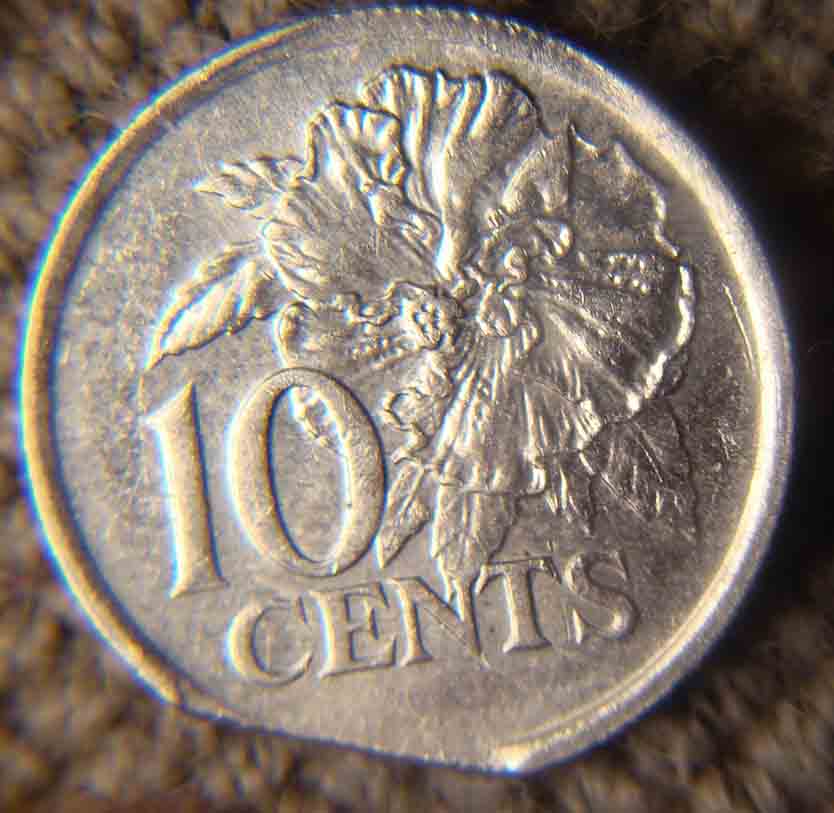
"clipped coins" have two causes: straight-edge clips (like this one) are caused by the planchet-punching machine reaching the end of the metal ingot, and only slicing off a piece of the coin.
Curved-edge clips (or "bites") are caused by the planchet-puncher overlapping two punches; part of the blank punched second is missing, because the first one had already been punched out there.
It can be easy to replicate an edge clip, with a good sturdy pair of tinsnips or some other metal-cutting tool, but there are tell-tale differences you can look for to tell fake from fair dinkum. This has a clear sign of a genuine clip: the Blakesley Effect, where the area of coin directly opposite the clip is weakly struck. On this coin, you can clearly see it where the reverse rim fades away above the flower.
Curved-edge clips (or "bites") are caused by the planchet-puncher overlapping two punches; part of the blank punched second is missing, because the first one had already been punched out there.
It can be easy to replicate an edge clip, with a good sturdy pair of tinsnips or some other metal-cutting tool, but there are tell-tale differences you can look for to tell fake from fair dinkum. This has a clear sign of a genuine clip: the Blakesley Effect, where the area of coin directly opposite the clip is weakly struck. On this coin, you can clearly see it where the reverse rim fades away above the flower.
Don't say "infinitely" when you mean "very"; otherwise, you'll have no word left when you want to talk about something really infinite. - C. S. Lewis

 I noticed that too--nice example of a straight clip.


