If you know the diagnostics of a genuine incomplete(clipped) planchet, you will never get fooled by a garage job. An incomplete planchet is created when the metal stock is not advanced far enough when blanks are being punched out or the blank punch overlaps the edge/end of the metal stock sheet(straight or ragged clip). Hence, the proper term is "incomplete planchet" since nothing is actually clipped.
After a blank is punched out, it is run through an upsetting mill that forms the initial protorim. The blanks are force-spun through a slightly narrowing channel which upturns the rim. Since the process works via opposable forces, an incomplete planchet will not have an upturned rim directly opposite the side of the clip. This weakness is known as the Blakesley Effect and it cannot be duplicated on a garage job. If the clip is fairly small, the Blakesely Effect may not be visible so you will need to rely on the other diagnostics.
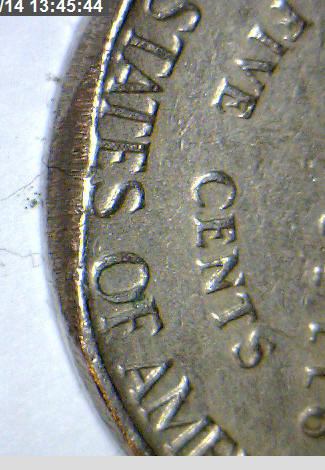
Another diagnostic is a tapering at the site of the clip. A planchet is slightly smaller in diameter than the resultant coin and when it is struck, the planchet spreads out until confined by the collar. This metal flow will usually give the clip a slight tapering appearance. Instead of a vertical cut, it is more of a sideways you or V shape. Another diagnostic directly resulting from the striking process is that the peripheral devices will be weak and details will flow towards the clip. Instead of the planchet metal vertically filling the voids of the die, the metal has a tendency to flow outward which results in the peripheral weakness at the site of the clip. The
Kennedy half dollar pictured below displays all three diagnostics.

photo credit: Tim Stroud






 Posted 10/14/2011 2:57 pm