| Author |
 Replies: 10 / Views: 2,453 Replies: 10 / Views: 2,453 |
|
|
New Member
United States
26 Posts |
Going through some of my grandfathers boxes and this coin was in there it took a while for me to figure out what it was. With the two holes that are in it I know it was ruined, local coin guy believes it is real.Any help would be great. 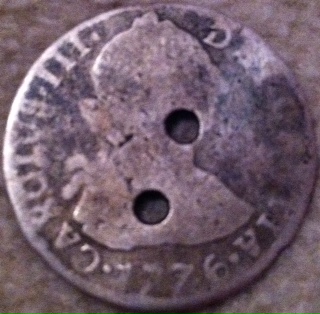 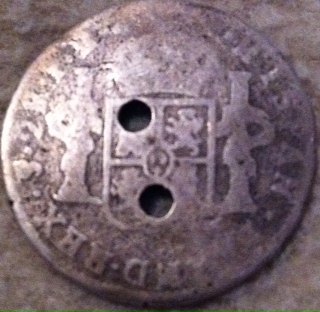 |
|
|
|
Valued Member
United States
115 Posts |
Hi NomadA32,
I'm not sure what help you would like with the coin, but I can say that it appears to be a 1776 Bolivia 2 reales minted in Potosi. It bears the bust of Charles III, King of Spain. Many coins of this period were holed in order to keep track of them, however these holes are unusual--perhaps it was part of a piece of jewelry. I don't think 1776 is a particularly rare date for this coin, so in in this condition it is worth $10 -$20 at most.
|
|
New Member
 United States
26 Posts |
rexvictor thanks for the help I was completely lost on this as it was very difficult to make anything out
|
|
Pillar of the Community
United States
651 Posts |
by the looks of the coin and the amount of even wear, it's a real 2 Reales. too bad for the holes. worth just the silver though.
|
|
Moderator
 United States
56855 Posts |
Placement of the holes makes me think it was used as a button  , what do you all think? John1  |
|
Valued Member
United States
327 Posts |
It does look like a button. Pretty cool coin.
|
|
Pillar of the Community
United States
1801 Posts |
I have seen lots of 2 reales with holes like this, you are correct John1, they are used as buttons, often to close the top of a cloth shoulder bag (kind of like a purse but everyone carries them in rural South and Central America). Of course in this condition as a coin it is worth silver value but if you plan on making a shoulder bag...you already have the button.
|
|
New Member
United States
30 Posts |
Nice coin. You should definitely keep this coin, NomadA32. Cool conversation piece.
Teia Baber
Heritage Auctions
|
|
Pillar of the Community
United States
1962 Posts |
Does anyone who is capably familiar with Kleeberg types and such think there's a possibility this could be a contemporary forgery?
|
|
Valued Member
United States
115 Posts |
I know nothing about Kleeberg types, but the only thing I think is curious about this coin is the appearance of the D in "DEI." I'm not sure there's enough of the coin left to make a final determination, but I wouldn't suspect that it is fake.
|
|
Pillar of the Community
United States
5362 Posts |
The coin does not appear to be a Kleeberg type and I do not suspect a forgery - but there is a new edition in the works that should be checked after publication.
The coin is definitely a button. Real coins were used primarily in the early 1800's as suggested for large fasteners. They were also used for saddle decorations etc. as an indication of the wealth of the owner. The practice of using counterfeit coins or coin like discs of metal developed later in the century under French influence. Many of the plated one sided buttons were manufactured in Lyon, France in the 1860's.
The age of the original coin here suggests use possibly during the Mexican Revolution or even the Texas war. Perhaps a US expatriate living in Texas in 1836 chose the date 1776 with a specific nod to history.
All in all - worth MUCH more as an historic item than as a coin. Great find.
|
| |
Replies: 10 / Views: 2,453 |
|







 Posted 10/29/2011 11:25 pm





