| Author |
 Replies: 9 / Views: 1,294 Replies: 9 / Views: 1,294 |
|
|
Valued Member
United States
187 Posts |
For Halloween, I am posting my "zombie" penny, which appears to have been shot repeatedly by non-zombie pennies, yet it still lives. Seriously, what causes this type of damage? Thanks! 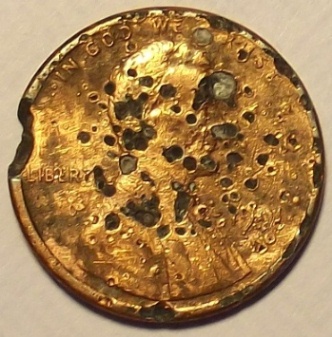 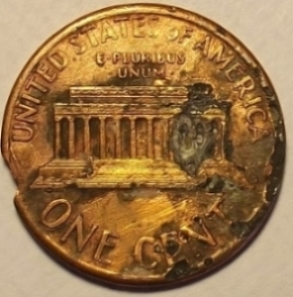 |
|
|
|
Bedrock of the Community
United States
10045 Posts |
Looks like he struck again!   |
|
Bedrock of the Community
United States
12437 Posts |
advanced stages of zinc rot
|
|
Valued Member
 United States
187 Posts |
So does the zinc "rot" from the inside, causing the pits in the copper? I have no clue as to the science behind this...?
|
|
Bedrock of the Community
United States
12437 Posts |
|
|
Valued Member
United States
304 Posts |
Possibly a high school or other chemistry class experiment with acid/corrosion.
Everyone knows one good clean shot to the head with any mid range caliber gun will do the trick.
|
|
Rest in Peace
United States
7075 Posts |
Good site, biokemist. If I understand the article correctly I can expect all my zincolns to deteriorate. Maybe they will last a little longer if they are sealed off in air-tight containers...I hope so. I like my proof set.
|
|
Pillar of the Community
United States
2661 Posts |
Quote:
If I understand the article correctly I can expect all my zincolns to deteriorate Not necessarily, you still must have an electron path provided by an electrolyte such as moisture in order for the anode(zinc) to react with the cathode(copper) for this type of corrosion to occur. One exception to this rule would be the formation of inter-granular corrosion within the zinc. This is caused by impurities within the metallic grain and would eventually produce similar effects as what you have posted here in the photo. As long as the coin stays dry, and the copper plating is intact, it should last almost forever. Once the copper plating is damaged enough to expose the zinc, ambient humidity in the air could start this process. In your case I would say that this coin may have spent a few months in some playground sand where the copper could have been damaged and it was exposed to enough moisture to accelerate the degradation of the metals. Edited by Tim Stroud
10/31/2011 6:43 pm
|
|
Bedrock of the Community
United States
10045 Posts |
yeah...if these Lincoln cents were simply zinc, they wouldn't corrode as fast. The copper plating "steals" electrons from the zinc, creating zinc rot. A lot of zinc coins were minted during WWII that haven't rotted away.
|
|
Pillar of the Community
United States
1388 Posts |
Very useful information...  |
| |
Replies: 9 / Views: 1,294 |
|










 Posted 10/31/2011 2:30 pm


