| Author |
 Replies: 13 / Views: 2,345 Replies: 13 / Views: 2,345 |
|
|
Pillar of the Community
United States
1208 Posts |
Anyone notice the "business strike" ASE in the set has a different finish than 'real' business strikes? It has a 'satin' finish like the mint marked 'burnished' coins. I wonder is everyone's set is like this, or just some sets? |
|
|
|
Pillar of the Community
 United States
1208 Posts |
 Center coin is the supposed business strike from the set. The others are real business strikes. There is a definate difference in finish. *Photo credit: YoYoSpin Edited by ratio411
11/20/2011 08:44 am
|
|
Pillar of the Community
United States
1208 Posts |
There is not only a difference in the surface appearance of the coins, but also a marker on the center tail feather.   Again, photo credits: YoYoSpin (I didn't discover this, just passing it along.) |
|
Pillar of the Community
United States
1027 Posts |
I still have a few problems with these potential varieties. First is the small sample size. Before drawing any conclusions we need to see many more coins on both sides of the argument. The finish comparison really needs to be done at high magnification, the die is responsible for the finish on the coin. Burnishing the coin blanks does not create a burnished finish on the coin, it only makes for a more consistent finish with fewer flaws. I don't think you can tell whether or not a burnished planchet was used for any individual coin. A minor difference between two examples of bullion coins is perfectly normal. Many hundreds of die pair are used to mint the bullion coins each year and more than a handful of die pair were required to mint the examples in the anniversary sets. At high enough magnification, the normal differences between die can often be established, that is that one can locate markers that identify almost any given die pair. From what I have seen, it appears that the expected lower strike force was in fact used to mint the bullion coins in the sets (again though, my sample size for that conclusion is smaller than it should be) so that is one strike against a systemic difference inherent to anniversary set bullion coins.
In the end, I am not sure what is being implied with these comparisons. If the first is trying to show that burnished planchets might have been used on the set bullion coins then you will need hundreds or thousands of coins to be sure and even then it won't be the finish itself that makes the distinction, it will be the average number and nature of surface flaws because that is what burnishing does, it reduces the number and severity of post strike surface flaws. If the claim is that the bullion die sets were given the uncirculated die preparation of vapor "sand" blasting, then a microscopic inspection of the surfaces should be telling and an FOIA request for data from the DIS should also confirm or reject that possibility. If the second set of images is attempting to show that different die were used for coins in the set as compared to other bullion coins minted at SF, well OK but so what? Many die pair were used to mint the millions of SF bullion coins minted this year and variation among die is expected and variations and similarities between die sets is probably more a factor of when the die in question were produced and whether or not they were touched up before use than anything else. It is a certainty that different die were used for most of the bullion coins in the anniversary sets than were used for SF bullion coins not in the sets. The only interesting possibility is that some of the set coins may share a common die pair with some non-set coins if the coins for the set were pulled from normal production. Not all die are the same and not all coins minted with any given die pair are the same. To find an indicator that distinguishes a particular die pair is perfectly normal and that fact does not establish any special circumstance.
|
|
Pillar of the Community
United States
2734 Posts |
I gave my opinion about this on a previous thread. My very first impression when I opened my boxes and checked my coins was how these "bullion" strikes had the same burnished finish as the "S" coins next to them. ratio411's photo of the "bullion (S)" surrounded by business strike bullion coins matches the difference my eyes see. |
|
Pillar of the Community
United States
7629 Posts |
We tend not to call any of them 'burnished' because they are all uncirculated. Difference is in the mintmark and nothing else, really. The idea that anything is specially treated - planchets or dies - is really a farce. I don't subscribe to the 'marker' theory posted above at all.
Who am I to say this? I have seen thousands of (S) silver eagles, I have seen hundreds of 25th anniversary sets. I produce and direct moderncointv.com
|
|
Pillar of the Community
United States
1027 Posts |
The primary difference between the bullion coins and the uncirculated ones (using uncirculated as the mint does, to mean a type of coin, not its condition) is the fact that the uncirculated die are vapor sand blasted and bullion die are not. The burnishing of the planchets used for the uncirculated coins has nothing to do with the final finish of the coins. Burnishing only reduces surface defects and slightly increases die life. Uncirculated coins are struck with higher forces than bullion coins as well, and produced at a slower pace. They are also handled much better after striking, although it is possible that the bullion coins for the anniversary sets received the same special handling instead of normal production handling. As uncirculated die near end of life, the coins they produce are very similar to the ones that come from nearly new bullion die since the initially rougher surface has been pounded smoother in use. The use of burnished planchets does not, by itself, produce burnished coins. Using burnished planchets for bullion coins would not change their appearance any more than using untreated planchets would change the look of uncirculated coins. It is not really important, but it is in fact the blanks that are burnished, before going through the upsetting mill and becoming true planchets.
Coppercoins, are you saying that you think that the mint is lying about burnishing the blanks and/or sandblasting the die for uncirculated coins? If so, what about proofs? do you think they don't polish the blanks used for proofs?
|
|
New Member
United States
5 Posts |
I still have found that of the 100+ bullion coins from the 25th anniversary set that I have inspected all have the tail feather dimple, and I have not seen it on the regular issued 2011 coin sold outside of this set. Are people eventually going to accept this as a positive marker for this particular coin with a mintage of only 100,000? I would like to hear more about this, as the finish seems to be more elusive to make a conclusion about.
|
|
New Member
United States
5 Posts |
I still have found that of the 100+ bullion coins from the 25th anniversary set that I have inspected all have the tail feather dimple, and I have not seen it on the regular issued 2011 coin sold outside of this set. Are people eventually going to accept this as a positive marker for this particular coin with a mintage of only 100,000? I would like to hear more about this, as the finish seems to be more elusive to make a conclusion about.
|
|
Pillar of the Community
United States
1027 Posts |
Daweens, it may well be only on anniversary set coins but it is unlikely that if that is true that all 100,000 coins have the marker. Since a number of die sets were used to create the coins in the set, if the marker exists on more than one die pair it is likely to exist on die that minted coins outside the sets as well. What that means is that if the marker is exclusive to the sets, it is on far less than 100,000 coins, probably on only one die pair.
|
|
New Member
United States
5 Posts |
I understand what you are saying. I have not heard of anyone coming up with one of these 25th ASE set bullion coins without the dimple though. I would like to see a picture of one if that is the case. I am hanging on to a number of these hoping they will have greater value in the future due to this marker. If someone can truly blow it up and knock it out I would like to see it happen. It is all very interesting to me lately. |
|
Pillar of the Community
United States
1027 Posts |
Here is the tail from the bullion coin in the anniversary set that I gave myself for Christmas (I opened one of the five sets I have). The tail here looks like the non-set image above, so this is an example of a set coin without the dimple. Additionally, while at first glance the finish looks very much like that of the two uncirculated coins, under the loupe the difference is clear. Under the right light, the loupe isn't needed to tell either. The bullion coin exhibits classic cartwheel luster while the sandblasted finish on the uncirculated coins lack this feature, as the designed surface scatters the light in a very different way. 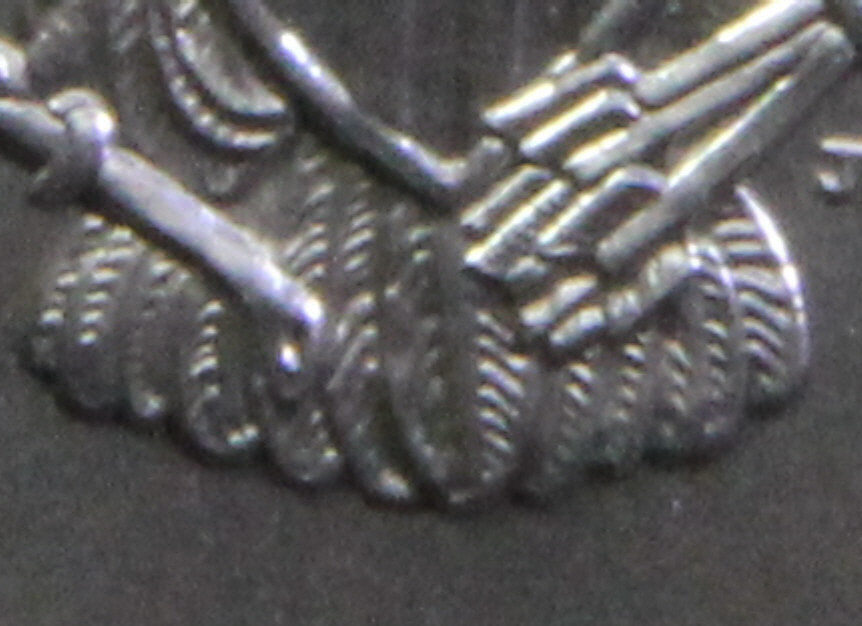 As a side note and point of information for all interested, I opened the set that had the lightest shipping weight (4.3 vs. 4.5 lbs) because I guessed that it was the one most likely to have suffered from damage during shipping. When opened, all coins were in their tightly closed capsules and all capsules were in their place in the display case. The coins in the set, from left to right were: UNC W, Proof W, RevP P, Bullion (S), and UNC S, and all were "standing straight up", unrotated. Also, I have not found anything under close examination that would even begin to cost any one of the coins a perfect 70 grade, and all show strong strike. From an aesthetic view, I am most pleased with the reverse proof, the new minting process (compared to the 2006 coin) was well thought out and the coin is fantastic. The devices are super reflective and the laser etch of the flat areas does its job well. I am most disappointed with the standard proof, as the laser etch of the devices comes at too high a price in terms of device detail for my tastes. I wish the mint would return to sandblasting the proof devices and giving us the double struck equivalent of an uncirculated coin with highly polished fields. |
|
Pillar of the Community
United States
7629 Posts |
Here's what I am saying regarding 'burnished' silver eagles:
On better than 50% of the examples I have seen from 2006 to present, there is no distinguishable difference by appearance alone between the burnished coins and the 'bullion' coins.
Clairhardesty - The image you posted of your silver eagle SUPPORTS the theory above. Yours has a small indentation on the end of the tail feather. This is what the reported difference shows on the coins that came from the A25 set. I personally do not subscribe to the theory as of yet, primarily because the difference is way too small, in my opinion, to matter to anyone. But also because I have not yet conducted any sort of 'study' to confirm or deny the theory myself.
|
|
Pillar of the Community
United States
1027 Posts |
Actually, my coin is closer to to the non-set bullion coins than it is to the ones with a pronounced "notch". I am not ready to believe that we are seeing anything other than normal variation as opposed to any sort of distinct variety. I still think that if you put all 39,968,500 2011 bullion coins in a row, you will not be able to separate out the 100,000 anniversary set coins with any reliability (of course that row would be a little over 1,000 miles long, but there you go). I also wish we could stop referring to the uncirculated coins as being "burnished". The coins are not burnished, the planchets were before being struck. The difference is that the uncirculated die are sandblasted and the bullion die are not. It is that sandblasting that accounts for the difference between the finishes on the coins. Burnishing only serves to reduce minor surface flaws and somewhat lengthen die life, important for the uncirculated die because of the higher strike forces used. Here are much better images, taken with my classic Canon FD 35-105mm, F3.5 lens stopped down to F22 and mounted backwards as a "poor man's macro", using a Canon T2i and a 1/10th second exposure using the built-in flash and two LED flashlights as fill. Several things can be deduced from these images, which were taken seconds apart under exactly the same conditions (the bullion coin is on top). The impact of strike force differences is evident, the uncirculated strike is much sharper. On both coins, the center rib of the central tail feather extends to the outer boundary line of the feather, no notch is present. The uncirculated coin appears darker, a result of the increased light scattering caused by the sandblasted die. Even though the actual surface details are still not clear at this magnification, the light that reaches the lens is clearly different and in line with theory. It looks like the die that produced these two coins were virtually identical before one was sandblasted, and that the primary difference in the finished coins is caused by strike force differences, with the surface treatment of the uncirculated die contributing fairly a minor, but distinguishable, impact on appearance 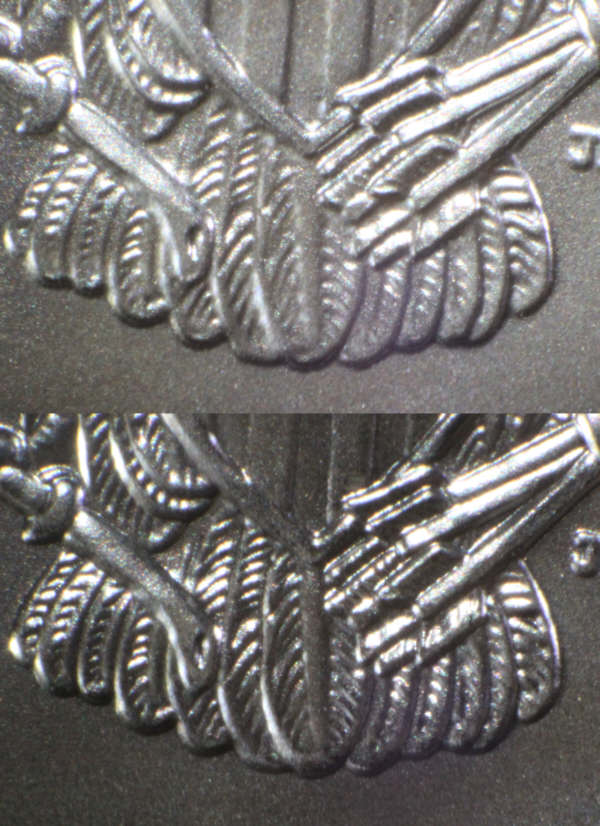 Edited by clairhardesty
01/01/2012 10:45 am
|
| |
Replies: 13 / Views: 2,345 |
|










 Posted 11/20/2011 08:54 am


