| Author |
 Replies: 10 / Views: 6,206 Replies: 10 / Views: 6,206 |
|
|
Pillar of the Community
Canada
617 Posts |
I've posted this question in the wrong section yesterday,so I'll try again..  Hi everyone: My dumb question of the day. Can anyone tell me at what point is a coin considered to have a "Heavy Cameo"? Is it a judgment call, comparing one coin to another sort of thing? Is it found on circulated coins or only non-circulating? I ask because I've seen people advertise say a 1964 silver dollar as a heavy or even ultra heavy cameo. |
|
|
|
Moderator
 Canada
10476 Posts |
The best thing to do is to look at known examples as analogies. Auction catalogues or even a search on ebay using the terms, cameo, heavy cameo and ultra heavy cameo (UHC). If you want to see what an ultra heavy cameo is, look at the 2003 Coronation Edition proof set (young Elizabeth effigy). Cameo effects can occur on specimen, prooflike and business strikes, up until about 1976 or so. They can have completely different contrast for coins struck in silver, nickel and bronze. If you want, I can probably send you some 1c and 5c PL reference coins for free with cameo and heavy cameo finishes (you would have to pay a bit for an UHC, but those are easy because they look like proof strikes). Here is a example of a 1966 prooflike cent, ultra heavy cameo. 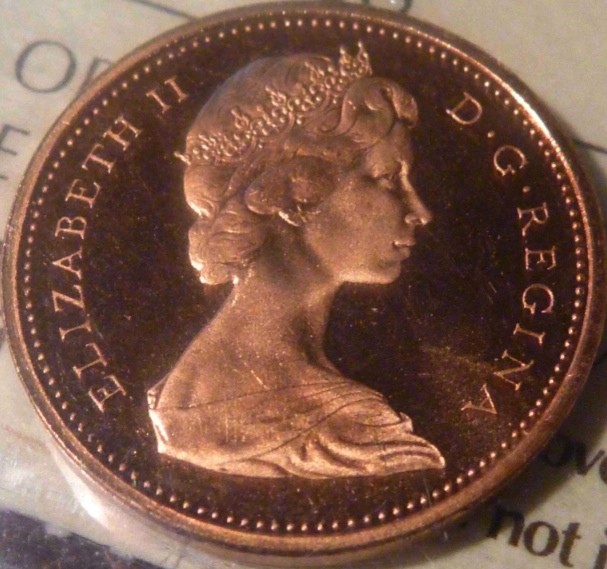 "Discovery follows discovery, each both raising and answering questions, each ending a long search, and each providing the new instruments for a new search." -- J. Robert OppenheimerContent of this post is licensed under a Creative Commons Attribution-NonCommercial 3.0 Unported License. See: http://creativecommons.org/licenses...0/deed.en_USMy eBay store
Edited by SPP-Ottawa
01/11/2012 8:46 pm
|
|
Pillar of the Community
Canada
1984 Posts |
|
|
Bedrock of the Community
Australia
21792 Posts |
How to tell if a proof coin has heavy cameo? The smooth surfaces in the design detail are coarser, such as on the cheek of H.M. the Q. The cameo effect on Royal Australian Mint proof products is far more obvious than than on British Royal Mint proof products, and I don't particularly like the Australian version of the cameo effect. Too much fine detail is lost. To achieve the cameo effect, the dies are either acid etched or sand blasted, before hardening them and polishing the fields. The British do not degrade the design detail nearly so much to attain the cameo effect. In some cases, too much 'ultra' is to the detriment of a good quality cameo proof product. The Cent shown here is much more akin to British standards. I like! Edited by sel_69l
01/12/2012 12:40 am
|
|
Pillar of the Community
Canada
1733 Posts |
Recall there were no specially designed proof presses here in Canada until they bought some in 72 (I think it was) to do the 76 Olympic coins. These were all produced on standard equipment with polished dies and planchets.
Edit: in other words, they were never made as proofs, not even the term proof like was used by the mint.
Edited by Ugly
01/12/2012 10:00 am
|
|
Moderator
Canada
10476 Posts |
North of 49, if you want a free reference set of late 1960s 1c and 5c business strike and proof-like coins in cameo and heavy cameo, send me a message.
"Discovery follows discovery, each both raising and answering questions, each ending a long search, and each providing the new instruments for a new search." -- J. Robert OppenheimerContent of this post is licensed under a Creative Commons Attribution-NonCommercial 3.0 Unported License. See: http://creativecommons.org/licenses...0/deed.en_USMy eBay store
|
|
Pillar of the Community
 Canada
617 Posts |
SPP:
thank you for the generous offer, but I wouldn't ask you to go to such trouble.I was really only trying to get a better understanding of the cameo effect ( wondering if I owned one or two with out knowing it). Thanks to your photo and the explanations from yourself and others here I think I have my answer.
Again thanks.
N
|
|
Pillar of the Community
Canada
695 Posts |
The best explanation I have seen is in the Charlton 2011 catalog. I recommend getting one - it's full of great info.
Ultra Heavy Cameo: Full frosting across the relief of the coin, both effigy and legend, when viewed from all directions under full lighting conditions.
Heavy Cameo: The frosting is neither full nor evenly applied across the relief of the coin. Some areas may appear bright when viewed under full lighting conditions.
Cameo: Touches of frosting may appear on the relief of the coin. There will be bright areas when the coin is viewed under full lighting conditions.
|
|
Pillar of the Community
 Canada
9903 Posts |
I think Charlton's should have added "from all directions" to the latter two cameo designations as well as the first.Cameos can only really be appreciated when you rotate them under the light.
|
|
Pillar of the Community
Canada
695 Posts |
DBM - I think the Charlton description is implying that only UHC has frosting in all directions when rotating the coin.
|
|
Valued Member
Canada
451 Posts |
DBM has a point. I find that the "Ultra" and "heavy" cameos don't really need to be turned to see it. It stands out on the coin when the coin is flat. Regular cameo or cameo I don't see unless I turn the coin a little
|
| |
Replies: 10 / Views: 6,206 |
|







 Posted 01/11/2012 10:37 pm





