| Author |
 Replies: 10 / Views: 1,202 Replies: 10 / Views: 1,202 |
|
|
New Member
United States
9 Posts |
I have been trying to educate myself on how to "read" a coin and assess its desirability/grade. One of the things that has been giving me a hard time is differentialting between a coin that shows lack of detail in its devices due to circulation wear as opposed to a weak strike.
I am focusing on Liberty 1/4 Eagles for now, and there are many coins I see graded by the Big Two at MS-60 or even MS-61 that have little to no detail on the eagle's claws, or neck and head feathers on the reverse, or the stars and hair bun on the obverse. If the lack of detail was due to circulation wear, I would, as a clueless neophyte, have graded some of these coins as low as XF-40. But I can only presume that the grading companies have identified that such lack of detail resulted from weak strikes (which I understand was prevalent at both Charlotte and Dahlonega, as well as early Philedelphia specimins).
But looking at magnified internet photos, I could not ascertain the difference between the XF-40 coin and the apparently weakly struck MS-60/61 coin, despite the sometimes vast difference in price.
Any insight from those of you who are wiser?
Cheers,
Mark Edited by mwhitmoe
01/20/2007 2:59 pm
|
|
|
|
Pillar of the Community
United States
7123 Posts |
On the Gold coins I think the most prominent visual difference would be the luster,, the luster on the high points of the coin will be broken if the coin has seen circulation or even moderate rub,, while the luster of an Unc coin will be full.
Metalman
|
|
Moderator
 United States
23522 Posts |
This is, unfortunately, a question which cannot be answered easily. Besides the luster issue which Metalman mentions, every single issue is different regarding strike quality. The only way to ever trust your ability to differentiate between wear and strike is to see enough examples of the specific coin in question to make an informed decision. In my own case, I consider myself only barely qualified to begin to make such distinctions, and only with Morgan dollars, and this is after about three years of concentrated effort to see every Morgan I could. That amounts to literally thousands of coins online (I look at hundreds of auctions a week), and about a thousand having actually passed through my hands for long enough to study, at one time or another. After all that, I'm beginning to get it. One of the unhappy truths about our hobby is that anyone can do it, but only those ready to invest significant time into learning can do it well. |
|
Pillar of the Community
United States
2254 Posts |
I agree that it will take a long time I think for me to understand and see a strong and/or weak strike. That being said, does anyone have a picture that can really show this well? If my memory serves me well, and after a lot of trying to learn from you folks on Morgans, the New Orleans mint is/was notorious for weak strikes? Can anyone post a side by side picture of a weak "o" next to a strong strike of same series? Not even same mint, just same type? Can you easily tell the difference? Sorry for all of the questions in one post, but this post really sparked my interest in more knowledge.
Thanks
|
|
Pillar of the Community
United States
7123 Posts |
I cant do side by side ,,because my pics were taken as singles, how about over and under ? Here are three O mint Morgans all with some degree of weakness, but from very weak to almost fully struck (Obverse only ) to seethe whole coin just click on the link in my sig line and check them out in my Dollar coins gallery. weakly struck MS 1888 O mint 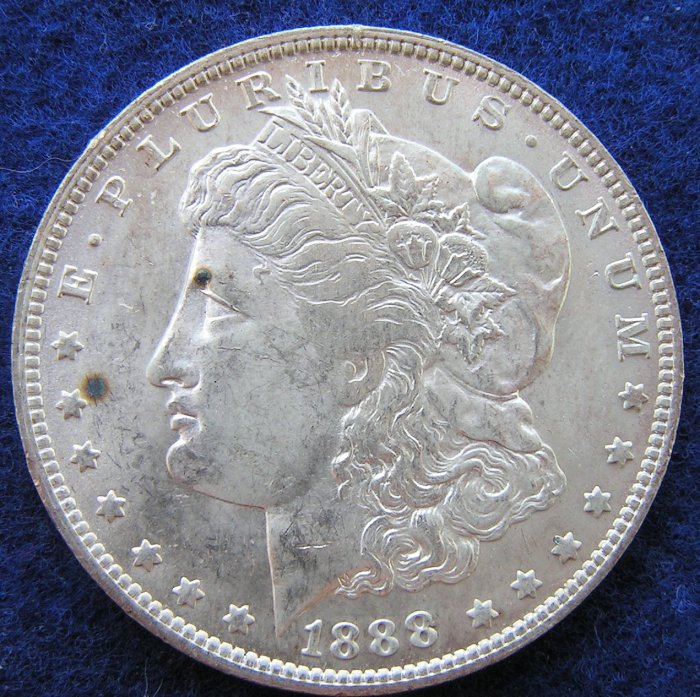 better strike but still weak in the hair details 1884-O  Much better strike practically full 1883-O 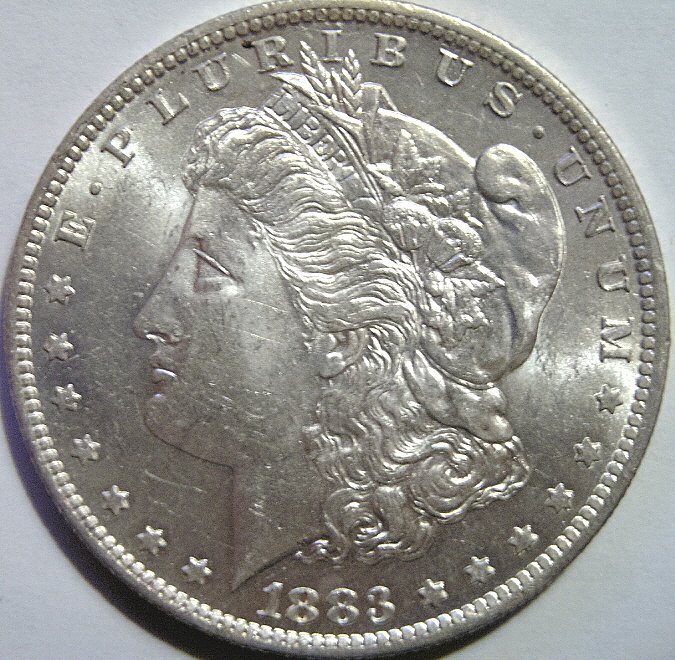 Hope these help !! Metalman Edited by Metalman
01/20/2007 5:33 pm
|
|
Pillar of the Community
United States
2254 Posts |
Metalman, thank you. Am I correct in assuming that the MS grades between the first and last are comparable, with the top one listed as "weak strike"? To my novice eyes, I would say the top one looks worn since there is no hair or ear detail.....Without stretching this post on forever due to my lack of knowledge, how do you tell that it's a weak strike MS coin on top and not just worn per say. Or is this hard to tell in hand and even harder through a pic anyway.
Unfortunately for me, this cleared it up and made it more confusing all at the same time unless I am just missing something.
|
|
Pillar of the Community
United States
7123 Posts |
Hi tigh The 88-O was in discussion here for some time,, I sent the pics in for evaluation since none of my coins are slabbed , to clarify if it was in fact mint state,, its also a probable VAM but they need the coin to verify that part,, it would be a common VAM anyway so I will not be sending it off. all of the coins are mint state,, technical numerical grade aside,, since each coin will have its own relivant only to itself qualities which provide that part of the senario. In my opinion they all grade very similarly,, of course opinions will vary on that aspect . all around 63's ,, except perhaps the 88 which may be closer to a 62. Metalman Edited by Metalman
01/20/2007 6:04 pm
|
|
Pillar of the Community
United States
2254 Posts |
Ohhhhh, so this is the infamous 88? I saw references to it numerous times and to be honest, I never went to your gallery to look at it. Shame on me. Sorry for semi making/asking you to post it again.
I really do appreciate the time you took to help educate me. Now I will just wait for Bryan and Superdave to come along and scold me for this picture post again of your 88....lololol
|
|
Pillar of the Community
United States
7123 Posts |
If anything they will tell me to be queit until I know more baout what I'm talking about ,, I'm a true newbie to Morgan dollars. Im still in pursuit of a fully struck O mint morgan,, If there is such a thing. Metalman |
|
New Member
 United States
9 Posts |
Metalman and Dave, thanks for your substantive, if sobering relies. If I only would have gotten into this hobby/obsession 20 years ago.
Metalman, I really appreciated your pics showing the different variations in strike quality among Morgans. Very illuminating. Do you suppose you could put a picture of a CIRCULATED Morgan with comparable detail to the 1888 right below the 1888 so I can see if there is a way I can discern between the two?
Thanks!
Mark
|
|
Pillar of the Community
United States
2283 Posts |
On most coins it's really pretty easy to tell wear from strike almost all the time but it is more difficult with gold. There are other things that can complicate it as well like dull luster.
Generally one should remember the wear starts at the high points and works down evenly in a plane across the surface which is normally parallel to the plane of the planchet. Tilt the coin back and forth between your eyes and the light to identify these high points. These will vary slightly from one coin to another because of slight differences in die alignment. Generally there is good luster on all these high points only if the coin is unc but poorly struck coins often exhibit poor luster on high points since these are the last area of the die to fill. If the metal doesn't fully fill such points then luster can be subdued on them.
Most coins have some high points that are fully filled and these become critical in the determination of whether it is mint state or not. If the luster on these is full then it's safe to grade it unc. Even slight impairment might warrant a downgrade especially on more modern coins.
Time don't fly, it bounds and leaps.
|
| |
Replies: 10 / Views: 1,202 |
|









 Posted 01/20/2007 2:27 pm


