







 First Page


 Posted 04/17/2012 02:16 am


Quote:
Nancy, are you using a stand or something? or is it hand held?
Neither. Nancy, are you using a stand or something? or is it hand held?

I know what you mean about the sensitivity, but I have found some tricks that virtually negate all that.
The small stand that comes with the scope is, in my opinion, pretty useless and I no longer use it. I have devised a number of alternate ways of getting the scope to the height needed above the coin, and for it to be stable.
I hope you're ready for this, as it's a very LOW tech solution and a case of necessity being the mother of invention.

Firstly, I removed the scope from the stand and took off the small C shaped clamp.
Before I started the following, I practiced on a couple old plastic tumblers, to get the feel of how it would work out.
I got a number of different height translucent white Tupperware (TW) containers, and carefully cut a hole in the centre of the bottoms with a Stanley knife to accommodate the black section of the front of the scope. Take care not to cut out too much, as it needs to be a snug fit, about 29-30mm is good. The black section of the scope needs to go approx 3 - 4 mm into the cut out. A good snug fit will mean little or no movement of the scope.
These TW items are my LOW Tech Light tents, and double as my scope stands, and I find them quite stable. I have 5 different heights, and can stack two or more to get extra height if needed, but this is only necessary if I'm imaging very large coins. Sometimes, if the coin is in a 2x2 or 1½ x 1½ holder, they are inclined to be unstable, as the cardboard sticks out a bit from under the TW containers, but a little bit of patience can overcome it.
There's nothing that says the containers have to be TW, just as long as they're white and will allow light through. I'm about to cut a hole in a larger tumbler, 12cm high, 7cm diameter bottom, 9cm diameter top, and it will be able to cover a whole 2x2, so the instability will be gone. I have to get my son to make the initial hole, as I'm not strong enough to get it started.
If the coin is in a 2x2 or 1½ x 1½ holder, you may need external light as the built in LED's cause too much reflection. Sometimes I get a reasonable image by tilting the TW container to get the reflection away from the area I want to capture, and this method can be used on a bare coin, as well as ones in 2x2s.
I NEVER use the button on the side of the scope to take the picture as it causes movement and is a pain in the butt.
With my Scope, there are 2 ways of getting close ups. Close ups that are about 16x magnification, and the other is about 66x magnification. (I'm not too sure about those magnification figures, maths leaves me cold these days. My scope is supposed to do 20 - 200 times, but somehow, I don't think it's that good).
When you've got the scope virtually right on top the coin, get the ‘regular' focus, see image #1 (below) with the focus dial on about 35, then wind the focus dial up to about 205, and you'll have a close up like image #2 (below), but because this is so great a magnification, it IS quite sensitive to movement, but still do-able, you do need a steady hand.
You will probably need to play around for a little while, but I'm sure in the end, you'll be happy with the results. I hope your scope settings are similar to mine, as otherwise my comments will make no sense to you at all.

Image #1 -1c 1960D Close-up of date directly on coin; Focus Dial on 35

Image #2 - 1c 1960D Close-up of date directly on coin; Focus Dial on 205
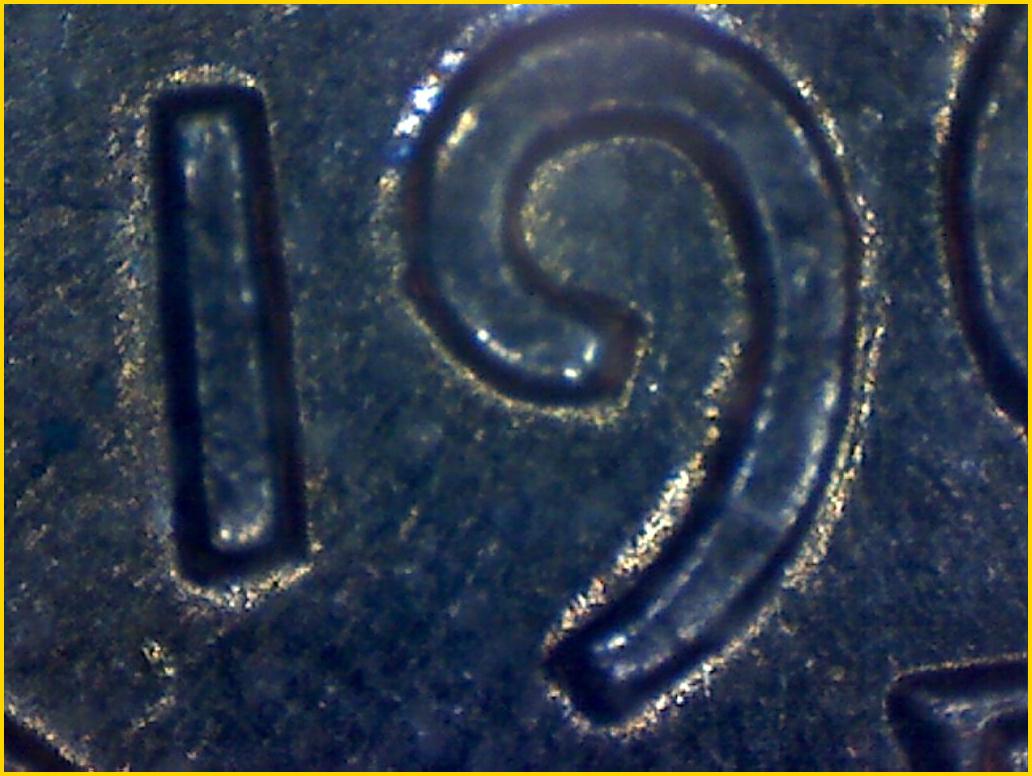
I did nothing to the images as far as size goes, I did reduce the quality, to get them under 100kb, but size wise, what you see is exactly what I got.
Good luck, let me know if this is any help to you, (or anyone else for that matter).
If you can refine the process and make it better, please let us know your tips.
life is a mystery to be lived not a problem to be solved

 .
.


