| Author |
 Replies: 10 / Views: 3,692 Replies: 10 / Views: 3,692 |
|
|
Valued Member
Australia
465 Posts |
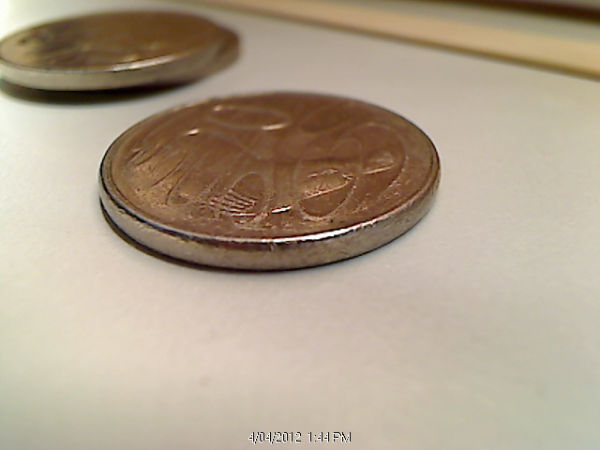 I am reading up on the coin making process right now! Not sure why I have not done this before! If there is no rim, then no collar, then this is a broadstrike, which makes the coin larger and thinner. This coin is slighter smaller, so not that. The edges seem to be deeper, but I cannot measure this. Any ideas?
|
|
|
|
Pillar of the Community
Australia
1295 Posts |
Three possibilities that I can think of. First, someone has polished off the edge graining. Second is that there was a lower than usual striking pressure. The edge graining is formed by the collar only if the striking pressure was high enough. Final possibility is that the blank was ever so slightly undersize and the edge graining was not formed because the coin didn't "spread" enough. Got some scales accurate to 0.1 of a gram? The mass would be interesting to know.
|
|
Formerly nancyc
Australia
5385 Posts |
If the edges are deeper, and the coin is smaller, another explanation may be that the coin has been stood on it's edge on a metal surface and tapped with a hammer, turned a tiny bit and tapped again, this is repeated numerous times until the edge is quite smooth. Years ago, this method was used with one & two shilling coins and when the edge was wide enough, the entire centre was drilled out, smoothed all around, and you were left with a silver ring, and if the person doing it was careful, the legend could still be read.  Just one more possibility.  life is a mystery to be lived not a problem to be solved
|
|
Pillar of the Community
Australia
1005 Posts |
I think this would also happen if it was rolled on its edge long enough.
I have a 5c somewhere which has a similar (but even more pronounced) effect.
My theory is that it was in some type of machine that rolled it until the edges were wider and the reeding was gone.
|
|
Bedrock of the Community
Australia
21792 Posts |
I used to see a great many 10 cent coins in particular, of this vintage, with barely discernable edge milling. That would make for a very common error or variety, depending how you look at it.
Just for fun, I have completely removed the milling with fine polishing, and put such a coin back into circulation.
The above explanations by markn and nancyc for weak or non existant milling seem perfectly reasonable to me.
|
|
Pillar of the Community
Australia
515 Posts |
Coins can get stuck in the rolling machines at say Armaguard and go round..and round...and round...and round. Or it went through the clothes dryer?
|
|
Pillar of the Community
Australia
1295 Posts |
That's a good suggestion Nancy!
|
|
Valued Member
 Australia
465 Posts |
I will get it weighed 2mrw, and get some close up pictures done of the rim.
I like your idea Nancy, although I would not like to see the woman that this coin would be adhered to!
|
|
Pillar of the Community
Australia
7096 Posts |
|
|
Valued Member
Australia
59 Posts |
I am new to this area so I might be seriously wrong. I have seen such coins many times (20c, 10c or 5c). I kept some then put them back to circulation when I realized that's quite common. I guess that was through the circulation. I will keep a eye on that and see can I find one as smooth as yours.
|
|
Valued Member
Australia
465 Posts |
I rarely see them with no ridges on the rim at all. This one stands out like a sore thumb!
The clothes drier concept I have trouble with, surely with the amount of time required to obtain the smooth rim somebody would have heard the clanging and gone to investigate. Possible though.
I don't know how rolling machines work so I have to add them to the list of things to learn about.
|
| |
Replies: 10 / Views: 3,692 |
|










 Posted 04/04/2012 12:49 am


