| Author |
 Replies: 10 / Views: 1,476 Replies: 10 / Views: 1,476 |
|
|
New Member
United States
1 Posts |
Hi, I received the following coin from a relative who purchased this from a dealer during a visit to Greece in the early 80's. I was told what they paid, however the amount seemed extremly excessive based on my very limited knowledge. I need help identifing exactly what this coin is. There is a fairly large pendent surrounding the coin, and there is an inscription on that as well. The pendent has a 14k small stamp on it as well as another marking that looks like 7x. It is added after the M on the right back side. I'd like to know as much as I can about the coin what the inscriptions mean and any input as to value. I do not know much more beyond just googling and looking at similar coins however I haven't come across one that is an exact match to this. Thank you all in advance for your help. 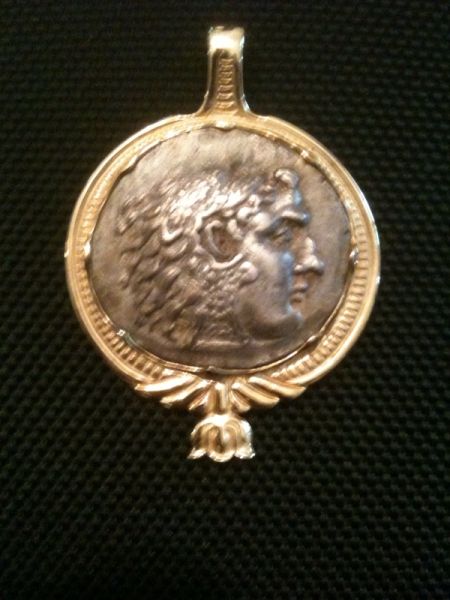 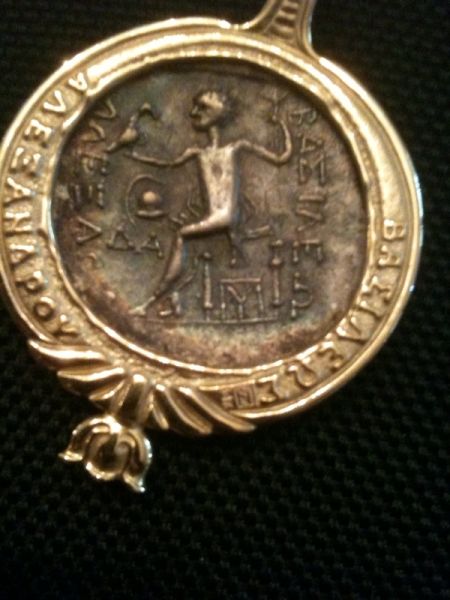 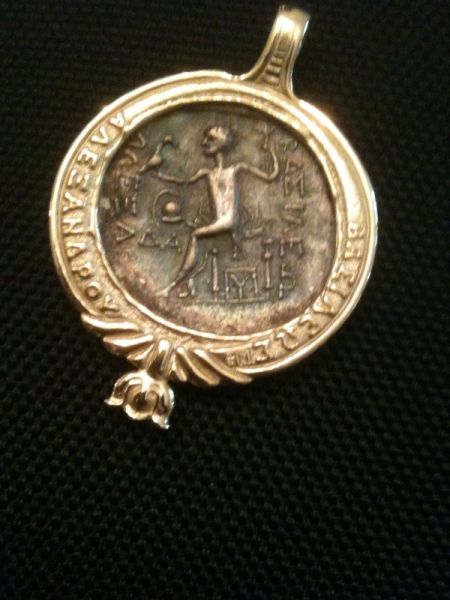 |
|
|
|
Bedrock of the Community
United States
10045 Posts |
 The coin resembles an Alexander the Great tetradrachm; the reverse says "King Alexander", as does the bezel. The portrait looks similar to coins minted in Odessos, but the style of the reverse is all wrong. I have never seen Zeus depicted as a stick figure without a beard; it looks like a copy for tourists. Someone here has observed it's easier to sell fake coins in Greece than the real thing. Sadly, I suspect that's the case with this coin. That's just my opinion, and perhaps others will give theirs. Here's an Odessos coin with a pretty rough depiction of Zeus, but he still has his facial hair.  |
|
Moderator
 United States
23731 Posts |
to the community. These type of coins are not really in my area of collecting, but I have seen a number of them over the years to have a general idea what is good or not. While the obverse of you coin has the classical looks and appears to be correct. The reverse appears wrong, there doesn't seem to be the attention to detail that is seen on this coin type. The figure of Zeus seated looks like a stick figure something that wouldn't be seen on this coin type. IMO this is a piece of coin jewelry made up to resemble a coin of Alexander the Great. DVC is our resident expert on Greek coins, hopefully he will be along soon and be able to tell you for sure. |
|
Moderator
United States
23731 Posts |
DVC you most type faster than me.  |
|
Bedrock of the Community
United States
10045 Posts |
I was trying to live up to being the "resident expert on Greek coins"--although we share the same sentiments on this one.  I spent some time looking for a match on the fake databases, but as there are hundreds of fakes of Alexander tetradrachms, that takes time. If I find a match I'll post it--but I think we can agree this one doesn't look very good. |
|
Pillar of the Community
United States
1549 Posts |
When a coin is mounted in jewelry it stops being a coin and starts being jewelry. Jewelry prices, whether fair or inflated, depend on the jeweler and have little to do with the pieces used. If real the coin is a late copy of something like the 2nd century BC (perhaps even later?). I can not say whether the coin is real or fake but either way it is ruined as a coin and now a bauble.
|
|
Valued Member
United States
422 Posts |
Bummer! How many of these type of fakes have we seen on this forum? Lots!
DVC ... are these type of coins cast or are they stamped, as it looks like they are cast to me? (both real and fakes I mean.) They seem to have a smoother look to the lettering and symbols, unlike some latter Roman coins that have sharp details. Thanks.
|
|
Bedrock of the Community
United States
10045 Posts |
Oxos, the real coins are always struck with dies--I'm unsure about this one. But, I know where you're coming from--the smooth stick figure looks like a modern attempt with modern tools.  I'm just going by "educated guesses"; I'm hardly the expert on these coins. Doug raises some good issues! |
|
Valued Member
United States
422 Posts |
I thought that was the case, but really don't have much knowledge on these older Greek coins. I can't remember the thread now, but it seems to me there was a coin that had been cast (might have been Doug that pointed it out) because you could actually see the entry point along the edge of the coin. Good stuff to know when making purchases of these type of coins, which seem to have a higher fraud rate than most. Thanks DVC.
|
|
Bedrock of the Community
United States
10045 Posts |
Quote:
...you could actually see the entry point along the edge of the coin. I remember that one--the casting sprue was still attached to the "coin"--it was a tourist curio with the Parthenon on one side and Athena on the other. |
|
Rest in Peace
United States
9104 Posts |
Considering the laws against exporting hysterical items, it makes the most sense that it's a replica in jewelry.
|
| |
Replies: 10 / Views: 1,476 |
|










 Posted 05/05/2012 12:54 pm


