| Author |
 Replies: 7 / Views: 6,259 Replies: 7 / Views: 6,259 |
|
|
Pillar of the Community
United States
1796 Posts |
Well, today in my roll searching I came across this specimen:  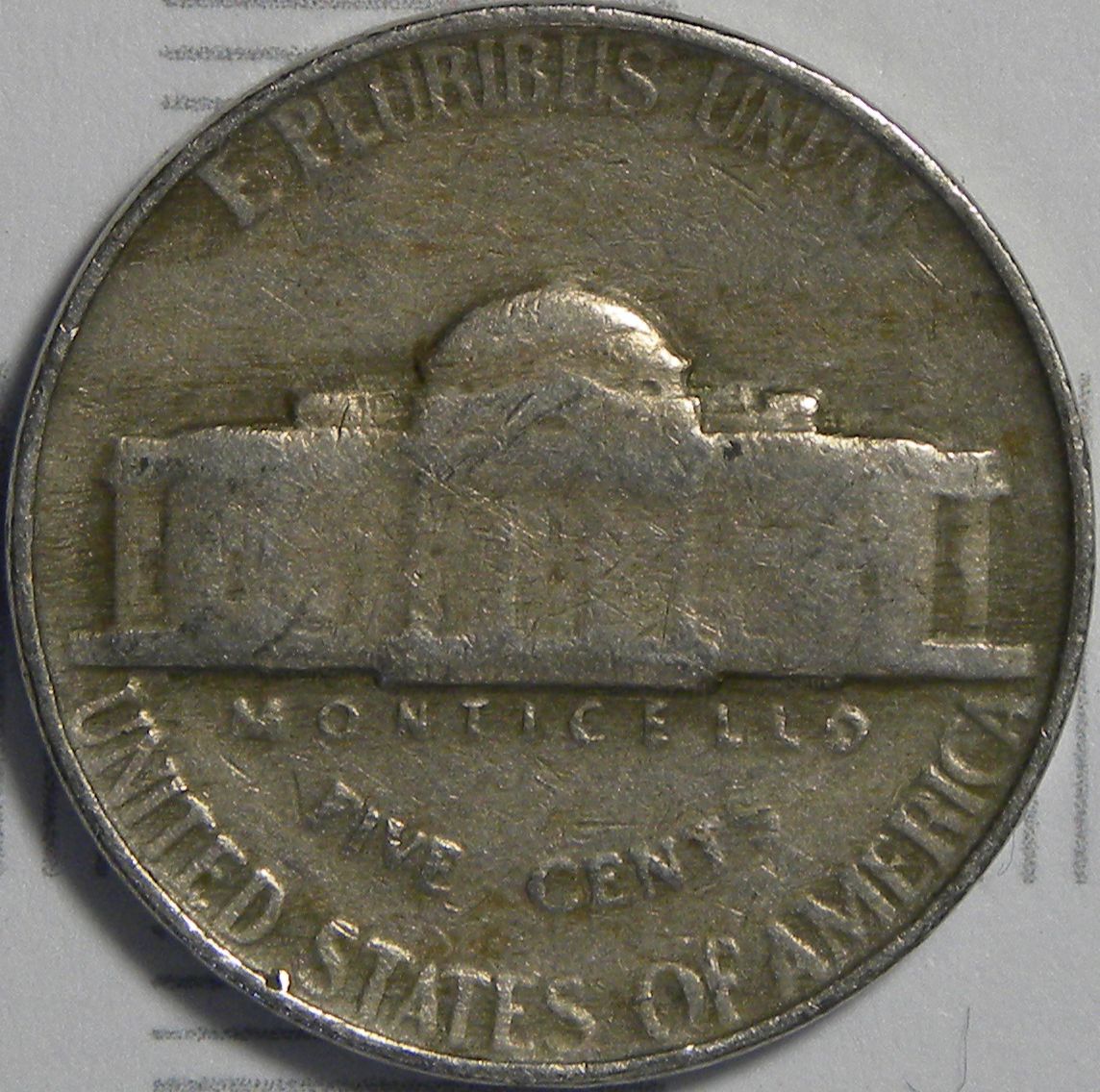 Where it is not a Henning Nickel, I am becoming very convinced that it is a contemporary counterfeit. Despite the level of apparent wear and complete lack of details, it weighs in at just over 5 grams. I would have expected 4.78-4.90 grams at that grade. Magnetic and diamagnetic reactions are normal, but they tend to be weak as it is on anything smaller than a quarter. However, it does not ring at all when flipped ("dinks" worse than a zlincoln; no resonance). Finally, on the obverse (especially around "IN" and by Jefferson's ponytail) there's a distinct graininess, generally characteristic of counterfeiting. Under the microscope confirms that they are raised, not incised from PMD or in any shape or pattern that one would normally expect from acid damage. They also appear on the border between the fields and the devices around other portions of lettering, where the outline of the letters becomes a bit jagged. While I'm not quite convinced enough to pass full judgement yet, and since I have no other examples to compare it to, I thought it best to solicit opinions. Whacha think? Any other examples out there of something similar? |
|
|
|
Pillar of the Community
United States
1195 Posts |
Noob-ish question, why would someone want to counterfeit a 1954 (p) nickel in that apparent g4 grade?  |
|
Pillar of the Community
 United States
1796 Posts |
@argentum - Not at all. :-) In the 1950s, a nickel was worth roughly a half dollar in modern money, so counterfeiting -- provided it was done in large volume -- would be profitable. It was in 1954 (the now famous) Francis LeRoy Henning counterfeited nickels dated 1939, 1946, 1947, and 1953 with a "no one expects the Spanish Inquisition fake nickels" mentality. Well, for a while it actually worked... until the Secret Service did stop and look when he struck a 1944 nickel without it's proper P mint mark. He tried to dump his inventory in a river or two and got caught. The rest is history. :-) In another thread, one of Henning's was recently found in circulation. https://goccf.com/t/118960Given the date on this one, and the date of Henning's crime, I don't think it's far-fetched that others were inspired by his story. This one certainly isn't one of his. Edited by SteveCaruso
05/14/2012 02:50 am
|
|
Rest in Peace
United States
1943 Posts |
I keep nickels 1958 on back and put them into solid date rolls to check for Hennings. Your coin is very common for 1954 and 1955. You can also find them in 1952 and 1953. The dies were used into a very late die state giving the mushiness to the details. Since the wear is on the die and not on the coin the weight is still normal.
|
|
Bedrock of the Community
United States
10284 Posts |
Quote:
Noob-ish question, why would someone want to counterfeit a 1954 (p) nickel in that apparent g4 grade? I am sorry, but for the family atmosphere we enjoy, I felt I should say this ... I think this is a rude response. In this forum, there are no stupid, silly or noobish questions. If you think something is, it is probably better left without a comment, than to be sarcastic. I can see where this nickel could be questioned because of the mushy details and "fat" lettering. If pyrbob didn't list the 1953 as one of the dates, I would have had to go look which of the 1950's obverses Henning used as I can never remember all 5. There is possibly more than 5 but so far, I think only 5 different counterfeit dates are attributed to Henning.If I remember correctly, I saw a 1943 no mint mark at a coin show that is owned by pyrbob in person. He felt it was not made by Henning but there you go, any coin could be a counterfeit. |
|
Pillar of the Community
United States
593 Posts |
It seemed to me that argentum was indicating his own lack of knowledge about counterfeit nickles. I didn't know about fake nickels either and I'm glad he asked the question. This is quite interesting. And by him saying that he was asking a "noob-ish" question, the responder correctly provided sufficient historical background to educate us both. I appreciated the question and the answer. Now, if someone had belittled him by calling his question "noob-ish", then I would agree with you.
|
|
Pillar of the Community
United States
1796 Posts |
@pyrbob - Thanks for chiming in. :-) Alright, so if VLDS is common in those years then my only unaccounted for curiosity is the graininess (as the resonance could be a simple patina issue). Do you have any examples with grains in those two places in your collection?
|
|
Rest in Peace
United States
1943 Posts |
Steve, good question. I'll pull some nickels out this week and check. But the Henning nickels had the graininess all over the nickel and not just at a couple little spots so I am still leaning to die wear.
|
| |
Replies: 7 / Views: 6,259 |
|










 Posted 05/14/2012 02:47 am


