We've got an Ancients subforum, but we don't have a Mediaeval subforum, which the Crusader period more properly belongs in.
For starters, you need to consider mediaeval coinage as as whole. In general, there's very little gold, and very little base-metal; your typical "crusader coin" is going to be silver. The silver denominations you're most likely to encounter are the denier and the somewhat larger and heavier gros and half-gros. These coins are typically fairly small (about dime to quarter-sized) and rather crudely made; they are, after all, called the "Dark Ages" because they lacked the artistic sophistication of either the Ancient or Modern ages. So collectors of either modern or ancient coinages often feel they're not getting "value for money" when it comes to buying mediaevals.
As for the kinds of "Crusader coins" you can get, that's quite a varied basket. Dealers looking for the sales angle tend to hype up almost any coin dating from 1100-1400 as "Crusader", even if the country or ruler in question had nothing actually to do with the crusades. But in truth, the "Crusader coinage" should be limited to coins issued by nation-states that were either founded by or heavily supported by the Crusaders on their various sallies into the Eastern Mediterranean.
Pre-eminent of these states is no doubt the Kingdom of Jerusalem, the city upon which the crusades were mostly fought over. Kingdom of Jerusalem coins are fairly cheap, but not particularly eye-appealing. It should also be noted that the "Kingdom of Jerusalem" continued in name for over a century after Jerusalem itself was recaptured by the Muslims.
Some of the other crusader states produced coinages that are just as, if not more, interesting than those of the kingdom. Most appealing to my mind are the coins of the Principality of Antioch, whose coins frequently feature a portrait of the prince, decked out in full mediaeval armour and helmet:
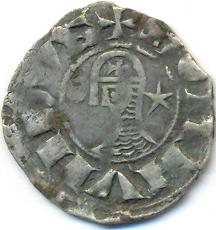
The Crusaders were occasionally side-tracked from their main goal to capture more... lucrative... targets. "Crusader states" were established in Greece and Cyprus, and after the capture of Constantinople in 1204, the "Latin Empire" struck crude imitations of Byzantine coin designs; these are usually considered an integral part of the Crusader series as well.
The Kingdom of Armenia, also known as "Cilician Armenia" or "Lesser Armenia", was a nearby state that had close relations with the Crusader states surrounding it; they are usually included in the Crusader series, though their coins are more "native" than "Latin" in appearance.
Then of course, there are the coins of the Crusaders' enemies: the various Islamic dynasties that vied for power against each other as much as the Crusaders. Though not in themselves "Crusader", they are often included in a "balanced" collection of the time period.
As for a source,
FORVM has a mediaeval/Crusader section, though it's not as busy as their Ancients sections. I've also bought mediaevals from
Civitas Galleries, though they don't have any Crusader States up at the moment.
Don't say "infinitely" when you mean "very"; otherwise, you'll have no word left when you want to talk about something really infinite. - C. S. Lewis










 Guys since I know nada about coins during the crusades I was hoping you could help me.


 Posted 05/18/2012 9:57 pm


