To answer your questions in order:
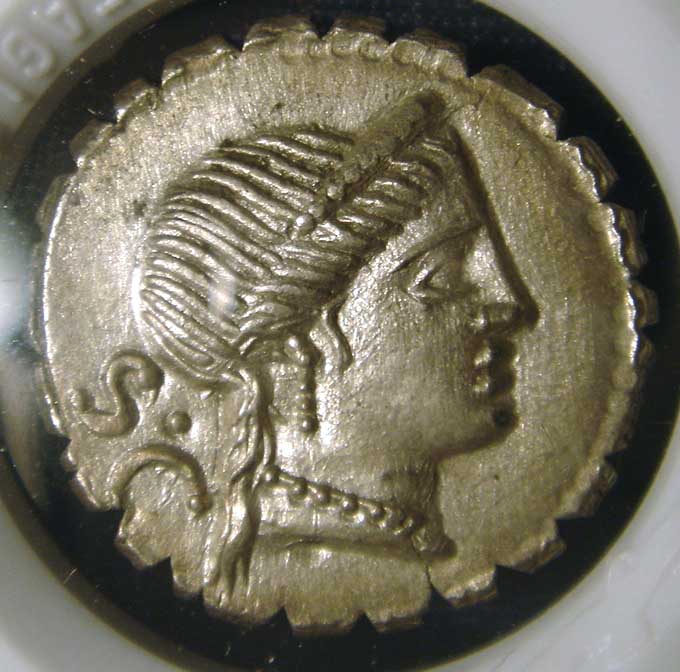
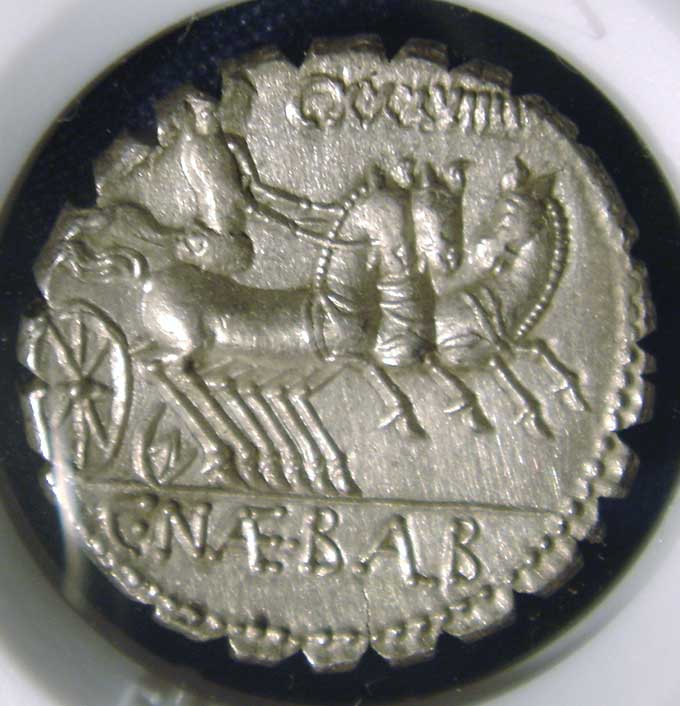
1. We don't really know why certain Republican denarii , or for that matter any of the other ancient "serrated series" coins, were produced. Some have suggested it was to prove the purity of the metal, making the serrations "official test cuts". Given the number of contemporary counterfeit serrated denarii that have been found, it seems to have been unsuccessful in this regard.
Others have suggested it functioned as a security device to prevent clipping - sort of a primitive reeded edge. Given it's primitive state, though, it probably wouldn't have been too hard for a silver thief to clip a denarius and then apply authentic-looking serrations of his own.
We do know that after the original series of serrati were produced (circa 118 BC), certain Germanic tribes preferred that any payments from the Romans were to be made in these coins. It is presumed that the canny Germans were aware that the serrated coins were older, and thus of finer silver. Perhaps the later series of serrated coins like this one were intended to circulate in the northern frontier areas, issued with serrations to fool the locals into thinking these were older coins. But given that the coins are found throughout the Roman world, this seems unlikely.
2. This particular type is number 309 in the Sear catalogue (millennium edition). Sear has a comment about this type, that there was a substantial increase in output of the Roman mint at about the time this coin was issued (79 BC), to pay for Sulla's military campaigns. It would appear to be one of the commonest types of Republican denarii.
3. In general, yes, grade does make a difference in value. The Sear ME catalogue was the first Sear book to come out with values at two different grades; earlier editions just gave "a value", and you had to guess what sort of discount or premium to apply due to grade. The CV of your coin, for example, is listed at £45 in VF, £140 in EF. Generally, EF seems to be around 2.5 to 3 times the VF price.
Finally: whatever your coin has, it won't have lustre in the conventional sense. There's no way a silver coin can be struck, circulated, buried for some 2000 years, dug up, cleaned, and still have "original mint lustre".
Don't say "infinitely" when you mean "very"; otherwise, you'll have no word left when you want to talk about something really infinite. - C. S. Lewis












 Posted 02/23/2007 3:53 pm


