Here's another commemorative silver dollar from the
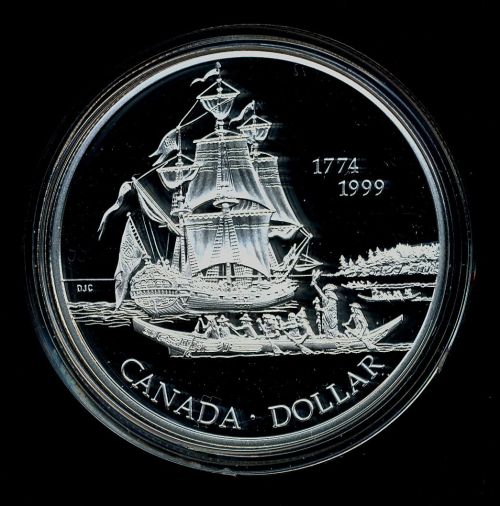
RCM that is historically meaningful and a wonderful example of the engraver's art -- the 1999 Voyages of Juan Perez and Sighting of the Queen Charlotte Islands coin.
Spanish ships had explored the coast of North America in the early 1600s and had claimed the land in the name of Spain. In the years that followed, however, Spain did not attempt to settle or colonize its newly claimed territory. In the 1770s, when Spain learned that the Russians were setting up fur trading posts in Alaska, Spain organized a sailing expedition to assess Russia's activities and further assert its claims.
The first Spanish expedition was lead by Juan Perez who was the commander of the ship Santiago. In 1774, he set sail from the Pacific coast of New Spain (present-day Mexico) for Alaska. Perez did not reach his intended destination, however, sailing only as far north as the present-day Queen Charlotte Islands/Haida Gwaii. Perez did not set foot on any of the islands, but did trade with the Haida people when they came to meet the Spanish ship in their canoes; the scene is depicted on the silver dollar.
Canada's 1999 commemorative silver dollar marked this event with a coin that is a wonderful example of what is possible by talented artists on the small, round "canvas" of a coin. Have a look at the detail in the Santiago and the Haida's canoe in the foreground, it is outstanding!
The coin is 36.07 mm in diameter and weighs 25.175 g. Its composition is sterling silver (92.5% silver, 7.5% copper). The coin was struck in brilliant uncirculated and proof.
Who else has a Juan Perez silver dollar?










 Posted 06/26/2012 09:26 am