Coin Community Family of Web Sites Join Thousands of Coin, Bullion, & Money Collectors
Shop for APMEX Bullion on eBay!Royal Canadian Mint products, Canadian, Polish, American, and world coins and banknotes. Join Thousands of Coin, Bullion, & Money Collectors 300,000 items to help build your collection! Vancouvers #1 Coin and Paper Money Dealer Coin, Banknote and Medal Collectors's Online Mall Specializing in Modern Numismatics


Username:
Password:
Save Password
Forgot your Password?


This page may contain links that result in small commissions to keep this free site up and running.

Welcome Guest! Registering and/or logging in will remove the anchor (bottom) ads. It's Free!

Understanding The Sheldon Grading System

To participate in the forum you must log in or register.
Author Previous TopicReplies: 46 / Views: 13,564Next Topic
Page: of 4
Pillar of the Community
trout1105's Avatar
Australia
7096 Posts
 Posted 07/14/2012  10:12 pm Show Profile   Bookmark this topic Add trout1105 to your friends list Get a Link to this Message Number of Subscribers
I lifted this info from the net.
It is great for us old farts to help us get our head around the Sheldon grades in comparison to what we are used to.
I still grade my own coins "old school" but it is handy to be able to understand the new fangled system when buying coins

Poor-1 or P-1 (Poor) - The type is barely discernable, but little else, due to the coin being badly damaged or worn smooth.

Fair-2 or FR-2 (Fair) - Type and date are barely discernable, but otherwise the coin is damaged or extremely worn.

AG-3 (About Good) - Type and date are discernable, although some spots may be worn out. Some lettering should be apparent, if not necessarily readable.

G-4 (Good) - Major devices and features are evident as outlines. although the coin overall is heavily worn.

G-6 (Good-plus) - Coin has a full rim plus major devices and features are clearly outlined. Heavy wear.

VG-8 (Very Good) - Full rim with clearly discernable devices and features. Most legends are readable clearly, but the whole coin is still significantly worn.

F-12 (Fine) - Distinct rim, all legends readable, clear devices showing some detail, but the whole coin is moderately, but evenly worn.

VF-20 (Very Fine) - Clearly readable but lightly worn legends, devices show good detail, rims are clean, but the whole coin shows moderate wear on the high points and a little wear below.

VF-30 (Good Very Fine) - Legends are clear, devices show all detail with little wear; high points are lightly worn.

EF-40 (Extremely Fine) - Legends are sharp, devices are clear with slight but obvious wear on the high points.

XF-45 (Choice Extremely Fine) - Legends and devices are clear and sharp, with slight wear on the high points, and great eye appeal.

AU-50 (About Uncirculated) - Sharp legends and devices show only a trace of wear on the highest points. There must be some remaining mint luster.

AU-55 (Good About Uncirculated) - Sharp legends and devices show only a hint of wear on the high points. Remaining mint luster must be at least half; great eye appeal.

AU-58 (Choice About Uncirculated) - Virtually uncirculated, except for minor wear marks on high points. Nearly all mint luster must be present, and must have outstanding eye appeal.

MS-60 (Mint State Basal) - Coins in this grade are ugly, dinged-up, bag-marked, ill-toned specimens, but they are in mint condition and free of any wear!
The grades from MS-60 to MS-70, as well as the Proof designations, are all based primarily on eye appeal, quality of luster and/or toning, and the presence or absence of contact marks, hairlines, etc. All coins MS-60 and higher are Mint State coins. It is worth noting that Proof is not a grade, but a type of coin.


Pillar of the Community
Australia
841 Posts
 Posted 07/14/2012  11:06 pm  Show Profile   Bookmark this reply Add Ausjack to your friends list Get a Link to this Reply
here we go again

But serious..thanks trout I really needed that as I was wondering how it worked but had too many other things to worry about graded coins, but soon mate
Pillar of the Community
trout1105's Avatar
Australia
7096 Posts
 Posted 07/14/2012  11:11 pm  Show Profile   Bookmark this reply Add trout1105 to your friends list Get a Link to this Reply

Quote:
here we go again

Be nice AJ.
This is for information only and not for debate.
Like it or not its here to stay so we might as well learn how to use it and understand it.
Pillar of the Community
Australia
841 Posts
 Posted 07/14/2012  11:32 pm  Show Profile   Bookmark this reply Add Ausjack to your friends list Get a Link to this Reply
trout1105 Posted - Today :16 Min ago
--------------------------------------------------------------------------------


Be nice AJ.
This is for information only and not for debate.
Like it or not its here to stay so we might as well learn how to use it and understand it.

You know me mate..always nice so what's the bet that this ends up in some sort of debate I'll sit this one out

, looks like it's here. So I hope they make a sticky out of this so it's easy to find very hand and thanks again cobba..done well
Moderator
Learn More...
Sap's Avatar
Australia
16808 Posts
 Posted 07/15/2012  01:36 am  Show Profile   Bookmark this reply Add Sap to your friends list Get a Link to this Reply
Personally, I learned the "Sheldon scale" back in 1983, when I lived in Canada for six months; the Sheldon system was only just being imposed onto Canadian coins and the 1983 Charlton catalogue went to considerable lengths to explain the system to a countryful of collectors that had never used it up until then. Unfortunately, the system I learned back then was slightly different to the one the American TPGs use these days; it seems to have been closer to the original scale as deigned by Sheldon. For example, my system begins with "BS-1" (Basal State) with "P-2" (Poor) next. I also added some novel improvisations of my own to the system after I came back home, in my attempts to graft what I'd learned of the Sheldon system to the Australian grading standard. For example, I jump straight from G-4 to VG-8 and from F-12 to VF-20, then have four levels within VF (20, 25, 30, 35). So my "VF-20" is probably everyone else's "good Fine".

The definitions given above are the commonly agreed-upon convention for the modern TPGs.

And trout: you should always provide your sources, although this particular set of definitions has been posted multiple times on the Net.
Don't say "infinitely" when you mean "very"; otherwise, you'll have no word left when you want to talk about something really infinite. - C. S. Lewis
Pillar of the Community
trout1105's Avatar
Australia
7096 Posts
 Posted 07/15/2012  02:26 am  Show Profile   Bookmark this reply Add trout1105 to your friends list Get a Link to this Reply
Sorry Sap, will do next time Mate
Pillar of the Community
Pertinax's Avatar
United Kingdom
2133 Posts
 Posted 07/15/2012  05:51 am  Show Profile   Bookmark this reply Add Pertinax to your friends list Get a Link to this Reply
I find the Sheldon scale puzzling.

Apart from trout's comparison above, is there a published comparison between British grades and Sheldon grades ?

I read on http://en.wikipedia.org/wiki/Coin_grading that the scale was intended to be a reflection of the relative value of a 1794 Large Cent, which was then worth $1 in Basal State and $70 in Uncirculated MS-70.

Is it still the case that there is this relationship; that is that an EF-40 is worth one third more than VF 30 ?

In my experience EF coins are worth more than that one third premium
Moderator
Learn More...
Sap's Avatar
Australia
16808 Posts
 Posted 07/15/2012  10:38 am  Show Profile   Bookmark this reply Add Sap to your friends list Get a Link to this Reply

Quote:
Is it still the case that there is this relationship; that is that an EF-40 is worth one third more than VF 30 ?

No. As far as it's original purpose was concerned (a simple correlation between condition and relative value), the Sheldon Scale quickly became obsolete.

As for grade conversion, a simple rule of thumb is to subtract three or four grade levels to get the British grade, subtract one or two grade levels to get the Australian grade.

Thus, an AU-50 would grade an Australian EF and a British VF.
Don't say "infinitely" when you mean "very"; otherwise, you'll have no word left when you want to talk about something really infinite. - C. S. Lewis
Valued Member
ammarabdulfattah's Avatar
Egypt
139 Posts
 Posted 07/15/2012  11:51 am  Show Profile   Bookmark this reply Add ammarabdulfattah to your friends list Get a Link to this Reply
Thanks Trout, this really helps :)
Pillar of the Community
Pertinax's Avatar
United Kingdom
2133 Posts
 Posted 07/15/2012  12:13 pm  Show Profile   Bookmark this reply Add Pertinax to your friends list Get a Link to this Reply
Have I understood you correctly, Sap ?

Are you saying that a British VF = an Australian EF = AU-50 ?

I thought AU meant about uncirculated.
Pillar of the Community
United Kingdom
575 Posts
 Posted 07/15/2012  1:43 pm  Show Profile   Bookmark this reply Add valdiman to your friends list Get a Link to this Reply

Quote:
Are you saying that a British VF = an Australian EF = AU-50 ?

http://www.ngccoin.com/world/intern...g-scales.asp

UK VF is more like XF 40-AU 53 Sheldon.
Pillar of the Community
trout1105's Avatar
Australia
7096 Posts
 Posted 07/15/2012  3:21 pm  Show Profile   Bookmark this reply Add trout1105 to your friends list Get a Link to this Reply
When I am looking at buying something with a Sheldon grade I totally ignore the letter prefix (egVF,EF,AU)and look more at the number, The higher the number the better the grade.
If I have to try and grade a coin with this system I write down the qualities of the coin eg wear,damage,lustre etc then look at the descriptions on that list and try and place the coin within the number scores.
I totally ignore my instincts to instantly give it a grade old school.
I find this time consuming and fiddly but after a while if I keep plugging away at it I will master it.
With the increasing number of coins coming onto the market graded with the Sheldon system I feel it is very important to be able to understand how the coins are graded.
That way I will know for certain what quality of coin to expect for the grade given.
Pillar of the Community
DavidUK's Avatar
United Kingdom
2624 Posts
 Posted 07/15/2012  3:47 pm  Show Profile   Bookmark this reply Add DavidUK to your friends list Get a Link to this Reply
Wow... this is too confusing... I think the Sheldon scale makes sense and everyone should just use that... but I am British and used to the British scale so no wonder in threads I must have seemed a tad harsh on grading.
Pillar of the Community
SteveCaruso's Avatar
United States
1796 Posts
 Posted 07/15/2012  3:59 pm  Show Profile   Bookmark this reply Add SteveCaruso to your friends list Get a Link to this Reply
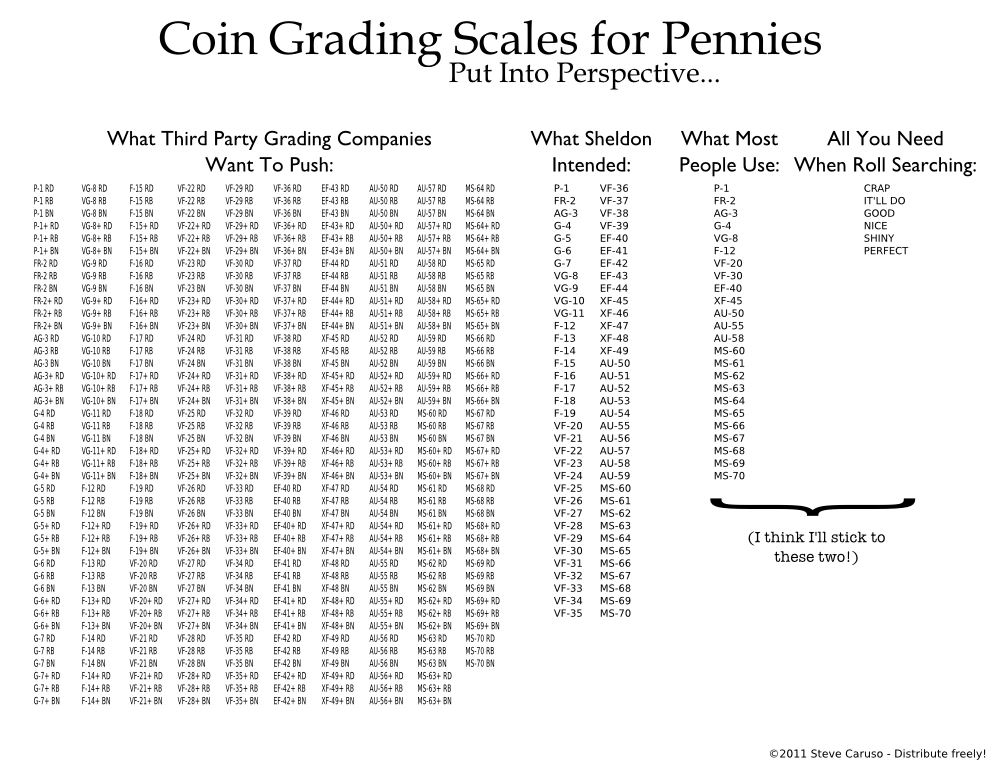
Now where is that info graphic I made up a while back that shows how we Americans muddle things up.... Ah yes!

Understanding-The-Sheldon-Grading-System
Edited by SteveCaruso
07/15/2012 4:00 pm
Pillar of the Community
trout1105's Avatar
Australia
7096 Posts
 Posted 07/15/2012  4:10 pm  Show Profile   Bookmark this reply Add trout1105 to your friends list Get a Link to this Reply

Quote:
Wow... this is too confusing... I think the Sheldon scale makes sense and everyone should just use that... but I am British and used to the British scale so no wonder in threads I must have seemed a tad harsh on grading.


Tell me about it, the UK grading system is more stringent than the Aussie system and the Aussie system is more stringent than the Sheldon system.
I think we are both guilty of being tough on grades


Quote:
Now where is that info graphic I made up a while back that shows how we Americans muddle things up.... Ah yes

I quite like the list on the far right Steve
Moderator
Learn More...
Sap's Avatar
Australia
16808 Posts
 Posted 07/15/2012  6:46 pm  Show Profile   Bookmark this reply Add Sap to your friends list Get a Link to this Reply

Quote:
Have I understood you correctly, Sap ?

Are you saying that a British VF = an Australian EF = AU-50 ?

More or less, yes. Though there are some variations within the systems. For example, British and Australian standards tend to see large bagmarks, scratches and edge knocks as simply factors to consider in reducing the grade; the American TPGs will tend to call such a coin "damaged" and refuse to assign a proper grade to it.

Quote:
I thought AU meant about uncirculated.

It does. The problem is, American, Australian and British collectors use those words to mean different things. The cause, as I've posted elsewhere on the forum when the topic came up last time, is that America has seen worse "gradeflation" than elsewhere.
Don't say "infinitely" when you mean "very"; otherwise, you'll have no word left when you want to talk about something really infinite. - C. S. Lewis
  Previous TopicReplies: 46 / Views: 13,564Next Topic
Page: of 4

To participate in the forum you must log in or register.


Disclaimer: While a tremendous amount of effort goes into ensuring the accuracy of the information contained in this site, Coin Community assumes no liability for errors. Copyright 2005 - 2026 Coin Community Family- all rights reserved worldwide. Use of any images or content on this website without prior written permission of Coin Community or the original lender is strictly prohibited.
Contact Us  |  Advertise Here  |  Privacy Policy / Terms of Use

Coin Community Forum © 2005 - 2026 Coin Community Forums
It took 0.38 seconds to rattle this change. Forums