| Author |
 Replies: 11 / Views: 5,648 Replies: 11 / Views: 5,648 |
|
|
New Member
United Kingdom
3 Posts |
Can someone tell me if this is genuine ? Not magnetic. Thanks! 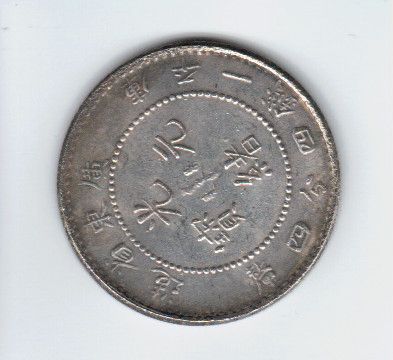 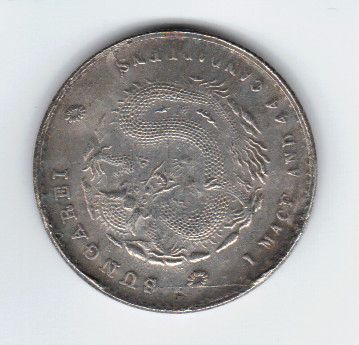 |
|
|
|
Pillar of the Community
United Kingdom
2145 Posts |
What's the weight in grams and the diameter, please ?
|
|
New Member
 United Kingdom
3 Posts |
The diameter is 24mm, thickness 1.5mm (just used a ruler, may not be 100% accurate).
I'll check the weight tomorrow when I have access to some scales.
|
|
Bedrock of the Community
Australia
21792 Posts |
coin5900:  to the CCF! I have a specialist coin catalogue of Chinese gold and silver coinage, published in Hong Kong. This coin is not listed, nor is the term 'Sungarei' shown anywhere in it. I suspect that this piece is not a coin, but a fantasy of a coin, with no attempt to deceive anyone. It is modelled after the Chinese dollars of the late 19th and early 20th centuries. |
|
New Member
United Kingdom
3 Posts |
The weight is 0.005Kg (to the nearest 0.001Kg).
Anyway thanks for your thoughts sel_69 :)
|
|
Pillar of the Community
United Kingdom
2145 Posts |
|
|
Moderator
 Australia
17006 Posts |
The "Sungarei" coins were not officially struck for circulation. They were private patterns, designed and struck by a company in Germany in an effort to obtain commissions to design and strike coins for the province. As far as can be ascertained, they were unsuccessful, though according to the discussion about this coin on zeno.ru, some of the dies may have ended up at a mint in another Chinese province. Unfortunately, it's still not genuine, for two reasons: Sinkinag province did not strike coins to the dollar standard, but the tael standard; so the known Sungarei small coins are exactly 1 mace, as seen on this zeno.ru example. Second, the coin is a "mule", in that the province named on the English-language side is not the same as the province named on the Chinese-language side. "Sungarei" is actually the German name for Dzungaria, the northern half of Sinkiang (now Xinjiang) Province, but the text at the top of the Chinese side of your coin says "Kwangtung (now Guangdong) Province", at the opposite end of the country; on the genuine examples on zeno.ru, the Chinese province-name is Sinkiang. Such mixed-province muling is either extremely scarce or impossible for genuine coins, but a very common mistake the counterfeiters make. Don't say "infinitely" when you mean "very"; otherwise, you'll have no word left when you want to talk about something really infinite. - C. S. Lewis
|
|
Bedrock of the Community
Australia
21792 Posts |
Sap: You have comprehensively explained why I cannot find this coin in my HK published Chinese catalogue!
|
|
Pillar of the Community
Australia
3841 Posts |
Definitely not genuine - no such coins exist as Sap has mentioned.
My partial coin collection http://www.omnicoin.com/collection/gxseriesMy numismatics articles and collection: http://www.gxseries.com/numis/numis_index.htmRegularly updated at least once a month. |
|
Pillar of the Community
United Kingdom
2145 Posts |
If the counterfeiters are Chinese, are they making these elementary mistakes intentionally to avoid prosecution ?
If they're not Chinese, where are they being made ?
|
|
Moderator
Australia
17006 Posts |
They are indeed Chinese-made. And no, the "mistakes" are not a deliberate anti-anti-counterfeiting measure. It is not a crime to counterfeit pre-Communist Chinese coins in mainland China. They are either ignorant errors (because the person responsible for pairing up the dies for a batch of fakes is unaware of which dies belong together) or deliberately concocted "error mules". From what I've heard of travellers tales from China, if you go to a street vendor selling them and point out the "mistakes" on their coins, they will immediately claim that they must be rare mint errors and double their asking price.
Don't say "infinitely" when you mean "very"; otherwise, you'll have no word left when you want to talk about something really infinite. - C. S. Lewis
|
|
Pillar of the Community
Australia
3841 Posts |
Chances are, it's leftover dies that were still "useable" and they made whatever to make any kind of money. Simple story cut short - stop buying counterfeit. It's not that hard. Genuine Chinese Imperial coins are worth a lot these days - if you think you can get them at a few dollars, think twice.
|
| |
Replies: 11 / Views: 5,648 |
|










 Posted 07/15/2012 11:13 am


