Josh,
Glad you are open to suggestions! First, let me give you a bit more background and then my suggestions...
First, pick up that
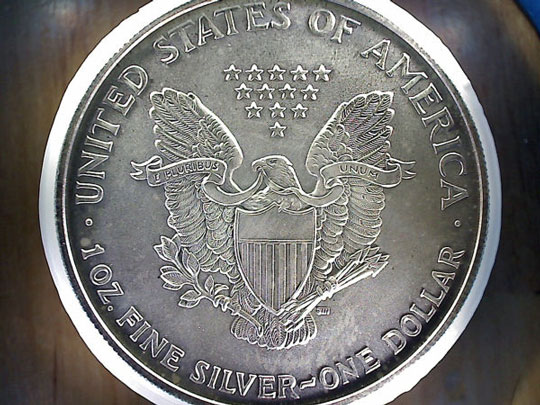
ASE and view it in-hand with your normal coin viewing lights. Tilt it around as you would on a coin show bourse floor, trying to decide to buy or not. What are you looking for? I look for marks, luster, "rub", etc to see if the coin's worth the asking price. Now, how are you holding the coin, and where are the lights that give you the best view of the coin and the characteristics you're looking for?
First thing most folks realize, unfortunately, is that they don't hold the coin "flat" versus their eyes. This is bad news for coin photography, because it's hard to take a good picture of a coin at an angle. There are tricks you can play, such as using Tilt/Shift lenses or bellows to bring the coin back to square from camera perspective and compensate for DOF issues, but that is advanced stuff and it's not always effective. But the question is: why hold the coin at an angle? Usually the answer is that you are trying to get the light to shine straight onto the coin and into your eyes. This gives the best rendition of color and a good rendition of detail, and emphasizes the surface reflections. It does NOT give a good rendition of true luster, which only comes from a slightly angled presentation. Try it! Move the coin around, and see what gives you the best color...the best luster...the best overall "look"...etc.
You'll probably find, unfortunately, that the answer is different for each characteristic you're trying to emphasize! So the next step is to determine what is the best lighting that gives you what you the best balance and minimal tradeoff between the characteristics. I can tell you what I found, after literally years of experimental effort:
- Two Lights, one at approx 10:30 and one at approx 1:30. Exact placement depends on the subtle shadow detail emphasis on the particular coin
- Lights placed a distance from coin that gives approximately a 20-deg radial illumination sweep and <10-deg axial illumination sweep. Smaller lights go closer, larger farther. Diffusion makes the lights look bigger
- Incident angle to horizontal >75deg but less than the aperture-dependent critical angle for direct reflection to the lens
- Elimination of any direct light from source hitting lens
So, my suggestions for you are:
Reduce the inner diameter of the assembly to the same diameter as your lens filter threading. This will help to increase incident angle
Add a blocker/reflector to reflect any light that would shine up to the lens instead downward to the coin
Add diffusion to minimize hotspotting
Attach the light holder to a system that allows you to move it up or down to optimize the incident light angle
Cluster 2 sets of 3 lights each such that the center lights are 90-deg from each other with the other two in each group about +/-20-deg from the center ones
Add switching to allow you to turn on one light from each group at random
Add a light at 12:00 for fill-in or single-light shots
Paint all areas not emitting light with heavy coat of flat black paint or attach flocking
I may have a few other suggestions but this is a start. These are things I would do myself if I had the equipment to make these assemblies.









 Posted 08/11/2012 2:54 pm





