| Author |
 Replies: 21 / Views: 3,140 Replies: 21 / Views: 3,140 |
|
Pillar of the Community
Czech Republic
803 Posts |
Wouldn't know until prices realized are published, but there's a small chance I might have won this one. Especially if you consider it was being offered unattributed in Scotland in an auction without any "live bidding". I'm keeping my fingers crossed, because this would be a pretty cool purchase. Thoughts? 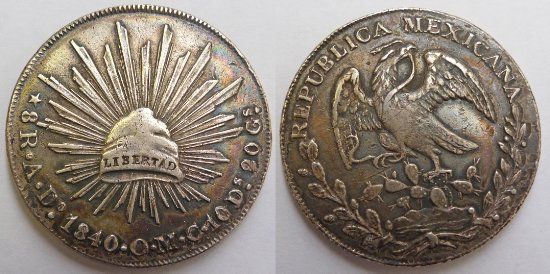 |
|
|
|
Pillar of the Community
United States
1801 Posts |
Edited 8/19. I was unaware of the controversial 1840 Durango Pattern coins, I was looking at this coin as "trial strike" or something and it did not meet any of the elements of a coin struck at the Durango Mint, hence my vote for fake. Having now read more about the coin in question, seems this is one of those coins.
Sadly I am voting fake. The eagle looks nothing like an 1840 Durango Eagle. 1832-1842 Durango coins have a very distinct look to the eagle (European dies). I am not sure who "OMC" was (the assayer on this coin) but he was not the assayer in Durango in 1840. Durango assayer initials are RM from 1930 to 1848
Edited by jfransch
08/19/2012 7:20 pm
|
|
Pillar of the Community
United States
1962 Posts |
AND it has the "O.M." assayer mark of Zacatecas, not Durango. That's a contemp ctft. - an interesting one. I hear there's this guy out there who collects them kind of casually...
|
|
Pillar of the Community
United States
1962 Posts |
Maybe I should research before I spout. I knew there was some kind of Durango pattern that was produced somewhere around this time, but didn't think it looked like this. Sorry, Roman - good pick, shouldn't have doubted you! The Durango Mint Pattern 8 Reales of 1840 Kent Ponterio, Ponterio & Associates NI #1221 http://www.numis.org/pdfarticles/Durango8.pdf |
|
Pillar of the Community
United States
1801 Posts |
Realswatcher, very interesting article. Roman, looks like you have one of the coins described in Kent's article. Be interesting if you could post some clear pictures and weight/size information for us when you actually obtain the coin.
|
|
Pillar of the Community
 Czech Republic
803 Posts |
There's surprisingly little information about this coin on-line. I will let you guys know if I won this lot.
|
|
Pillar of the Community
Czech Republic
803 Posts |
A friend specializing in the series posted this on another forum: Quote:
2K, I hope you got it!
I know a little something about Mexican patterns as I have been collecting them for about 15 years.
This one usually comes in silver-plated bronze (Sheffield plate), although it is known in white metal and silver (both very rare). The plated variety is plentiful as patterns go, maybe 32-64 known (I like specifying rarity as a power of 2).
They are thought to have been struck in Spain.
Believe it or not, the last one (before yours) sold in the Sep 2011 Heritage Long Beach sale for $12,000 plus the juice. I was a bidder but dropped out at a reasonable $3500 or so, but two Internet cowboys slugged it out to my astonishment, especially since it wasn't even a really nice example! Although it was graded AU58 by NGC, the edge was simply awful.
I have it on good authority that another specimen will be coming to market before the year is out.
Mind if I ask how much you paid once you're sure it's yours?
Once you have it in hand, ping me for authenticating diagnostics. The die looks good from the photo, but it almost appears cast? Here's the link to the Heritage one sold last year: http://coins.ha.com/c/item.zx?saleN...&lotNo=25311Regardless of whether I won the auction or not, this was an interesting lesson so far. |
|
Pillar of the Community
United States
5362 Posts |
I understand the debate over Pattern versus "forgery" it happens with a few specific designs in this series and personalities often get involved.
The Birmingham area in England was the source of innumerable varieties of both real and counterfeit issues for decades. They often employed Sheffield plate and the design is well within their capability (in fact it is a bit crude for their standards in 1840).
Durango did experiment with French dies in 1830-32 and in 1839 those hubs were worn out so finding a replacement source is very likely in the 1840 time frame.
I vote pattern but conditionally. A coin of this design was in fact made as a pattern, but I am suspicious that it has been copied as a Numismatic fraud within the past 20 years. But until several copies can be compared side by side - it may be difficult to prove.
I hope the coin comes with a solid history so that it can be traced back to before the 1950's.
|
|
Pillar of the Community
Czech Republic
803 Posts |
Received an email confirming I was the highest bidder. I will post dimensions, better images of all 3 sides, and SG once I receive it.
|
|
Pillar of the Community
Czech Republic
803 Posts |
Swamperbob - provenance will be hard to establish, especially since this auction did not attribute the coin for what it was, but there's a documented example from the 1930's in the ANS collection with Julius Guttag pedigree. I'm going to see if I can get my hands on an image of it to compare die markers.
|
|
Pillar of the Community
United States
5362 Posts |
Great coin - Congratulations - I have been hunting for onr for YEARS.
|
|
Pillar of the Community
United States
1962 Posts |
Bob, just to clarify... Quote:
I vote pattern but conditionally. A coin of this design was in fact made as a pattern... So, it's your belief that this "Do 1840 O.M.C." style ***as originally executed*** was indeed a PATTERN and not a contemporary fake, yes? Quote:
but I am suspicious that it has been copied as a Numismatic fraud within the past 20 years. ...however, you believe this pattern issue may have been a target of some modern-day numismatic forgery? You seem to be saying that like you've seen something... |
|
Pillar of the Community
United States
5362 Posts |
realeswatcher Yes in both cases. That the 1840 coin was most likely a pattern of sorts makes complete sense to me and it is very well known that the Soho facility and others in Birmingham, England did make unrequested patterns for many different countries while attempting to sell their expertise as die makers. The original intent was not to make counterfeits for circulation. But a pattern for any coinage is normally required to have been produced in response to some form of "request" to do so by the governing agency responsible for coinage. I am unaware that any researcher has located the supporting documentation to prove that the coin in question was a "requested" therefore authorized pattern. In 1840 the Durango mint was still operated under lease by Bras de fer and since he used French hubs in 1832 it is very likely he was shopping again. But in many places, producing such an unrequested or unauthorized "pattern" could be considered a crime if the coins in fact reached circulation. The coins would then become de-facto counterfeits regardless of the actual original intent of manufacture. So the non-fraudulent purpose of the original production does not make the coin an "authorized" pattern - that is another issue entirely. The status of the 1840 absent the written proof that it was considered to be a pattern contemporaneously or was actually requested by Mexican mint authorities - leaves us somewhere between Pattern and Counterfeit. This is an area which has no actually well accepted name. So, while I think an answer in the affirmative should be considered absolutely the correct answer because I believe the coin was meant as a pattern for a proposed coinage in Durango - I could not oppose an interpretation of counterfeit should circulated off metal strikes be encountered in significant numbers (relative to known mintage - which here is a very low number). The second question has a much clearer answer. Yes, I have seen a crude copy of this coin which was obviously made to capitalize on the rarity of date. The coin was in a collection of counterfeits and I only briefly examined it. But it was a poor excuse for a pattern. The primary purpose of a pattern is to demonstrate the capabilities of the maker as a die sinker. It is, therefore, not a crude rendering like a concept trial by an artist. The coin was clearly cast and lacked fine details. That "odd" counterfeit was what drove me to research this date in the first place perhaps 15 years ago. So as in ALL CASES where a rare item is involved - be CAUTIOUS but not paranoid. 
|
|
Pillar of the Community
United States
1801 Posts |
I think I would refer to this coin as a salesmans sample, produced with the intent of convincing the Durango Mint to buy dies from the manufacturer. This opens up a whole new genre of collecting, the only other similar example that comes to mind would be the "salesman sample" of the Teddy Bear Encased Cent holder (of Kolbs Bakery fame) that sold on ebay a few months ago. |
|
Pillar of the Community
Czech Republic
803 Posts |
Finally received it in-hand. SG of 8.44, which sounds about right for silver plated bronze. Same crazy rotation as the coin in the Heritage auction and the same die markers. Going to shoot some close-up pics before sending it in to NGC to get into a holder.
Pics will be posted shortly. Very neat coin.
|
|
Pillar of the Community
Czech Republic
803 Posts |
Large obverse and reverse - edge will follow shortly. Interesting effect in the legend - letters almost seem shifted, leaving a depressed image of the letter right below it. You can clearly see this ghosting under "O.M.C.10.D". Could this be the plating shifting during strike? Looking at some spots on the edge, the core metal seems cast, which could explain the surface dings and pockmarks if the plating is thin enough.   |
| |
Replies: 21 / Views: 3,140 |







 Posted 08/19/2012 01:36 am





