| Author |
 Replies: 15 / Views: 9,555 Replies: 15 / Views: 9,555 |
|
|
Pillar of the Community
United Kingdom
2139 Posts |
Here's a bit of a mystery: 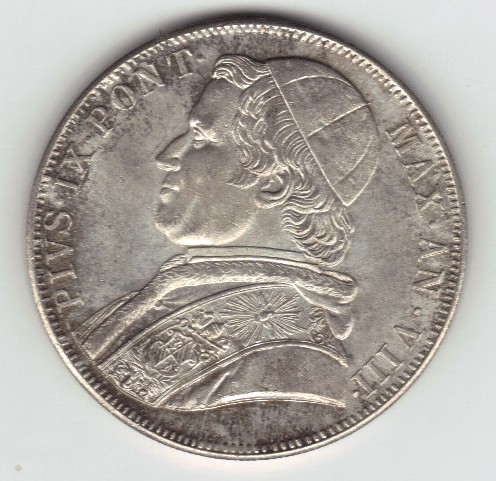 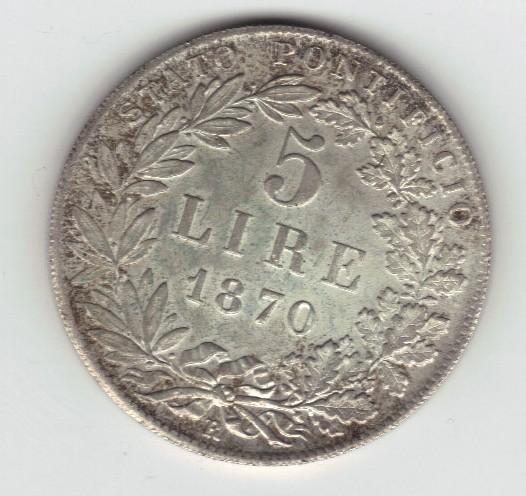 This coin looks at first glance like a Papal States 5 Lire of 1870. But it's not. A real Papal States 5 Lire of 1870 should have an obv legend of PIVS IX PONT MAX A XXIV or PIVS IX PONT MAX A XXV but this has PIVS IX PONT MAX AN VIII. Pius IX became pope in 1846 so his regnal year in 1870 is either 24 or 25 not 8. The coin should weigh 25g but only weighs 22.91g, which is suspiciously light for a BU coin like this one. I'm presuming that it's a fake; however if it is a fake, what is it a fake of ? |
|
|
|
Moderator
 United States
23731 Posts |
The details are an exact match to an orignal coin with the exception of the regnal year. The coin looks struck not cast. I don't understand how a forger would make a perfect match and than make a stupid mistake and put the wrong regnal year. They would have had to know that a collector would catch that.
|
|
Pillar of the Community
Australia
2830 Posts |
does it react to a magnet ?
|
|
Bedrock of the Community
Australia
21789 Posts |
Some strange things happen in the manufacture of fake coins.
The Italian Government prohibits the export of genuine heritage items from their country without an export licence. Same for Greece, especially for ancient coins.
However, there is nothing wrong with selling 'copies' to unsuspecting tourists that are not genuine heritage items.
One way getting around this problem is to sell a coin with an impossible legend, the heritage laws are then not broken.
Which brings up another problem.
Deception.
Apparently, the selling of fantasy coins to tourists is tolerated by the Government. This will continue to happen until the Government allows enough tourists to be angered enough to affect their tourist trade.
I suspect that will take a looong time.
|
|
Pillar of the Community
United States
2605 Posts |
The sash looks wrong. Compare to this one from MA-Shops. |
|
Moderator
United States
23731 Posts |
Good eye svslav, didn't notice the difference also there is no signature under the bust.
|
|
Pillar of the Community
United Kingdom
4208 Posts |
Its a good coin to own - Vatican City Euros are bloody difficult to get today and they're still being made. Even if its fake, its a nice coin.
|
|
Moderator
Australia
16976 Posts |
Quote:
The sash looks wrong. Compare to this one from MA-Shops.
Good eye svslav, didn't notice the difference also there is no signature under the bust.The obverse is wrong for a 5 lire of 1870 - but it's perfectly fine for a silver scudo of 1853; NGC database example. This coin is a mule, of two different Papal States coins struck 17 years apart. And, given that a "regular" mint error mule with a 17 year difference in dies is pretty improbable and that the coin weighs much less than either a 5 lire or a scudo, then it's almost certainly a Chinese-made fake mule. Don't say "infinitely" when you mean "very"; otherwise, you'll have no word left when you want to talk about something really infinite. - C. S. Lewis
|
|
Pillar of the Community
 United Kingdom
2139 Posts |
Thanks for all the replies. It's not magnetic. I haven't tested the specific gravity but it has the appearance of silver. Thanks for the links, however I'm a bit fearful about using NGC as a trusted source. I've found mistakes in other series, and there's this one http://www.ngccoin.com/poplookup/Wo...oinid=345287 with a bust in an ordinary suit with a moustache and no papal cap which seems distinctly odd. |
|
Moderator
Australia
16976 Posts |
It's true the NGC database isn't absolutely reliable; the pictures come from the Krause catalogues, which are not in themselves a flawless source. But that particular one is listed with an "X" number rather than a "KM" number, meaning it's listed in the "Unusual World Coins" catalogue rather than the mainstream Krause catalogue. It is a flaw in the database design that they do not always clearly distinguish such fantasies from genuine coins.
Don't say "infinitely" when you mean "very"; otherwise, you'll have no word left when you want to talk about something really infinite. - C. S. Lewis
|
|
New Member
United States
1 Posts |
I was somewhat amused and chagrined at the same time when I saw the same coin in my collection. A fake! I agree with other comments, why make a well struck fake and then screw it up with a rookie mistake like the wrong regnal year for the pope? Frustrating but fascinating at the same time. But after viewing the real deal in multiple images, the fake isn't really all that well done. I think they made the pope look kinda fat.
Edited by hallamark
05/07/2019 08:29 am
|
|
Moderator
United States
195042 Posts |
 to the Community, hallamark! |
|
Moderator
Australia
16976 Posts |
Hello and welcome, hallamark!  Quote:
...I agree with other comments, why make a well struck fake and then screw it up with a rookie mistake like the wrong regnal year for the pope?... As I understand it, the modus operandi of a Chinese fake coin factory works something like this. The fake-makers would, almost certainly, have originally made correctly matched obverse and reverse dies for an 1870 5 lire. They presumably also would have made correctly matched dies for an 1853 scudo. Their top-tier fakes of the 1870 5 lire and the 1853 scudo would have been made using freshly-cut, correctly matched dies, probably using the correct weight and actual silver. Once that first batch of fakes were made, the dies would have then gone into the fake-factory's inventory, awaiting production of lower-quality fakes. Those lower-quality fakes would, by definition, have less quality control - their target market is not the top-end auction houses, but the street vendors selling "rare coins" to passers-by. For these fakes, ensuing that the correct obverse and reverse dies match up perfectly is not necessary, as their target market is not actual coin collectors. So "mules" of all kinds are likely to crop up. Some of the "bottom-tier" fakes, made with poor-quality dies or when the better dies are too badly worn and re-tooled to fool anyone, are even from different countries - like this rather comical example of a St Helena 50 pence reverse muled up with a Uganda 5 shillings obverse. Some of the "errors" may even be deliberate, in the hopes that someone with just a little knowledge about coins might think "hey, that's some kind of error" - and thus be encouraged to purchase one. I'm told by one visitor to a street market in Malaysia that, on pointing out that their "coins" had obvious errors on them (something like the mis-spelling of "PENCE" or the "1086" date on the coins in the thread I linked to earlier), the seller said "Those must be valuable mint errors then" and promptly doubled their asking price. Don't say "infinitely" when you mean "very"; otherwise, you'll have no word left when you want to talk about something really infinite. - C. S. Lewis
|
|
Valued Member
Canada
242 Posts |
Very very very fake!
Unfortunately not all of the Papal States scudi fakes are this bad, I own a specific piece that is made in full weight over-grade silver with extremely well carved dies, probably a late 19th century (or famous 1950's Rome mint shenanigans- don't get me started on those) re-strike. Some of these copies have made it (as reproductions) onto well known auctions where they reach decent price levels. If people are interested I'll post it on the forum some time.
|
|
Pillar of the Community
United Kingdom
2139 Posts |
Quote:
If people are interested I'll post it on the forum some time. I'd be interested in seeing it. |
|
Pillar of the Community
Canada
5287 Posts |
@Sap describes it well. A grossly underweight coin would not fool a serious collector. Their target market for these is not the serious collector but the impulse buyer who is lured by the apparent age, and well-made silver-looking appearance.
Their initial sale might well be outed as a terrific "bargain".
Edited by oriole
03/21/2020 08:06 am
|
| |
Replies: 15 / Views: 9,555 |
|






 Posted 08/30/2012 8:24 pm





