| Author |
 Replies: 14 / Views: 1,566 Replies: 14 / Views: 1,566 |
|
|
New Member
United States
20 Posts |
Maybe it had something to do with the silver used? Or not enough copper alloy, or too much?
I noticed this when I was looking to buy one around late 2006/early '07. I finally bought one in like VG10 for about $350 - and it had this appearance, though not as bad as some of the others I looked at.
|
|
|
|
Pillar of the Community
United States
3552 Posts |
Anthony,  to CCF. I am unsure if this is the type of answer you were gearing your question toward. But the 'cleaning' or excessive wearing phenomenon could be the result of a poor design in terms of longevity. IMHO this SLQ coin is actually one of the more beautiful designs out there but has similar problems not unlike the Buffalo nickel in terms of excessive wear on the date, for example. Both this SLQ and the Buffalo have dates that are thicker compared to the other elements of the coin. And millions of uncleaned fingers with each containing amino acids will obviously etch down these coins over time. In the case of the SLQ apparently the thickness of the date is similar to Ms. Doscher's elevation away from the field. Her beauty alone  was not enough to wart off the evil effects from these multiple attacks of weak amino acids which contributed to excessive wear. Without going too far out on a tangential issue when comparing the hardness of 90% silver SLQ coins to Buffalos one should firstly keep in mind the following metallic compositions: SLQ comp.: 0.90 Ag (silver) and 0.250 (Cu) copper Buffalo nickel comp.: 0.750 Cu (copper) and 0.250 (Ni) nickel The Mohs scale, a chemical designation of intermediate hardness, is really more geared toward gemstone and mineral characteristics, however, it can at least partially assist to further clarify the original question of SLQ wear. Using this Mohs scale the following ‘approximate' values (the higher the number, the harder the substance) are arranged in ascending order for review: pencil lead: 1.5 pure silver: 2.7 SLQ comp. [0.90 Ag (silver) and 0.250 (Cu)] copper coins: 2.8 pure copper: 3 Buffalo 5 cent comp. [0.750 Cu (copper) and 0.250 (Ni)] nickel: 3.2 pre-1982 US penny [0.95 Cu (copper) and 0.05 (Zn)] zinc: 3.3 pure nickel: 4 diamond: 10 It is important to emphasize that these above figures are only general/relative values since I was unable to determine the 'exact' US mint classifications of coin wear. fyi, mdpmedia |
|
Pillar of the Community
United States
3552 Posts |
Quote:her beauty alone was not enough to wart off the evil effects from these multiple attacks of weak amino acids which contributed to excessive wear. For what it's worth here's a shot of what was considered captivating beauty back in the early 20th century: 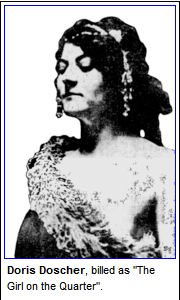 Quote:
Buffalo nickel comp.: 0.750 Cu (copper) and 0.250 (Ni) nickel On another totally unrelated but inquisitive note the Buffalo ‘nickel' should really have been called the Buffalo ‘copper'. It's the same amount of syllables but more aptly descriptive of what the coin is actually made of.... IMHO mdpmedia |
|
Moderator
 United States
16697 Posts |
I have one that I can assure you, has never been cleaned.
swcoin.ecrater.com
|
|
Pillar of the Community
United States
3552 Posts |
Quote:
I have one that I can assure you, has never been cleaned.  |
|
Valued Member
United States
280 Posts |
I know that this may be a little off topic, but do any of you know how to get the date on a dateless SLQ? I'd really appreciate it.
|
|
Pillar of the Community
United States
3552 Posts |
Quote:
how to get the date on a dateless SLQ I have never personally tried this experiment but per my past studies in chemistry one may conceivably attempt to mix one part of nitric acid (HNO3) with three parts of water (H2O) under a fume extraction hood to avoid inhaling any noxious vapors. Then acquire a thin wire-type thickness tubular material (glass, stainless steel, etc) that should not dissolve when immersed in this mixture when exercising a limited exposure time of this solution to this applicator rod's minimal surface area. After having quickly dipped this approximate 1/16" diameter max. applicator in the solution one-half inch deep max. simply touch the end of this now solution-coated rod on top of the location where the date should have been on the coin. Once again it is imperative to always use adequate ventilation and to avoid any contact with the skin. The intent of the thin rod applicator is to only apply a minimal amount of acid solution just on the date area attempting to avoid having a large spreading halo after effect of the acid over the entire coin etc. Gauging the exposure time of the solution on the coin's surface will depend upon how much etching is achieved and the desired appearance of the date. Thoroughly rinse everything with water multiple times when the test has termed. Please let us know how you made out with this suggestion. mdpmedia PS: Commercially available nitric acid is typically about 68% HNO3(with the balance being water) and is also classified as 15 molar. |
|
Pillar of the Community
United States
1291 Posts |
Quote:
SLQ comp.: 0.90 Ag (silver) and 0.250 (Cu) copper ? That doesn't compute! |
|
Pillar of the Community
United States
3552 Posts |
The correct metal composition for a SLQ should be:
0.90 Ag (silver) and 0.100 (Cu) copper
Thank you for pointing out my error.
I was looking at the 0.250 Ni composition of the Buffalo in the same narrative when I inadvertently made this typo.
The increasing hardness list of materials previously presented should remain the same since the 90% silver amount of a SLQ is still accurate and comprises the majority of this coin's makeup.
I apologize for the confusion.
mdpmedia
|
|
Valued Member
United States
280 Posts |
Would anything else work besides nitric acid?
|
|
Pillar of the Community
United States
2150 Posts |
It's been discussed here before and even attempted by a member. I think the final say after experimentation was it was a no go.
|
|
Bedrock of the Community
United States
17884 Posts |
Maybe most of them HAVE been cleaned. It's a key date and everyone wants them to look better so as to sell for more, so a lot of them have probably been cleaned under the theory that "bright is better".
|
|
Pillar of the Community
United States
1291 Posts |
The member that attempted it was ME. Nitric acid worked but only to such a slight degree that I deemed it "not worth the trouble". I will say, however, that I have no chemical background whatsoever and have often wondered what would happen if somebody with some real smarts ever put their mind to this. Here's the thread from back when I attempted this: https://goccf.com/t/70019&whichpage=1 |
|
Pillar of the Community
United States
2734 Posts |
The 1921 SLQ was a desirable key date even in the 1930's/1940's, when it was more acceptable to clean coins. Toned coins were not as accepted/desired as they are now.
In those two decades, a large pool of SLQ's were still in circulation, and the post-Depression era would be the time period in which most of the circulated 1921's would have been saved.
A number of 1921's stayed in (or were returned to) circulation during the Depression, and (key date or not) their mintage was still much higher than the 1916.
|
|
Valued Member
United States
280 Posts |
It might not have worked because the molarity (concentration) of your nitric acid solution was too low. I a chemistry set  , but I still can't try weerdsteev's experiment because the molarity of all my chemicals is .1 mol(VERY weak). |
| |
Replies: 14 / Views: 1,566 |
|










 Posted 09/23/2012 2:52 pm


