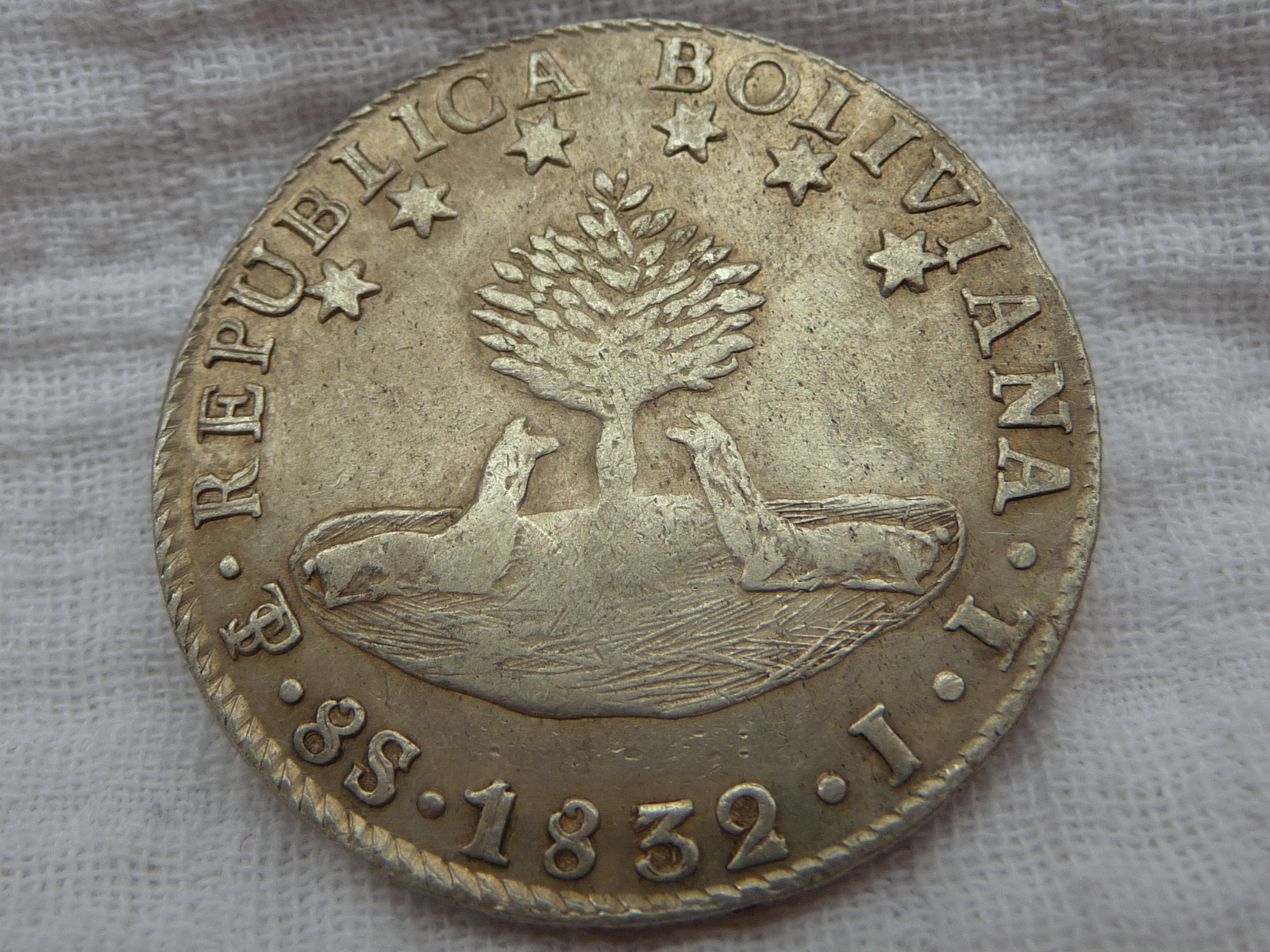
The symbols on the coins are derived from the symbols on the coat of arms.
According to the original Act defining the coat of arms in 1825, the coat of arms must have on it a tree that symbolizes "the wealth of the state in the plant kingdom". The alpaca likewise is mandated merely as an animal that symbolizes "the wealth of the state in the animal kingdom".
Now, in South American society, wealth-by-animals is traditionally measured by the alpaca, so choosing the alpaca for the animal on the coat of arms has been virtually unanimous. But there is no parallel traditional interpretation of "wealth-by-trees". Nor was there a traditional European-derived heraldic tree-symbol that fit the bill well. Originally, breadfruit was chosen, because it had no prior heraldic symbolism attached to it (being a plant native to the Pacific islands, and therefore unknown to mediaeval heralds) and was a suitable symbol for wealth because when the tree bears fruit it produces lots and lots of fruit. European colonists valued the trees as much as the native Polynesians did when they arrived in the Pacific, and went to great lengths to transport the fruit to their other tropical colonies - including South America.
Unlike the coats of arms of many other nations, the arms of Bolivia are somewhat fluid, having been redesigned and re-tweaked numerous times as governments changed and new dictator-generals wished to leave their mark on the national symbolism, all the while still adhering to the rather vague definitions laid down way back in 1825.
This rather irate Bolivian heraldry fan bemoans (in Spanish, so you'll have to ram the text through Google translate) the slackness with which the Bolivian arms have been depicted down through history, and gives "an example of the monstrosity of these frequent deformations and the seriousness of the irreverence for the homeland that carry with them, and this is in regard to the distortion of the image of the breadfruit tree.". He notes that often a palm tree has been chosen to be depicted instead, which he insists is wrong, because palms have the historic heraldic symbolism of conquest and victory, rather than wealth. Nevertheless, a palm may have been seen to be a suitable substitute once the breadfruit craze died down, especially if palm products were a major export of the country.
Breadfruit do grow in the tropical-jungle-half of Bolivia, although they are not a native species; today, they are more commonly seen in South America as symbols of "feral agricultural pests" rather than "wealth".
So in short, the "tree" on the Bolivian arms (and the early Bolivian coins) is interpreted differently, because the original definition in 1825 was vague and did not actually specify which tree it ought to be. But from a strictly heraldic point of view, it "should" always have been a breadfruit tree.
Don't say "infinitely" when you mean "very"; otherwise, you'll have no word left when you want to talk about something really infinite. - C. S. Lewis









 Posted 10/03/2012 12:36 pm