| Author |
 Replies: 36 / Views: 4,873 Replies: 36 / Views: 4,873 |
|
|
|
Bedrock of the Community
United States
20043 Posts |
Sorry Paul, you just completely ruined a $40, semi-key coin. Peroxide is the absolute WORST thing you can subject ANY coin to.
Let this be a lesson to you all on how to NOT properly conserve a coin. Proper conservation is a scientific process, not randomly soaking coins in various solvents to "see what happens". If you're not fairly certain of what the outcome will be, DO NOT DO IT! It's better to have a dirty grimy coin rather than an improperly cleaned piece of dung.
|
|
Bedrock of the Community
United States
10982 Posts |
I would conduct "experiments" on low value, common date cents (i.e. those worth 10 cents or less).
BadThad thinks you destroyed a semi-key date with good value. He has a lot of experience and should know what happened. I don't and wonder what it looks like now. Can you post current pics?
|
|
Valued Member
United States
110 Posts |
good old ms-70 and e Z Est and on copper prob some dahlers darkener might be needed.....
|
|
Rest in Peace
United States
7075 Posts |
He did post that he was experimenting on an old farthing.
I would have liked to seen before and after photos of the experiment....but it's probably too late.
|
|
New Member
United States
19 Posts |
If and when I find some reagent grade acetone and xylene, I'm going to post a series of tests like this in hires x5 images (new Canon T4i with an MP-E lens!).
I've spent hours reading anecdotal stories with too little facts. I can't believe nobody has done this yet, there are just bits and pieces all over the place. It should be pretty simple to get 50 or so of the same non-key 1950-ish (brown) and 2010-ish (red) Lincolns in about the same condition. Then do timed, temp, measured tests with a collection of chemicals, reagents and fingernail polish remover, H2O2, olive oil, tap water, Verdicare, the polarity ladder, etc. Image before and after 5/20/90 second and 1-24 hour treatments of each.
Can't be that hard, can it?
|
|
Valued Member
 United Kingdom
115 Posts |
Just to clear up-I did NOT use the 1912 penny, as I mentioned earlier in this thread; relax! It's an old farthing.
I did also take some before and after photos, which I shall post up presently.
I'm not a gung-ho halfwit!
|
|
Valued Member
United Kingdom
115 Posts |
And thanks for your concern, BadThad, but may I respectfully suggest that you might read the post before expressing your disdain. Perhaps that is a little lesson for you?!
|
|
Valued Member
United Kingdom
115 Posts |
So here are the pics if anyone is interested; First one is uncleaned original sitting in DI; Second, after it had soaked for a while, then frozen; Third, the stripped finish, working from the centre, outwards. I note that the detruitus has taken on a waxy finsh. Longer in the H2O2 would have probably gone on to remove this entirely, however I was not concerned about cleaning it and so removed it. 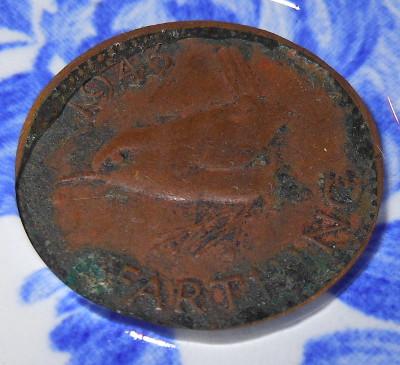 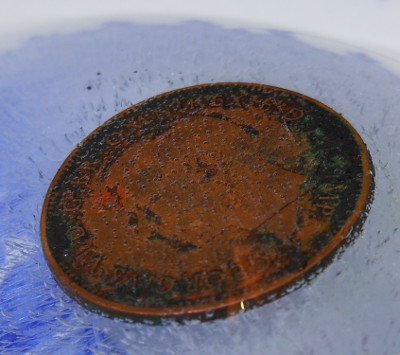 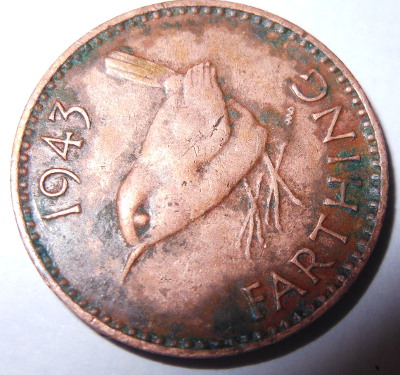 |
|
Pillar of the Community
United States
3755 Posts |
Thad, ok, so WHY is peroxide so bad? What does it do to the penny?
|
|
Bedrock of the Community
United States
20043 Posts |
Look at the post above. LOLOLOL
Lincoln Cent Lover!VERDI-CARE™ INVENTOR https://verdi.care/
|
|
Bedrock of the Community
United States
20043 Posts |
Quote:
And thanks for your concern, BadThad, but may I respectfully suggest that you might read the post before expressing your disdain. Perhaps that is a little lesson for you?!
Not a lesson, just a failure to read all the posts. I just don't want noobs reading and following some of the appalling suggestions I've seen in this thread. |
|
Valued Member
United Kingdom
115 Posts |
Quite right sir, I was a little shocked myself to see the first suggestion of soaking it in nail polish remover for a week!
The pictures of the farthing are a good illustration of what NOT to do, and the resulting destruction of the patina, although I note the pictorial evidence was still questioned by someone.
I really am most grateful for folks' suggestions, certainly professionals with experience. I love my H2O2 for other cleaning uses, and I wanted to try for myself on an old coin
|
|
Bedrock of the Community
United States
20753 Posts |
Quote:
Thad, ok, so WHY is peroxide so bad? What does it do to the penny? The H2O2 explains that this solution is sort of top heavy with Oxygen. Oxygen is the first thing that attacks Copper and does so readily. If you read the posts about coin cleaning, cleaning coins, Acetone and all the other similar posts available by using the Search Tab at the top, you sould see or should many discussions about most of this. There is possibly many, many items people claim they have used or read that someone used on coins with only great or OK success. And possibly some are true but more than likely what you read on the internet is from people that really just guess, repeat something someone else said or make it all up. Over the years I've read about Baking Soda and water, Orange Juice, Tomato Juice, Olive Oils, Spit, Nail Polish Remover, Acetone, Laquer thinners, Mineral Spirits and on and on and on. Such experimentation is fun but shouldn't be attempted on a coin of a value over face value. And even then it could be the ruining of a coin for someone in the future. It is not smart to sand down a 500 year old table. It is not smart to rewrap a 2,000 year old Mummy. Nor would it be smart to run King Arthurs Sword accross a bench grinder wheel, it there was such a Sword. As a general rule it is always best to let sleeping dogs lie. Old saying. |
|
Pillar of the Community
United States
8534 Posts |
Somebody said lighter fluid was really good for taking off gunk. I dont remember the member.
Oregon coin geek.....*** GO BEAVS ! ! ! ***
|
|
Valued Member
United States
110 Posts |
Agree.......although....there are ways 8).......
|
| |
Replies: 36 / Views: 4,873 |








 First Page


 Posted 11/15/2012 6:06 pm


