

 Posted 11/19/2012 5:25 pm


Hello and welcome. 
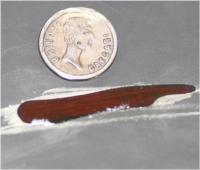
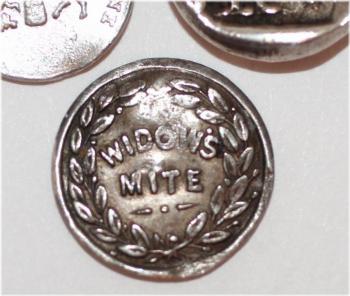
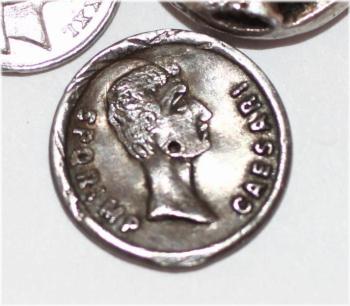
Your piece isn't an actual "widow's mite"; it doesn't even resemble one. Widow's mites were ancient Jewish coins and didn't have the Roman emperor's portrait on them. And obviously they didn't have the English language on them, either, nor did they have Latin; they had Greek. A genuine widow's mite looks like this.
The "David J. de Sola Rogers" mentioned on the museum site was the author of the book referenced further down the page: "Toy Coins". Which basically describes your piece. It was presumably given to Sunday School children as a reminder of the bible story of the poor widow, from which the widow's mite derives its name.
The one on the museum site is also listed as being made of cupronickel. I'd be very surprised if a cheap giveaway trinket like this would be made of silver.
Your piece isn't an actual "widow's mite"; it doesn't even resemble one. Widow's mites were ancient Jewish coins and didn't have the Roman emperor's portrait on them. And obviously they didn't have the English language on them, either, nor did they have Latin; they had Greek. A genuine widow's mite looks like this.
The "David J. de Sola Rogers" mentioned on the museum site was the author of the book referenced further down the page: "Toy Coins". Which basically describes your piece. It was presumably given to Sunday School children as a reminder of the bible story of the poor widow, from which the widow's mite derives its name.
The one on the museum site is also listed as being made of cupronickel. I'd be very surprised if a cheap giveaway trinket like this would be made of silver.
Don't say "infinitely" when you mean "very"; otherwise, you'll have no word left when you want to talk about something really infinite. - C. S. Lewis