|
This page may contain links that result in small commissions to keep this free site up and running.

Welcome Guest! Registering and/or logging in will remove the anchor (bottom) ads and the security checks. It's Free!
To participate in the forum you must log in or register. | Author |
 Replies: 16 / Views: 3,666 Replies: 16 / Views: 3,666 |
|
Pillar of the Community
United States
5155 Posts |
I have always been interested in history, ancient cultures and ancient peoples, they way they lived, the way they did business, the way they worshiped and how they observed and interacted in the world around them. I find languages and ancient scripts fascinating. Coins seem to fit this interest very well. So one day, I decided to try and find coins of my ancestral land. Then it hit me. I couldn't find them. Apparently coins of antiquity have not come down to us for this place? I found only but a small and very debated reference from Pliny the elder...he mentions the land of "Scania." Wikipedia says,
Scandinavia and Scania (Skåne, the southernmost province of Sweden) are considered to have the same etymology. Both terms are thought to be derived from the Germanic root *Skaðin-awjō, which appears later in Old English as Scedenig and in Old Norse as Skáney.[19] The earliest identified source for the name Scandinavia is Pliny the Elder's Natural History, dated to the first century A.D.
Various reference to the region can also be found in Pytheas, Pomponius Mela, Tacitus, Ptolemy, Procopius and Jordanes. It is believed that the name used by Pliny may be of West Germanic origin, originally denoting Scania.[20] According to some scholars, the Germanic stem can be reconstructed as *Skaðan- meaning "danger" or "damage" (English scathing, German Schaden, Dutch schade).[21] The second segment of the name has been restructed as *awjō, meaning "land on the water" or "island". The name Scandinavia would then mean "dangerous island", which is considered to refer to the treacherous sandbanks surrounding Scania.[21] Skanör in Scania, with its long Falsterbo reef, has the same stem (skan) combined with -ör, which means "sandbanks".
In the reconstructed Germanic root *Skaðin-awjō (the edh represented in Latin by t or d), the first segment is sometimes considered more uncertain than the second segment. The American Heritage Dictionary[22] derives the second segment from Proto-Indo-European *akwa-, "water", in the sense of "watery land".
The Old Norse goddess name Skaði, along with Sca(n)dinavia and Skáney, may be related to Gothic skadus, Old English sceadu, Old Saxon scado, and Old High German scato (meaning "shadow"). Scholar John McKinnell comments that this etymology suggests that the goddess Skaði may have once been a personification of the geographical region of Scandinavia or associated with the underworld.[23]
[edit]Pliny the Elder's descriptions
Pliny's descriptions of Scatinavia and surrounding areas are not always easy to decipher, even though his writing of geography was what he considered a "clarior fama" ("a clearer story"). Writing in the capacity of a Roman admiral, he introduces the northern region by declaring to his Roman readers that there are 23 islands "Romanis armis cognitae" ("known to Roman arms") in this area. According to Pliny, the "clarissima" ("most famous") of the region's islands is Scatinavia, of unknown size. There live the Hilleviones. The belief that Scandinavia was an island became widespread among classical authors during the first century and dominated descriptions of Scandinavia in classical texts during the centuries that followed.
Pliny begins his description of the route to Scatinavia by referring to the mountain of Saevo (mons Saevo ibi), the Codanus Bay (Codanus sinus) and the Cimbrian promontory.[24] The geographical features have been identified in various ways; by some scholars "Saevo" is thought to be the mountainous Norwegian coast at the entrance to Skagerrak and the Cimbrian peninsula is thought to be Skagen, the north tip of Jutland, Denmark. As described, Saevo and Scatinavia can also be the same place.
Pliny mentions Scandinavia one more time: in Book VIII he says that the animal called achlis (given in the accusative, achlin, which is not Latin), was born on the island of Scandinavia.[25] The animal grazes, has a big upper lip and some mythical attributes.
The name "Scandia", later used as a synonym for Scandinavia, also appears in Pliny's Naturalis Historia, but is used for a group of Northern European islands which he locates north of Britannia. "Scandia" thus does not appear to be denoting the island Scadinavia in Pliny's text. The idea that "Scadinavia" may have been one of the "Scandiae" islands was instead introduced by Ptolemy (c.90 - - " c.168 AD), a mathematician, geographer and astrologer of Roman Egypt. He used the name "Skandia" for the biggest, most easterly of the three "Scandiai" islands, which according to him were all located east of Jutland.[21]
Neither Pliny's nor Ptolemy's lists of Scandinavian tribes include the Suiones mentioned by Tacitus. Some early Swedish scholars of the Swedish Hyperborean school[26] and of the 19th-century romantic nationalism period proceeded to synthesize the different versions by inserting references to the Suiones, arguing that they must have been referred to in the original texts and obscured over time by spelling mistakes or various alterations.[27][28] Edited by Ancientnoob
11/25/2012 11:30 pm
|
|
|
|
Moderator
 United States
23731 Posts |
Very interesting read about Scandianavia, I didn't know that the Romans made it that far north. Maybe because of it being such a hazard to land they didn't see a need to establish a colony. Were the inhabitaints settled into villages at that time or were they just small bands of people living off the land? It's seems to me that Rome didn't see them as a threat and just left them alone.
|
|
Pillar of the Community
United States
4253 Posts |
Funny. I just read earlier today that the Vandals are believed to have originated in Sweden.
|
|
Bedrock of the Community
United States
10045 Posts |
Interesting read...I saw the title and wondered about the same locale--I have ancestors from Skåne. Quote:
So I wonder does anyone know if coins exist before the Vikings appeared? Roman and Islamic coins found their way to Scandinavia, but the first 'Viking' coins came from the later, Christianized period. Norway and Sweden began minting coins around 995 AD, which were copies of Anglo-Saxon designs, which were already in use. Before then, Viking money was often roughly shaped pieces of silver, or loops of gold--probably worn on a cord. Here's a nicer example of wearable money from 850 AD.  I have a photoessay of Viking money here I have a photoessay of Viking money here, pictures taken at Oslo's Cultural History museum. Here are links to part II and part III.Edited by DVCollector
11/25/2012 11:07 pm
|
|
Pillar of the Community
Canada
1411 Posts |
Wow... My heritage is a lot easier to find coins of... My family was British from Celtic times to between 1620 and late in the 1700's... Also, gold coins issued by a fellow clansmen of mine (clan Moffat): http://www.coinfacts.com/historical..._company.htm |
|
Pillar of the Community
 United States
5155 Posts |
Interesting..I have been doing alot of reading about trying to find my origins. I have green eyes and hoped I would be able to track the mutation, with a little research and sources provided through wikipedia's sources. Green eyes find there origin in Central Asia during the late bronze age. Then I started reading about 4000 year old Europoid mummies discovered in Western China. Thats wild!
|
|
Moderator
Australia
17007 Posts |
Scandinavia was very slow to adopt the concept of "coinage as money". Coins certainly did reach Scandinavia in ancient times, but these are purely foreign imports and were treated as pieces of bullion - much like the ancient Egyptians treated ancient Greek coins until just before the time of Alexander. The Vikings themselves produced no coinage of their own, either, until they began to conquer and colonize parts of the world that already had coinage circulating, such as Normandy, Ireland and England. The first truly native "coins" from Scandinavia proper did not originate until around 1000 AD. If you're happy to include Denmark in "Scandinavia", then the Danes were slightly earlier adopters. The Hedeby coins, some of which depict classic Viking-style longships, appear to originate from Denmark and date from around the 800s AD. Norway even issued a commemorative coin for the 1000th anniversary of the first Scandinavian coin, in 1995, with a replica of that original design stamped into it. NGC Database page. As for the originals, many are extremely scarce, with less than a dozen surviving examples known. So if you've set your heart on acquiring a very early Scandinavian coin, I hope you've got a longship-full of cash to pay for it. Don't say "infinitely" when you mean "very"; otherwise, you'll have no word left when you want to talk about something really infinite. - C. S. Lewis
|
|
Pillar of the Community
United Kingdom
2624 Posts |
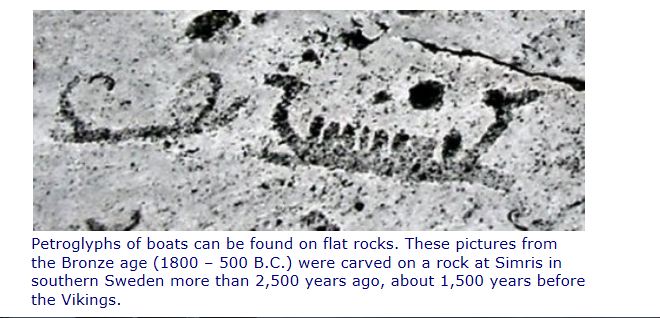 There were people there clearly before the Vikings but it doesn't mean they were necessarily monetarized. I find it amazing to think that approximately 5,000 generations lived their lifes before dreaming up money and I wonder how many times it was independantly invented since it seems such an obvious idea...(the world after all has had pockets of people that remained cut off from the rest, lived and died maybe undiscovered, who knows what occurred before historical records began?) |
|
Bedrock of the Community
United States
10045 Posts |
That's a cool petroglyph--obviously the basic "Viking" ship design far predated that culture.
I had forgotten about the Hedeby coins. No doubt pieces of gold and silver sufficed as money long before there were banks and central authority issuing currency. In the Viking era, there may have been an informal issuing of money based on metal value. Check out the symbols on the gold above--that arch symbol is found on a lot of Viking-era money, which I've linked to above.
|
|
Pillar of the Community
United States
5155 Posts |
Why mint coins it seems a heck of a lot easier to show up and take them...Great background information, maybe my people where not all that civilized as to make fine works of art in antiquity, ah well what can you do? Seeing as I don't have a long boat full of cash, I suppose I should just do what my ancestors did... head out, and procure easily accessible coins.
|
|
Pillar of the Community
United States
1316 Posts |
I have a little Norski in me too!..very good info, thanks Master Anoob...  |
|
New Member
Norway
2 Posts |
I live in Norway, and my ancestors can be traced back to the early 1100's here in Norway. And I'm a very serious coin collector, I'm so lucky to have a very early bracteat with a capital B in the middle, it's from 1100's like my ancestors. The Norwegian minted coins from that era is unbelievable rare. Even the highest expert on those coins who is responsible for the coins from the "viking era" on the Norwegian coin gallery in Oslo have many coins even he hasn't seen. Like the wery few coins minted in Trondheim just besides the Nidaros Cathedral and the Archbishop's Palace are located side by side in the middle of the city centre. The cathedral, built from 1070 on, is the most important Gothic monument in Norway and was Northern Europe's most important Christian pilgrimage site during the Middle Ages,[17] with pilgrimage routes leading to it from Oslo in southern Norway and from the Jämtland and Värmland regions of Sweden. Today, it is the northernmost medieval cathedral in the world, and the second largest in Scandinavia. Also the oldest parts of the cathedral consist of the octagon with its surrounding ambulatory. This was the site of the original high altar, with the reliquary casket of Saint Olaf, and choir. Design of the octagon may have been inspired by the Corona of Canterbury Cathedral, although octagonal shrines have a long history in Christian architecture. Similarly, the choir shows English influence, and appears to have been modeled after the Angel Choir of Lincoln Cathedral.
|
|
New Member
Norway
2 Posts |
and the coins minted in Trondheim was minted under Archbishop Olav Engelbrektsson who served as a leader of Norway in attempting to resist the Danish Reformation but was forced into exile by King Christian III in 1537. The archdiocese was abolished and replaced with a Lutheran superintendenture. I was there checking out the remains after the coin workshop there earlier this year. it was realy interesting!!
|
|
Pillar of the Community
United Kingdom
946 Posts |
Last month I had the luck to win a small piece of my heritage, this AE Half Chalkus of King Tigranes II of Armenia (Herakles type, Bedoukian 101), 95-56 BCE, from a "Gitbud & Naumann" auction. 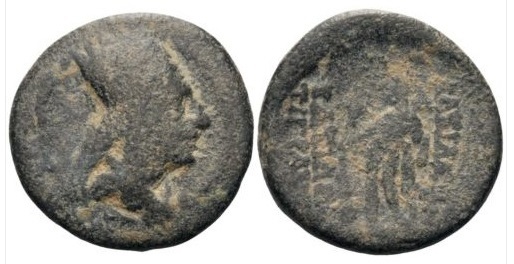 |
|
Pillar of the Community
United States
1315 Posts |
This is a cool topic.
My ancestors are Czech. Wikipedia has this:
The Czech people are primarily descended from Western Slavs[12] who settled in Bohemia, Moravia and Austria in the 6th century, and mixed with Celts, the Gallic tribe Boii, and Germanic Marcomanni and Quadi in the 1st century.
Maybe with some research I should be able to find a coin or two.
Thanks Anoob!
|
|
Pillar of the Community
United States
1315 Posts |
|
| |
Replies: 16 / Views: 3,666 |
To participate in the forum you must log in or register.
Disclaimer: While a tremendous amount of effort goes into ensuring the accuracy of the information contained in this site, Coin Community assumes no liability for errors. Copyright 2005 - 2026 Coin Community Family- all rights reserved worldwide. Use of any images or content on this website without prior written permission of Coin Community or the original lender is strictly prohibited.
Contact Us | Advertise Here | Privacy Policy / Terms of Use
|
| Coin Community Forum |
© 2005 - 2026 Coin Community Forums |
| It took 0.45 seconds to rattle this change. |
 |
|
| |
| |






 Posted 11/25/2012 10:22 pm


