| Author |
 Replies: 9 / Views: 8,113 Replies: 9 / Views: 8,113 |
|
|
Pillar of the Community
United States
522 Posts |
Hello,
New to the early halves and I have a question. In many bust half related posts, I see a designation like "O-101, R1". I can't figure out this classification system. In the edition that I have (1967) the varieties are listed by year and then a number starting at 1. These designations are based on assigned numbers for the obverse die and letters for the reverse, both of which may have variations. So where does a type like O-101, R1 come from? I must be missing something here.
Thanks
|
|
|
|
Pillar of the Community
United States
1432 Posts |
Johnny . . The master numbers begin with 101, for the first variety listed under each date and follow in numerical order to the last die marriage listed. Only one master number is assigned for each die marriage. 101a would be from the same pair of dies but indicates a different die state. Using 1795 as an example, with a mintage of just under 300K, 19 obverse and 22 reverse dies were used. The combination of 41 obverse and reverse dies produced 32 separate varieties. In addition, 12 of the 32 have "a" added for a total of 44 different sets of attributes for just this one example. As for the R (rarity) ratings, here is a chart showing basic guidelines. Hope this answers your question.  |
|
Pillar of the Community
 United States
522 Posts |
Thanks jeffrose but I am still wondering about some posts on this site. For example https://goccf.com/t/103963&whichpag...Cbust%2ChalfThis is a really great thread and I've been looking at some of the coins and trying to match them with die varieties. On the above linked page you'll see Moe145's post (second one from top) of 1827's. His third coin is attributed (O-146, R2) (Curl Base 2); however, in the Overton book the curled base 2 varieties start at number 87, which from what I understand would be O-187. So, I am still not getting it. Sorry if this is a dumb question but I feel stuck with this. |
|
Valued Member
United States
168 Posts |
Jeffrose has given you good information. Each year starts with an O-101 die marriage and this number increases with each new die marriage. Similarly, new die states of established marriages receive a letter such as O-101a and so on. The rarity number (R) is given for the estimated extant population of any given variety. These go from R1 (common) to R8 (unique or nearly so).
I do not have a copy of the 1967 Overton book, but I would suggest you buy a copy of the third edition (1991 or thereabouts) or fourth edition (2008 or thereabouts). The book has changed some over the years and the comment about number 87 may be something that has changed.
|
|
Moderator
 United States
23522 Posts |
Quote:
however, in the Overton book the curled base 2 varieties start at number 87, which from what I understand would be O-187 I have no idea where that bit of data might have come from; there are 49 Overton varieties for 1827, and only one curled-base 2 die paired with two different reverses. My Overton (3d Edition) mentions nothing about "87." |
|
Pillar of the Community
United States
522 Posts |
Thanks for the info. I'll check out a new edition. Here's a sample page of what I was talking about. 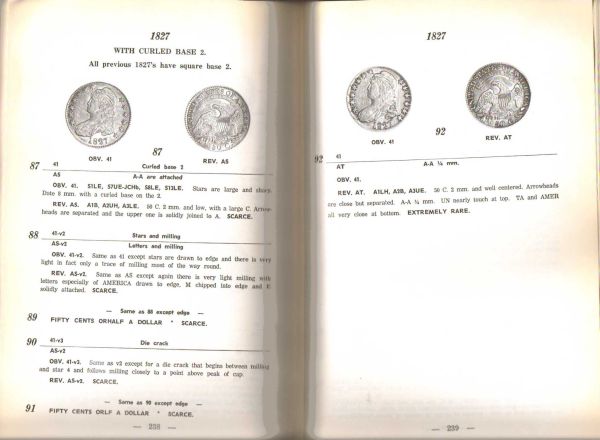 |
|
Valued Member
United States
168 Posts |
It appears the way the book is written has been changed. You would be very wise to use a much more updated version instead of one published 45-years ago.
|
|
Moderator
United States
23522 Posts |
Ah, I see now. Yes, the naming convention is entirely different these days.
|
|
Pillar of the Community
United States
4897 Posts |
I have the 1970 2nd (revised edition). There is and added table that explains that " Due to the elimination of minor die states, duplicates and the seperate listing of edge varieties, many old numbers have been consolidated into just one new basic die variety number." Hence the " New Master Numbers".
|
|
Bedrock of the Community
United States
17884 Posts |
Yes the problem is the old book. The 1967 edition was a first start (It was better than Beistle) but it had a lot of problems. In it Overton assigned the numbers starting at 1 and running straight through the series not starting over again for each year. When he changed that in 1970, I believe he started each year with 101 so there would be no confusion between the old numbers and the new ones. Another problem he corrected can be seen in the page illustration above where he assigned a new variety number because of a difference in how the edge read. In the later book he realized this was cause by slippage in the Castaining machine or from not fully retracting the machine to its starting position. So all the edge variations were pulled out to their own section and do not determine the die variety.
|
| |
Replies: 9 / Views: 8,113 |
|










 Posted 12/16/2012 11:28 am


