| Author |
 Replies: 14 / Views: 1,660 Replies: 14 / Views: 1,660 |
|
|
New Member
11 Posts |
|
|
|
|
Moderator
 United States
14463 Posts |
do you have a specific question?
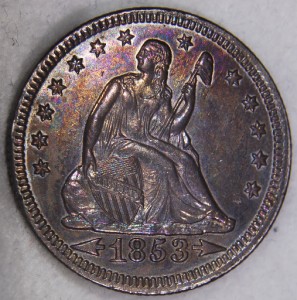
It looks real, AU-MS quality. Others can give more expert opinions and perhaps a possible value.
|
|
New Member
 11 Posts |
what value do you think it is ?
|
|
Moderator
United States
14463 Posts |
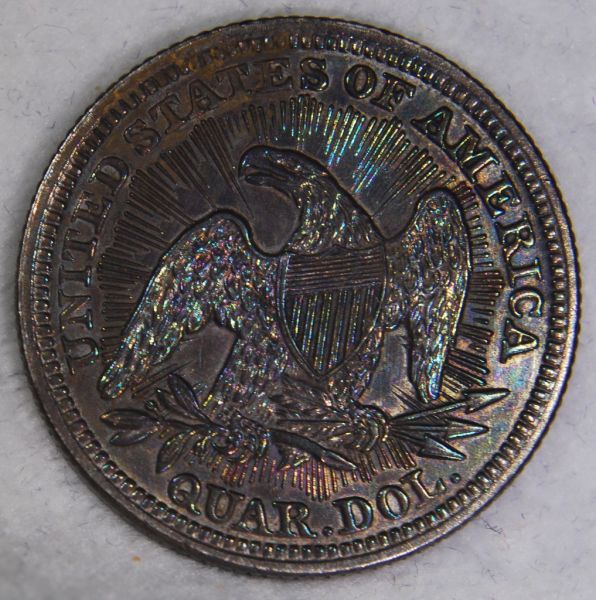
is that the actual color? it should be silver and brighter
|
|
New Member
11 Posts |
|
|
Moderator
United States
14463 Posts |
according to the CCF US Coin Facts for a Seated Liberty Quarter: Diameter: 24.3 millimeters Content: 90% silver 10% copper Weight: 6.2 grams Edge: Reeded does it match all those  |
|
New Member
11 Posts |
|
|
Moderator
United States
14463 Posts |
only guessing that it's real and unaltered(uncleaned): if its raw, $200-$500 if its slabbed and graded in the AU-MS range, perhaps the raw guess x 10 Do not take my opinion as gospel. Wait for an expert's opinion and nice looking coin 
|
|
Pillar of the Community
United States
6429 Posts |
This is a common and inexpensive coin in low grade but the value escalates rapidly in higher grades, approaching $1000 (retail) at the lower end of the Mint State (uncirculated) grade range. Your coin appears to be uncirculated or very close to it. However, the toning is maybe a problem, particularly on the reverse. I've never seen that jewel-tone effect on a naturally-toned seated coin and would presume this one has been artificially "enhanced" to produce this effect.
If this coin were professionally graded by, say, PCGS and they judged the toning to be natural the value could easily exceed the $1000 mark. If however it was determined to be "Mint State details, artificially toned" it would likely be worth much less than half that value.
This is a very pretty coin but unfortunately the color is "too good to be true" IMO.
|
|
New Member
11 Posts |
how much do you think my coins worth jaobler ?
|
|
Bedrock of the Community
United States
10982 Posts |
This coin really needs professional, in-hand evaluation to determine value. It looks artificially toned with near MS details.
As-is my guess would be $300 to $400. Could be much higher but needs a slab to actually get it.
|
|
Pillar of the Community
Australia
2830 Posts |
that's a stunningly beautiful coin.
I'm trying to put together a year-set of 1853, and I dream of finding something like that.
|
|
Pillar of the Community
United States
6429 Posts |
Quote:
how much do you think my coins worth It's important to understand that collectors pay much more for ORIGINAL coins. Any piece that has been harshly cleaned, dented, scratched, bent, or otherwise mishandled loses a big percentage of its potential value. The "problem" with your coin is the suspicious color. If you try to sell it on ebay for example you might get $300-400 as previously mentioned. Most potential buyers would see the bright colors and presume the coin was chemically altered to make it look that way. If however that coin was submitted to a professional grading service like PCGS and they determined the color was OK (i.e., naturally-developed, not an artificial enhancement) they would put it in their tamper-resistant slab with an assigned grade. With the coin in a no-problem PCGS slab the color becomes an asset rather than a liability because it is after all very pretty. Then potential buyers will open their wallets much wider. Here are some sale prices for this date from Heritage (a major auction company) during the last year. All are for coins in no-problem PCGS slabs. AU-53 grade: $374; $382. AU-55: $489; $518. AU-58: $764. MS-62: $1208; $1265. MS-63: $1495. MS-64: $2768; $3450; $3755. If your coin didn't have any color issue it looks to be in mint state to me and could grade MS-63 which puts it in the $1500 ballpark. But, that is a huge IF and you would only realize that high price if it were certified, preferably by PCGS. The more likely outcome IMO is that PCGS would certify it as "mint state (MS) detail, artificially toned" in which case it would be back in the $300-400 range, most likely. It might still be worth having it graded, because the PCGS holder means the coin is genuine and that itself can reassure buyers, even if the toning problem is described on the label. Many would pay more for a slabbed problem coin than for the same coin offered as raw (i.e., not slabbed). I've written this long-winded explanation because this is a very common situation: someone has a potentially high-value coin that has a "problem" and they don't understand why it doesn't bring a high sale price. It's because collectors with deep pockets want the best and usually won't dig deep for any coin they don't judge to be original. Hope that helps! |
|
Valued Member
United States
366 Posts |
Coin should be sent a third party grading service - PCGS, NGC, ANACS. That would help establish value.
|
|
Valued Member
United States
240 Posts |
Is it just me or does the coin appear to have been cleaned and at? No I am not an expert and still learning. It appears to have a lacquer finish to it.
|
| |
Replies: 14 / Views: 1,660 |
|









 Posted 12/17/2012 12:45 am





