| Author |
 Replies: 13 / Views: 38,448 Replies: 13 / Views: 38,448 |
|
|
Valued Member
Australia
335 Posts |
Hello, Over the past year or so, counterfeit $2 coins have been found by collectors when checking their change for decimal errors and varieties. The majority of these have turned up in Sydney and Newcastle but they have been found at the Gold Coast in Queensland and south into Victoria, probably distributed by unsuspecting tourists and travellers. The majority of coins are dated 2003 though one has been found dated 2002. There has been no mint, government or police announcements that these coins are circulating. Most bank staff at least outside of Sydney and Newcastle seem to be unaware they are there. I know of counterfeit coin notices with images have been in some Sydney banks. Because the Australian two dollar coin is small like a 5 cent coin, few people bother to look closely at it when they receive their change and thus this is why it has been so successful. A close examination however reveals some unique features not present on the genuine Australian $2 coin. On the reverse, the image of the Aboriginal elder is not clearly defined, the strands of hair at the back of the head are different, the face only shows one eye, not two and the grasstree to the right of the 2 has a broken base line and is weakly defined and the end of the 2 can be pointed instead of blunt. The obverse is even more distinct from the genuine coin. The hair of the Queen is very course and lined, her nose rounds down than curves slightly up before the tip, the top two tips of the crown are longer, the base of the lettering is curved or fish-tailed, the IRB is not parallel with the base line of the neck, and the left end of the neck's base is over the EL of ELIZABETH on most coins though there is one 2003 variety where it is over the E as with the 2002 fake and similar to the genuine coin. Apart from the coin dated 2002, three obverse varieties of the 2003 coins have been sighted. The edge's interrupted reeding is also weak and does not appear to spand right across the edge. The coin's colour can be much yellower in less circulated coins. It is illegal to knowing trade counterfeit coins for goods or services and any coin passed or found is forfeited as the loss of the possesser. Despite this some coins have found their way onto ebay where the seller believes them to be some error or variety or they state this may be fake. Bidding has gone into the $60 Australia range for such coins. The counterfeiters might have made more selling them on ebay. Below are some images.  Reverse of two counterfeit coins and one genuine coin (right). Reverse of two counterfeit coins and one genuine coin (right). Obverse of two counterfeit coins and one genuine coin (right). Obverse of two counterfeit coins and one genuine coin (right). Edge of two counterfeit coins and one genuine coin (right).Below are the Obverse varieties so far identified and the seemingly common reverse of the Counterfeit $2 coins Edge of two counterfeit coins and one genuine coin (right).Below are the Obverse varieties so far identified and the seemingly common reverse of the Counterfeit $2 coins Images courtesy of several forum members from Australian Coin, Token and Banknote Forum. Happy hunting. Edited by Brissyboy
04/09/2007 07:09 am
|
|
|
|
Moderator
 United States
23779 Posts |
NEWCASTLE ? Bigfella are you finding a new way to make a profit?  rggoodie
aka Richard
"catch em doing something right"
|
|
Pillar of the Community
United States
1173 Posts |
Thanks for the post, Brissyboy. I'm not likely to run across any Australian coins at all, but your photos and detailed analysis go a long way toward educating all of us in the spotting of counterfeits of any variety.
|
|
Pillar of the Community
Australia
853 Posts |
Nice summary Wayne. Gee you have pumped out some good work lately...particularly in CAB.
The first and only one I came across was from a workmate of mine when I was working for the tax office. I took it to the guy that owned my shop (he has now passed on) and who verified it as a counterfiet. It was handed back to my workmate who I believe still has it. I have heard of a few others floating around but have not seen another.
The striking features about the one I SAW WAS IT WAS A "WEAK" strike and under weight.
|
|
Pillar of the Community
Australia
3841 Posts |
I'll put another exception to this, that is I have one that is "dated" 1997. Suprisingly it weights about the same as a genuine 2 dollar coin. 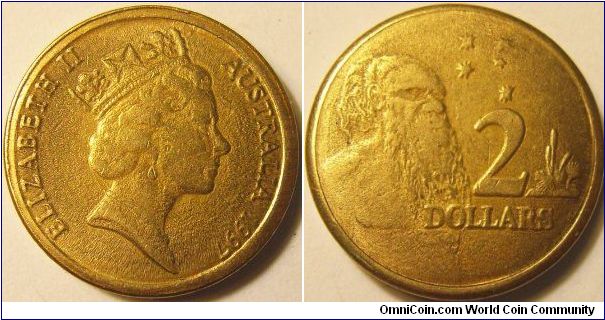 My partial coin collection http://www.omnicoin.com/collection/gxseriesMy numismatics articles and collection: http://www.gxseries.com/numis/numis_index.htmRegularly updated at least once a month. |
|
Valued Member
 Australia
335 Posts |
Hi gx,
What makes you think this coin is counterfeit? It looks genuine from what I can see of the image.
Would love for you to give more details.
Wayne
|
|
Pillar of the Community
Australia
1262 Posts |
I agree with you brissyboy, looks real to me just a bit worn. Looks nothing like the err....err...error coin I have.  |
|
Pillar of the Community
Australia
3841 Posts |
Wayne, it should be rather obvious that from the ultra low relief of the overall "coin", something is unusually suspicious. I guess my photography of those two coins aren't too convincing. I'll retake them soon but I can assure you that it's definately not real. When I got it in change, I noticed it immediately. Here is an example of a normal 2 dollar coin for comparison of the same year: 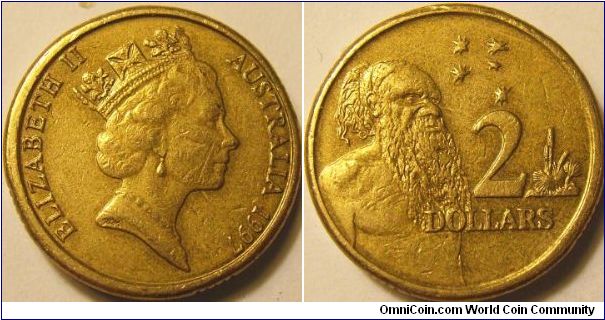 What should be more obvious is the text - they don't seem very sharp at all. The background surface of most 2 dollar coins or 1 dollar coins after circulation are usually smooth with some scratches here and there. The rim too is another sign that it was made from cast. And finally I haven't taken the pictures of the edges too but it clearly shows that it's weakly done. More pictures to come I promise - give me a few hours. |
|
Pillar of the Community
Australia
3841 Posts |
Here are better pictures that I promised. They are the same 2 dollar coins that I have shown earlier on:  And here is one view with the edge with two extra coins to show that I wasn't rigging this photo:  The "counterfeit" is the third coin on the left. Notice that the edge engravings is relatively weak with unusual "cracks" as well as, if you look carefully at the planchet size, it's definately thinner and wider than an normal one. Not suspicious enough? I'm not too sure if normal wear can cause edges to wear off, unusual background surface as well as thinning of planchet AND enlargement of the planchet. In conclusion: there is no way this can be a genuine 2 dollar coin. Even a coin dating 1988 that I pulled from circulation shows any of these signs. My partial coin collection http://www.omnicoin.com/collection/gxseriesMy numismatics articles and collection: http://www.gxseries.com/numis/numis_index.htmRegularly updated at least once a month. |
|
Formerly nancyc
Australia
5385 Posts |
I've seen quite a few of these 'grainy' looking $2 coins & assumed they'd been cleaned or dipped in some solution that had removed some of the surface making them look pretty different. I'd probably see at least 1 a month that look similar to this.
Wayne, If you like next time I get one I'll email you & send it to you to examine more closely.
I hung on to one for a while as I doubted it's authenticity, but after I found a real counterfeit, the difference was obvious so then I sent the first dubious one to the bank.
|
|
Valued Member
Australia
335 Posts |
I can see some difference now such as texture and the size looks slightly larger.
Thanks Nancy, I would appreciate a closer look so if you get another do let me know.
I have asked Ken (Secret Squirrel) to have a look at the images.
Wayne
|
|
Valued Member
Australia
161 Posts |
I have these and dont think they are counterfeit at all. What I have found is its due to a low pressure strike. Take note of the obverse double type rim. The outter one is the original rim that gets applied by the upseting mill when changing blanks into planchets. The inner one is what you get from the striking of the coin. With the correct pressure these 2 join flush to produce a single fully struck up rim.
|
|
Pillar of the Community
Australia
3841 Posts |
Ken, I beg to differ. What are the chances that it's a "low pressure strike" as well as on a thinner and larger planchet? If it was a high pressure strike, I might be able to understand but not the other way around.
I should do a metal test later to see if it does sound the same.
My partial coin collection http://www.omnicoin.com/collection/gxseriesMy numismatics articles and collection: http://www.gxseries.com/numis/numis_index.htmRegularly updated at least once a month. |
|
Valued Member
Australia
161 Posts |
Thinner and larger planchet? Sorry I never noticed that about your coin. Mine are on standard planchets with correct weight and the obverse and reverse are exactly the same as your image. I have both 1997 and 1999 and they go back as far as 1992. A larger than normal coin wouldnt fit into a collar.
Incorrect strike pressure can be accidently done easy if the previous coins struck on that press were say a 5c or 10c where they dont need the same pressure to strike up a coin.
|
| |
Replies: 13 / Views: 38,448 |
|










 Posted 04/09/2007 09:31 am


