| Author |
 Replies: 30 / Views: 6,463 Replies: 30 / Views: 6,463 |
|
|
|
Valued Member
 Germany
194 Posts |
By the way, here is another MVA coming up in the next Stack's Bowers auction. 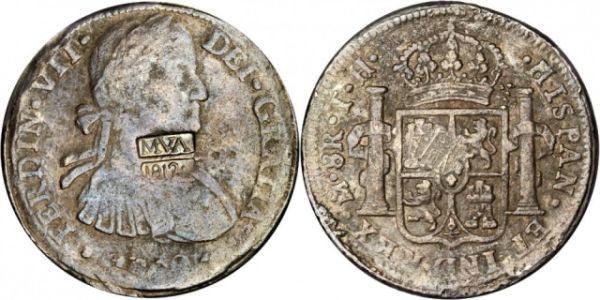 This one made me think, because the host coin in its crudeness especially in the legends resembles much more a production of the Insurgents in the south than of the Monclova mint. I don't want to cry foul here. It just came to my mind: if I were a counterfeiter in possession of a fake MVA punch and of one of the cast coins of the Insurgents that don't show a counterstamp (most of them have at least the Morelos mark, but they do indeed exist without counterstamps), it just would make a perfect combination  . Also, such a coin would look as if the counterstamp was recently applied, unlike the other MVA coins where the depressions in the counterstamp always appear dark. |
|
Pillar of the Community
United States
5362 Posts |
DosMundos I am in complete agreement with you that the stamp seems anomalous. The inverted presentation always bothered me. However, the basis for acceptance of the stamp as possibly real is the Pablo Gerber, Sr. Collection Part 2 sold at the Spink's America Sale of June 3, 1996 # 8350, Lot # 87. The coin sold for $990 and is listed as a "cast" Mexico City piece. I am working on that right now to try to verify all the facts. I may have a small edit in text to make.
|
|
Pillar of the Community
United States
5362 Posts |
DosMundos I got an answer which surprised me. The coin cited has the stamp in the correct orientation not in the inverted position. So I am going to re-write the description calling a a counterfeit stamp. I guess my gut feeling was correct all along.
|
|
Valued Member
Germany
194 Posts |
Swamperbob: Yep, Lot 87 is an MVA/1811 on a cast 1809 Mo 8 Reales, host coin and stamp just as they are supposed to be. So it's not only your gut feeling, but Mathieu's and mine as well and there's still hope for us  I hope that makes up a little bit for my inability to spot the TC copper host for the fake counterstamp trials  I take it that you don't have the Gerber catalog at hand - the preceding lot 86 is an MVA/1812 on an 1817 Chihuahua 8 Reales - a very nice example of the later use of the stamp as a validation counterstamp, as I have laid it out above. Neither the numismatic writers nor the catalogs really get this differentiation between the MVA stamp as mint mark of the Monclova mint and the same counterstamp as a later validation punch of issues produced in other mints. These validated coins are much rarer by the way, judged by auction appearances... |
|
Pillar of the Community
United States
5362 Posts |
dosmundos I do not have the Gerber catalog - I have several thousand old catalogs but I doubt Gerber is in there. They are the residuals out of a large estate and tend to be low or no value catalogs that I want to sort out sometime. When I have some EXTRA time.
|
|
Valued Member
Germany
194 Posts |
For the sake of completeness:
Heritage has pulled the coin from the auction.
Thanks to Swamperbob for your valuable support!
|
|
Pillar of the Community
United States
1769 Posts |
THere is alot of work to be done in the War of Independence Mexican Issues -- I may start a new collecting venue here ...
John Lorenzo
United States
Dod Mundos these T & Pillar of Hercules countermark cast issues - what is the silver content supposed to be on these issues. Although cast - is the silver suppose to be 90% or so ...
|
|
Valued Member
Germany
194 Posts |
As issues of a regular and official royal Spanish mint in Chihuahua, fineness and weight should be as close to the official standards as possible. I would assume the same holds true for the Monclova casts discussed above.
Riddell shows No. 35, a Chihuahua 8 Reales, and gives a fineness of 916/1000, but notes that the assay was made from "ten Sand Dollars melted together", so we don't know if they all had come from the Chihuahua mint.
Only the cast issues of the Insurgents in the south apparently were often made from debased silver
|
|
Pillar of the Community
United States
1769 Posts |
Yes Dos Mundos. Bought my first cast 1812 piece from the Mexican Coin Company at the NYITL and an XRF analysis did show it as a debased silver alloy with the normal high copper content like the CC8R's Class 2 China pieces - sort of like a billon type alloy. From memory around 60% Ag, 30% Cu and other metals. Unlike copper casts lead is not needed in the alloy mix to make a good cast silver (i.e., Pb~0.5%). As with most cast they are ugly so prices are lower - this is predictable as most collectors regard casts as ugly and hence not worthy of strong prices. We bring this in from our earlier days of liking NICE shiny new coins ... the MS 65 mentality <BG>. We can't escape totally from our naive beginnings <BG>. Anyway - This is just one example but as we proceed forward they are struck over cast examples as we proceed away from this early 1811-1814? period as you know. Again no reference here at work ... this is indeed an interesting area of research. I recently joined the Mexican Numismatic Association ... as you may know my previous experience has been with the off-metal 2 Reales of Spanish American Mints (Kleeberg types) and working with Gurney & Nichols on the new CC8R book of Portrait 8R's via the ANS primarily in cataloging coins and metal testing all the types of different alloys in this series. There is much work to be done with metal analysis in this field (Mexican - War of Independence) ... you may see some articles soon in the MNA journal from me ... <BG>.
John Lorenzo
United States
|
|
Valued Member
Germany
194 Posts |
John,
I'm definitely looking forward to this as I think there would be a chance to solve some of the mysteries surrounding these issues through XRF analysis.
Apart from the obvious use in detecting modern counterfeits...
May I ask what kind of cast coin you used for the analysis? Was it counterstamped in any way? Did it come from the Chihuahua mint or from the southern Insurgents?
|
|
Pillar of the Community
United States
1769 Posts |
Sure it was from the Chihuahua Mint with the T and Pillar of Hercules (as described) countermarks from the Mexican Coin Company. I have another coming my way from a major Puerto Rico dealer of high standards (my opinion). Now as I understand these earlier issues were struck over with good dies in a screwpress after 1815 or so (no book in front of me)? - so are these all cast based but with the later ones just struck over with dies? I think the mystery or dilemma here is most people believe these are of a high silver or good silver content - never debased? Yes or No? What is the current thinking beyond Pradeau ...
|
|
Pillar of the Community
United States
5362 Posts |
Hi John - you know my opinion, but the forum members may not.
Riddell and Hort who melted at least 50,000 of these War Time hammered and cast issues per year at New Orleans did not report finding any with a significantly debased alloys.
Circulating dollars as condoned by the mint and businesses did not assay under 94 cents per coin before they were melted down for re-coining by the mints.
I have found no records from the mint regarding coins from Mexico that failed to pass muster anytime before 1825. The coins tested routinely were considered adequate for circulating as dollars in US commerce. Such was not the case for coins that were 6% under assay.
Specific gravity as a test for a bad dollar coin became a very common practice at some point before 1839. A simple balance scale accurate to 1/10th gram was accurate enough to isolate a coin with a density below circulating tolerance.
The density test was introduced into China in the 1830s and it was used in the US and Great Britain as early as 1796 by banks.
So the existence of large numbers of significantly debased copies (by this I mean 30-40% below standard) seems to be beyond the realm of possibility. The coins would have been local tokens only and would have been unacceptable in general commerce.
Think of it in example form. In 1815 a dollar was an average week's wage in the US - more in Mexico I suspect. Who in their right mind would accept a payment of 60 cents in place of a dollar. That would be a massive pay cut in terms of actual buying power. Remember that Mexican insiders (banks with connections to the leased mints) used to pull out coins as little as 1-2% overweight for salvage and refused to accept coins that were 5 cents under.
What was the market for a 60 % silver dollar?
I see the answer to that question as being the budding collector market as soon as it began to develop in the late 1800s and early 1900s. Technology to make a crude cast copy of a Chihuahua issue is relatively easy. So a cast copy of a collectible item selling for $1-2 that cost about 25 cents to make (silver value of a 60% assay in 1890) would be a GREAT profit margin.
That is why I think a detailed study of these "so called" debased but "GENUINE" coins needs to be done. I would be interested in looking at trace elements (contaminants) that are out of place in silver mined in Mexico in the 1810-1815 period. Conditions were crude but to get into the silver every element had to exist naturally in Mexican ore. There are a few elements that were first discovered in the 1900 to 1910 period that were present in some of the Class 2 coins you tested for me.
I would of course look for the rare earth electronics elements (super-conductor connections) because they would prove a VERY modern forgery after 1970. But also I would look for trace contaminants that might be missing from silver refined in the 1880s and later (gold, platinum and palladium - in very minute traces). These elements were parted effectively in 1890 but not in 1810.
I think we need to get a complete inventory of all results of XRF tests of silver coins to date and graph the trace contaminants down to as fine as they can possibly be tested - on the order to 10-20 PPM.
The elements like iridium, indium, yttrium and molybdenum are great starting points. Some of these elements are unknown in native Mexican ores so the answer to their presence can in my opinion ONLY point to some source for silver OTHER than Mexico.
I recall one element (can not recall which) that is found only in ores native to Asia which was used commercially only after 1906 primarily in furnace linings in silver refineries which was present in some of my Class 2 coins. To me that trace contaminant is absolute proof of age. If it occurs in a Chihuahua casting the coin can not be real. There was another additive that was added to silver flatware in 1936 as a tarnish preventer. I found thta one in one of nthe Class 3 Numismatic forgeries. But that element was also NEVER in silver in any form prior to 1936. The origin of the metal not in the Americas.
These are the kinds of things I would start hunting for in the Wartime issues in general. More research into ores and their components needs to be undertaken. What are natural concentrations of say iridium in Mexico and why does it seem to be in higher than appropriate percentages in some coins?
I suspect that a large percentage of these crude coins are not in fact originals but were fantasy fabrications to take advantage of a market that was buying coins faster than they could be studied - especially in the 1950s. This market once saturated with fakes started accepting the fakes as genuine and the "experts" backed up the sales with very un-scientific data. Once accepted as originals it is hard for "experts" to back track on their opinions.
Just an early stage theory on my part but one I would like to study in far more depth. There are JUST TOO MANY of these cast Chihuahua coins around to believe they could all be real. Simply makes no sense to me.
|
|
Valued Member
Germany
194 Posts |
A 30-40% debased cast from Chihuahua is clearly a suspicious item. The Chihuahua mint produced cast copies in the early years and struck coins from 1814 on (If I am correct). In later years, these earlier casts were often used as planchets and struck over with regular dies. It is said that this was done so the actual and official bust of the king would be on the coins. We may assume that it was also a cheap method of increasing striking numbers and thus raise the coinage fees.
However, there is no reason why the mint would have wanted to produce coins below standard. They already had the problem of the people looking suspiciously at the coins because they were cast, which is why they were validated with the "T" and "pillars" punches. Chihuahua coins circulated throughout the country (there are even a few known with Philippine counterstamps). As Bob mentions, when they were assayed by Riddell, they were found to be good.
Nevertheless, reports exist that there were many complaints in Chihuahua about the cast coins having been counterfeited almost immediately after their release. Irregularities existed, who knows whether there was some moonlighting at the mint, or a fraud involving the punches, or whether somebody simply turned counterfeit coins into official mint products at a later stage by applying these punches. What I mean to say is that not every debased Chihuahua coin needs to be a later production. Of course, only an XRF examination could shed the necessary light on this.
The Insurgents in the south also produced cast copies of Colonial 8 reales, however, these coins should more frequently be found debased, as the Insurgents deliberately made them that way to get more coins out of the silver they had. Remember that these were fiat money and that most of the coins were made in copper to be redeemed for silver after the Independence. I am quite positive that the silver issues were seen in the same line of thinking and that no bank or trading house in the regions where the Insurgents operated (if they even existed) would have them assayed for weight and silver content.
As for the question whether the Chihuahua casts were counterfeited in the 20th century for sale to collectors, it would definitely not have been my first choice. I think a maximum of 1.5 million were made in Chihuahua over the whole period (that is, cast and struck), so yes, the early casts should be scarce but by no means unobtainable. As I have mentioned above, the natural object for falsification to defraud collectors (Class 3 if I am not mistaken) would be the Monclova coins â€" same work, equally difficult to detect, much more profit!
Again, an XRF study would contribute a lot of new data to this. I wonder whether the coin dealers and auction houses (and maybe advanced collectors with larger collections) would be very happy about such an undertaking?
|
|
Pillar of the Community
United States
1769 Posts |
Well lets not get ahead of ourselves as I only own one piece which has the legitimate? countermarks but was examined as a debased silver alloy. BTW ... Bob - the gold level was pretty high (0.2-0.3% from memory). Still an unusual piece from the top? company in the field selling legitimate Mexican coins (Mexican Coin Company) to the public - its a low grade piece (Fine). I will be purchasing more this year but if any reader wishes to send me some for analysis let me know for a future article with Mexican Numismatic Association. Could be just an oddity ... just don't know ... this is the beginning ... makes sence Bob - they must be regal type Ag pieces ...
|
|
Pillar of the Community
United States
5362 Posts |
I agree that no decision can be made at this point - just puting out my opinion based on SG and die workmanship.
I think there were and are originals of course I just think that there may be more counterfeits than are normally believed.
|
| |
Replies: 30 / Views: 6,463 |








 First Page


 Posted 01/06/2013 12:02 pm


