| Author |
 Replies: 30 / Views: 6,420 Replies: 30 / Views: 6,420 |
|
Valued Member
Germany
194 Posts |
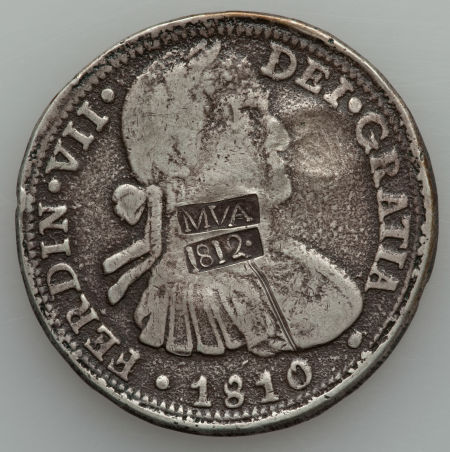 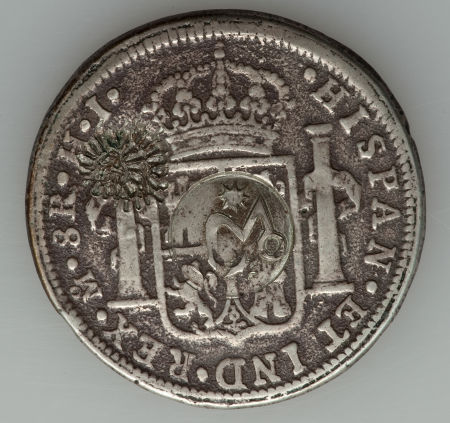 This is a coin that is being put up for sale by Heritage in their next auction. Ever since the pictures were published online, I have been revising the coin. I have contacted Heritage and voiced my concerns about the authenticity of this item. They are currently still reviewing this, their basic standpoint is that they will always be prepared to return the money if ever a third party grading service failed to authenticate it. Well, Heritage is definitely big enough to honor this promise in case of need, and I am definitely not pointing any fingers at them... Since I find this coin very intreaguing (and because of all I can observe through the pictures I am fully convinced that it is a modern day fabrication), I would like to post it here. Maybe somebody with deeper knowledge of this particular series and/or falsifications can contribute anything further to my observations below. The original coin was produced in the town of Monclova in what is now the state of Coahuila in northern Mexico. It is an emergency issue made during the War for Independence by the Spanish Royalist forces that held the city. Attribution is made through the counterstamp, MVA for Monclova and the date 1812 (1811 also exists) in two rectangles, which were placed in the center of the obverse of the coins. It is important to bear in mind that although the attribution is through a counterstamp, Monclova was by all means a mint â€" they issued coins made there and validated them right after production with this stamp (commonly, in numismatics we see counterstamps as punches applied to coins made elsewhere or at earlier times). The coins, however, were not struck, but cast copies were made of regular Spanish Colonial 8 Reales coins from the Mexico City mint. And this is the tricky thing in this case. The ORIGINAL coins of Monclova already were cast copies of real circulating coins, validated through the special counterstamp. So, in order to produce a fake host coin, one would only have to reproduce the circumstances under which the originals were made. If it can be seen that the coin is a cast copy, it doesn't matter â€" the originals are as well. There are now three observations that raised my suspicion: 1) The cast host coin, while still crude and imitating the contemporary casts, is of much better quality than the average Monclova 8 reales. They are very crude coins. Having studied the series for years, I can even say that it is one of the, if not THE best cast I have ever seen! A quick search on the internet for Monclova 8 Reales will turn up pictures of about a dozen coins that have been at auction in the last years, and if you check this coin against these other Monclova coins, I am sure you will see what I mean. 2) The two boxes with "MVA" and "1812" are misaligned. The original counterstamp was made with one punch, and you will never find the two boxes not to be parallel, as it would have been almost impossible to cut a punch and NOT get the two boxes aligned. This leads me to believe that the countermark in question here was actually made with TWO punches, one for MVA and one for the date. Again, if you check against other coins, you'll always find the two boxes of the stamp properly aligned. 3) The third point is concerning the countermark on the reverse center, which is a punch used by the Insurgent leader Morelos. Here it is somewhat more difficult for me to argue with hard facts, but the Morelos countermark is rather off in its style. As simple as the mark is, it seems to be very difficult for counterfeiters to get the style right. Also, the sharp rim and the sharp outline of the script are typical feature that can be observed with later falsifications. The original punch is usually much softer at the edges (it is my theory that the original punch was frequently heated when it was applied, but it is very difficult to test this theory). The third, unidentifiable countermark was intentionally obliterated. In my opinion (and this is only speculation, of course), this was done by the counterfeiter to cover up a wrong third counterstamp he had placed there, in order not to have to throw away the whole coin. Deliberate cancellations of counterstamps are virtually unseen in the Mexican War for Independence series. One thing I could not do was a comparison of the edges. I don't know if the original Monclova coins show a distinctive edge, and if so, which. Interestingly (or rather, sadly), there is no mention of an edge design neither in books or articles about the series, nor in auction catalogs (which could of course only mean that there is none). All in all, this item is extremely doubtful. Of course, I have not held it in my hand and can only judge by the pictures, but there are just too many bells ringing here. The falsification of a complete Monclova host coin along with two counterstamps would be a scary thing! Any comments are welcome!
|
|
|
|
Pillar of the Community
United States
5362 Posts |
DosMundos Good analysis of a troubling coin. It is troubling because of the venue.  Here are the facts as I see them. The coin purports to be a cast made at Monclova in 1812 that was immediately authenticated by the mint authorities there by applying the MVA 1812 counter-stamps dead center. The host coin is a casting of a Mexico City issue which is as it should be. The coin dates to 1810 so an 1812 cast is possible.  Applied to the coin are two counter-stamps - a Morelos type A stamp (two stars) and one you do not identify.  Here are my conclusions: First, the unknown counter-stamp is this one:  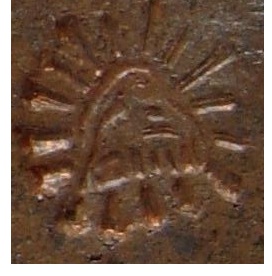 It is more recognizable as a doubled impression like this one:  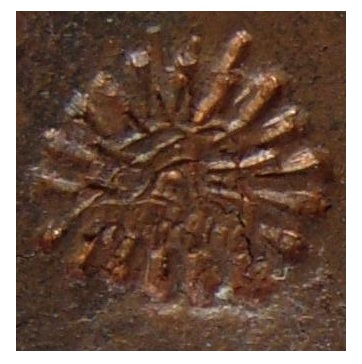 This small liberty cap is a well known if not well attributed stamp from the War of Independence. I can not recall who was responsible for it. Next you have the Morelos type A counter-stamp - here is one of mine for comparison:  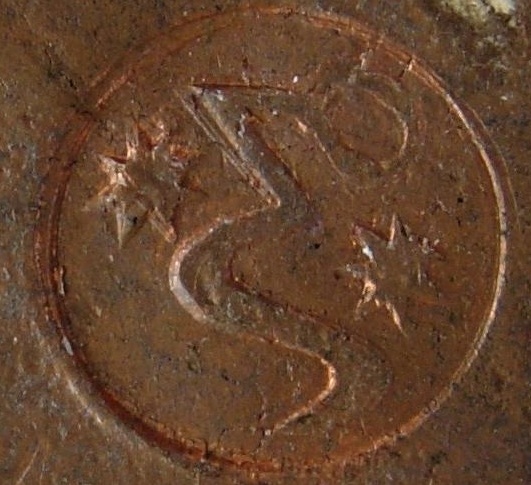 Anyone who knows me has probably guessed at this point that I have a method to my madness in choosing my pair of comparative pictures.  Both of my stamps are applied to a Copper coin. Both are in fact applied to the SAME copper coin. So the association of the two counter-stamps on the same coin is demonstrated. Here is a side by side comparative collage. 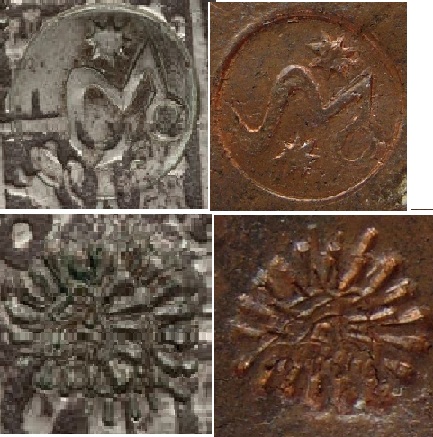 Now at this point, I will digress to a bit of history. First Monclova. Monclova was the area where Hidalgo was captured in an ambush in March, 1811. He and his army were moving north toward Texas having begun the revolution in Guanajuato the previous September (Sept.16, 1810). Hidalgo was executed by firing squad in July 1811, and his head was displayed in Guanajuato. Morelos took effective control of the insurgency after the death of Hidalgo. Morelos was captured and executed in 1815. Monclova was a Royalist mint not an Insurgent mint. This is important to remember. By now I hope most readers have fast forwarded to the obvious conclusion.  Now back to the coin. The MVA 1812 stamp was applied shortly after the coin was cast in a royalist mint in 1812. Yet for some odd reason the application of the MVA 1812 crushed the impression of the Morelos stamp on the other side.  To me that says the Morelos stamp was there FIRST.  So besides a two part MVA stamp which should not exist, you have Morelos counter-marking a Royalist coin BEFORE the maker could apply his own Royalist stamp.  Wouldn't you think someone with the purported credentials of Heritage would NOTICE.  By the way, the stamps I copied to place next to the two on the Heritage coin come from a coin that came from the collection of Virgil Handcock (ca 1970) by way of Richard Long (2002). It came to me in the sale of the last 100 Counterfeits from the Hancock collection that were in Long's possession. It is a coin that was displayed at the Louisiana Money Show in 1964 by Virgil Handcock. The coin is a die trial made by a forger who created the counter-stamps. It is a picture that I included in our new book. Here is the coin itself. 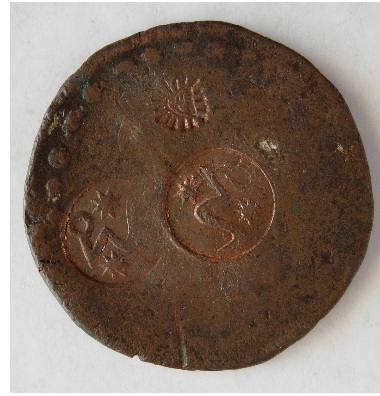 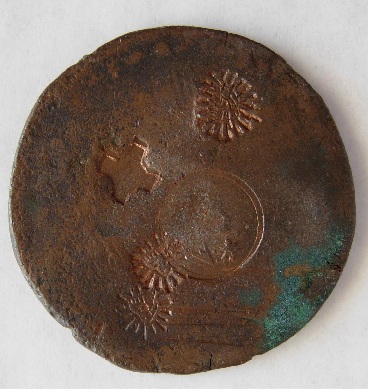 To me there is no question but that the coin has to be a fake but then again I am not a big well paid expert either.
|
|
Valued Member
 Germany
194 Posts |
WOW!  Here I was sitting at my computer, staring at the coin for hours, and all the time there was even the counterfeiter's original "die trial" out there! I have never seen the Liberty Cap counterstamp - are you sure it was modeled after an original counterstamp, and that it is not a later invention, like the purported "Hidalgo" counterstamp (the large letter "H" with the dots around it)? Most of all, I have to admit that I simply missed the most obvious telltale sign - that the MVA counterstamp was applied after the Morelos stamp (which. at least, I correctly identified as a fake). Way to goy for me as a counterfeit spotter  !! Obviously, I you want the right answer, it is better to ask somebody who simply knows than a "big well paid expert" |
|
Pillar of the Community
France
1591 Posts |
Wow, I'm speechless, we have been discussing about this coin since a while on the FB group and with dosmundos !!
You are really impressive swamperbob, even more when you give us a trial for the stamps we didn't liked :P
This coin was one of the best investigation we had since a while :D
|
|
Pillar of the Community
United States
5362 Posts |
dosmundos and MathieuMa Thank you for the complements. This was an example of exactly what my old mentor used to say - don't get into the small stuff until you understand the context of the coin. He had a remarkable encyclopedic knowledge of history, manufacturing, and metallurgy. He was a go to guy in the old days. No one knew coins as well as he did. I am actually not as knowledgeable as he was. Stamping priority is something I am used to looking for. It is second nature. Many forgeries can be diagnosed from the edge alone without even looking at the coin because of edging priority. So perhaps I just observe DIFFERENTLY. So knowing the sequence is the key here. That little stamp is problematic. I believe that it likely never existed as a "real" issue, but it is so crude that it may have been used very shortly after the war in some form. It appears in several catalogs as "unknown". But I have never see it UNDER a truly early counter-stamp in a 100% original coin. Now - did anyone notice the HOST? I am testing powers of observation.
|
|
Pillar of the Community
United States
5362 Posts |
For anyone interested here is a Monclova counter-stamp from my own collection. 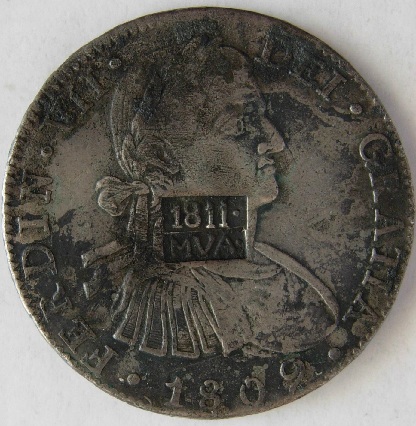 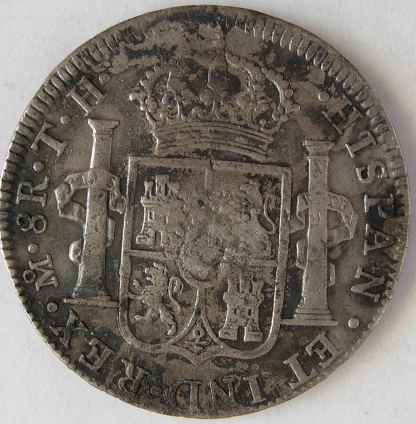 Comments? |
|
Pillar of the Community
France
1591 Posts |
Regarding the host, I didn't liked the edge. But it seems the way it looks, with the denticles not going to the end, is normal :  There is something though, the field have cast high points (from a sand cast ?) - but the high points are very clear. If worn-out a bit, the field shouldn't have so much cast details, but be worn-out as well, no ? BTW, here is a perfectly made cast, which you forgot to mention dosmundos (you knew it, we discussed about it :P ) :  |
|
Pillar of the Community
United States
5362 Posts |
MathieuMa The dentils that end in an arc before the edge of the coin are indicative of cast copies as I have said on many occasions. But the host is supposed to be cast so it is not a problem in this case.
The second picture you post has a serious oddity in my opinion. The anvil used was circular as if the press was set up for a round stamp. The forger in that case took a short cut that caused the edge of the Date to fail to come up.
The molds were made from different host coins. The wear you point to is indicative of a new cast made from a worn original.
I also love the small o inside the 0. Nice touch and a great diagnostic.
Edited by swamperbob
01/05/2013 2:07 pm
|
|
Pillar of the Community
France
1591 Posts |
I shouldn't mix what I'm posting :D
I was commenting regarding the first coin posted.
- Regarding the denticles, I understood that it was normal, we agree on this.
It's just the first thing that I saw, before remembering this was normal for a cast (and looked for other examples)
- Same, regarding the field and the coin's high point. Some stuffs are very clear, while the field has a grainy look. Shouldn't the overall coin be more regular ? (less grains in the field ?)
Regarding the second coin I posted, it sold @ Stack & Bowers for 750 USD ...
I didn't even looked at it more than this.
I just noticed the two blocks of the stamp were not aligned (in addition to the odd circular anvil mark on the back ...)
The test in the 0 looks like a metal test, so someone also had doubts ...
(and the first one I added was just another example to compare the edge)
Now, to finish, regarding yours ... metal looks odd (sheffield ?)
The coin don't look cast (which is not possible for this type of C/S)
The denticles don't go to the end (which is not possible for a struck coin ...)
The stamp is inverted (MVA should be on top), the design is not correct, the two blocks are not aligned, they are not rounded,
|
|
Pillar of the Community
United States
5362 Posts |
The MVA I posted is a struck coin. So yes the counter stamp was not necessary at all. It claims to be a Mexico City Royalist issue. It would not be stamped.  The coin is a thin silver plate on a debased gray metal (likely a debased silver) it is a late Sheffield Plate by my definition. Here is a close up of an area where the plate is peeling away. 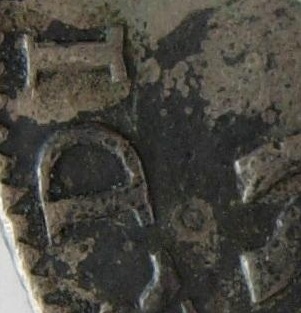 As I said this is a very thin plate - possibly an electro-plate but I am not 100% sure at this time. An XRF of the plate can tell if it is .999 fine or .900. If it is an electroplate (which personally I doubt because of other clues) it would move to Class 3. Actually in person the dentils are OK on this one - the picture makes it look worse than it is. Part of the dentil arc is actually visible at BOTH ends so the entire lozenge is seen. But since it is a fake the lozenges are too short. Your last comment about the stamp is at present under dispute. Spink believes it is a REAL version and the coins they have sold as authentic have identical issues using the same odd stamp. I am not fighting the opinion expressed by my co-authors either way - I believe it is a Class 1 counterfeit. It is still one of my prized early counterfeits with a counter-stamp. |
|
Pillar of the Community
United States
5362 Posts |
Still No One has commented on what the copper host for the forger's die trial is. No guesses?
|
|
Pillar of the Community
France
1591 Posts |
Oh, didn't thought you were asking about this one :)
This is a Tierra Caliente 8 reales, made in copper (with a bow + TC SUD under it on one side, 8R 181X + morellos logo)
|
|
Valued Member
Germany
194 Posts |
I am getting a little confused here about the different coins...
Swamperbob, with regard to your post: the host coin is a silver-plated debased coin, but is there anybody claiming the counterstamp to be real?
With regards to the second one posted by Mathieu from the Stack's auction, this is an interesting thing - usually the counterstamps are full and deep impressions, and this one is not. The punch was not pushed into the coin at a rectangular angle.
There are, however, examples of Monclova counterstamps that are not perfectly struck. These are the ones that are found on later coins from the Chihuahua mint. This is because the minting operations themselves were stopped around 1813 in Monclova, but the counterstamps were used in later years to validate other Royal issues - mainly the Chihuahua ones. The one in question here, however, is not one of these later issues...
Well, my wife is getting a little angry because I've been staring at the computer screen for too long, so I'll have to admit defeat: no, I don't recognize the copper host coin for the punch trials...guess it's not something Mexican?
P.S. regarding Monclova "errors" - I remember having seen a coin at auction where the box with the date was empty (I hope to remember this correctly), unfortunately I didn't take a note of the coin, so I don't know when or where I saw it...I only remember that I found it very strange and rather inexplicable...
|
|
Pillar of the Community
United States
5362 Posts |
MathieuM - You are absolutely correct. The best surviving detail is the decoration around the perimeter a series of stars and dashes that alternate. Great job. 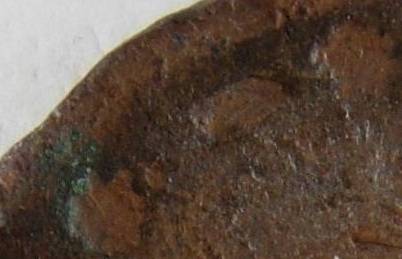
|
|
Pillar of the Community
United States
5362 Posts |
dosmundos - The second Stack coin has rounded edges and a partially missing edge because of the ROUND anvil.
That screams hydraulic press to me.
Regarding the stamp - yes there is disagreement over the nature of the stamp. I believe fake but I have been over ruled to data. Do you have anything that proves beyond all doubt that the stamps were not used after 1815 to authorize Royalist strikes?
|
|
Valued Member
Germany
194 Posts |
Swamperbob, with regard to your MVA/1811 coin: What is the explanation of the experts why on this stamp the date and "MVA" are exchanged? That would be a highly unusual engraving error. Besides, these seem to be two separate stamps. As I stated in the beginning, I don't find any evidence, looking at a larger number of Monclova coins, that the MVA/date counterstamp was made with two separate punches. The switching of the date and "MVA" was not even the first thing I saw. Before that, I already felt something off about the whole design of the stamp. Also, what is the explanation why the authorities of Monclova would place this stamp on a coin that was not made there, and which they either would have discovered to be a counterfeit or would have taken for a legitimate Mo issue that needed no counterstamping? With regard to the period in which the stamp was used: The Monclova MINT (that is, the production of cast host coins that were subsequently counterstamped) must have ceased to operate in 1813, maybe even already in 1812. Pradeau cites a letter from the director of the Mo mint to Viceroy Calleja dated March 7, 1813, in which he talks about the minting operations in Monclova in past tense. Also, there is a later report on activities of provisional mints that refer to "Valladolid and Monclova" as the ones with the shortest operation span. It would also explain why there are only counterstamps with the dates 1811 and 1812. (The 1811, by the way, seems to have been very rare in the past and shows up more frequently ultimately. But then, MVA/1812 coins also seem to be much more available today than they were in the past, judging by the frequency of auction appearances ) However, the Monclova COUNTERSTAMP itself is found on Chihuahua productions of later dates. Again Pradeau refers to an order of the Colonial Government of New Spain that ordered pieces of Chiahuahua to be sent to Monclova to be counterstamped before being placed into circulation there. I have not seen this order (as Pradeau never provides any sources to the documents he cites), but I would stongly assume that coins were sent from Chihuahua and other places to Monclova to aleviate shortages there, and thet the Monclova authorities used the old stamps for validation, because they were already known to and accepted by the people. According to Pradeau, coins as late as 1819 are known with the MVA/1812 counterstamp. KM even lists Chihuahua 1821 as host coin. So, while the Monclova MINT was operating only in 1811-1812, the Monclova COUNTERSTAMP was used at least until 1819/1821 and can be found on necessity coinage not produced in Monclova and dated later than 1812. But there is NO REASON why it should be found on coins that were neither cast in Monclova nor made in Chihuahua or, at the most, in other provisional mints like Zacatecas. So the only explanation why the MVA/1811 counterstamp on your coin should be good would be the following: - it was applied as COUNTERSTAMP after the closure of the mint operations - it was erroneously applied to an official Spanish Colonial issue of the Mo mint, although no validation would have been needed to such a coin - it was not discovered to be a counterfeit - it was counterstamped using separate "MVA" and "1811" punches, although evidence tells us that normally mint mark and date were on one single punch - the counterstamper switched the order of the date and mint mark by mistake Lots of coincidences and anomalies... |
| |
Replies: 30 / Views: 6,420 |
To participate in the forum you must log in or register.
Disclaimer: While a tremendous amount of effort goes into ensuring the accuracy of the information contained in this site, Coin Community assumes no liability for errors. Copyright 2005 - 2026 Coin Community Family- all rights reserved worldwide. Use of any images or content on this website without prior written permission of Coin Community or the original lender is strictly prohibited.
Contact Us | Advertise Here | Privacy Policy / Terms of Use
|
| Coin Community Forum |
© 2005 - 2026 Coin Community Forums |
| It took 0.52 seconds to rattle this change. |
 |
|









 Posted 01/05/2013 05:41 am


