| Author |
 Replies: 416 / Views: 99,889 Replies: 416 / Views: 99,889 |
|
|
|
Pillar of the Community
Hong Kong
1270 Posts |
austrokiwi, Quote:
Walter Hafners book the lexicon of the MAria Theresa thaler. Is there an English version of this book? If yes, how can I buy it? Archraz, Quote:
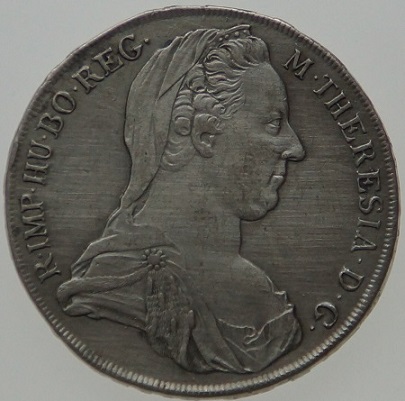
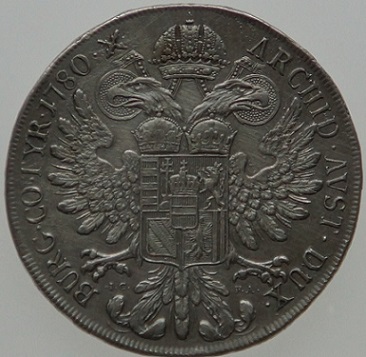
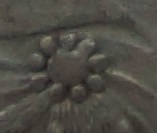
a copy of Clara Semple's 2007 monograph, "A Silver Legend: The Story of the Maria Theresa Thaler How can I buy a copy of it? For the problem of talon as an indicator of mint era of MTT, I still assume MTT with longer eagle talon might indicate it is a more current issue. Of course, I will continue to collect and search more specimens to make my final conclusion. Today I want to post my currently acquired MTT, it looks like a Roman mint specimen and want all of you (esp. austrokiwi) to leave a comment on it. Speification of the coin: 27.97 grams, 40.0-40.7 mm, S.G. 10.124 (appro. 79.6% Ag). My impression on the coin: first, the saltire indicates it was a specimen in 1930s but the striking of this coin is weak (low relief) when compared with those MTT from the same era. Second, the edge letters are thick and blurred, not looks like the edge letters of the same peroid of other MTT. Third, there is a complete circular die crack on the reverse side and a partial arc die crake on the observe side also. This last evidence makes me feel it is a Roman mint specimen. (According to austrokiwi's paper: The Twentieth Century Minting of the 1780 MTT) See the pictures: 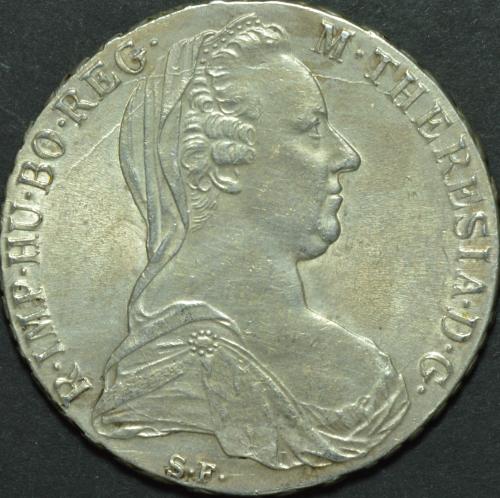 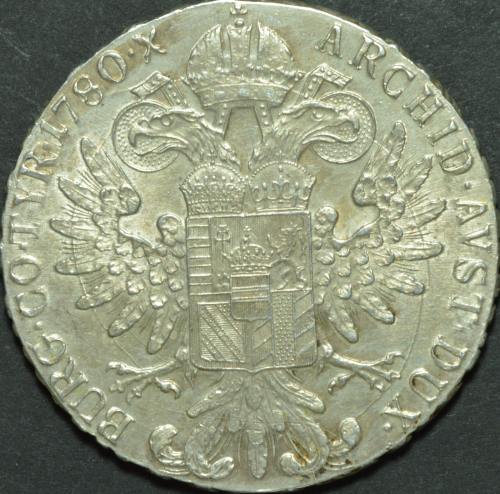 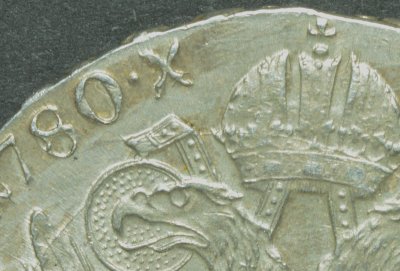 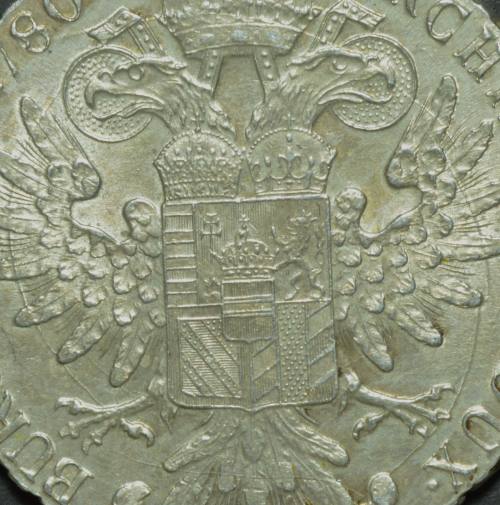    |
|
Pillar of the Community
2087 Posts |
The silver legend by Clara Semple is a great coffee table book but it should not be relied on. It was one of the first books I purchased but once I started doing my own research I quickly became disenchanted with the book. HAve a look at the picture on page 41 (Original Prague strike) Semple describes the coin pictured as a prototype for re-strikes. The statement doesn't make sense, worse she doesn't point our how rare the coin is( only two in existence). I have no idea why she referred to the coin as the prototype I suspect ( but don't know) that she was told the coin was a "probe" and instead of understanding this as meaning trial strike she translated the word incorrectly as prototype.
She repeats many assumptions about the coin ( with out testing them) for example she states that the MTT was successful because of its high Silver content and decorated edge. However when one looks at the coins it competed with one finds the MTT was invariably the one with the lowest silver content ( which is one of the substantive reasons for the MTTs success. )
Hafner's book is just a catalog, it is in German and English. The most numismaticly important modern book on the MTT is Dr Franz Leypolds small 1976 work Der 1780 Maria Theresien Thaler. This is the work that breaks the MTT down into types ( not the first time but the most comprehensive) unfortunately the book is all in German
|
|
Pillar of the Community
2087 Posts |
That coin really does look like a Rome mint example. The die cracking was/is used by Italian dealers to identify the type but the only way to be sure is XRF Rome mint coins are 835 standard and MS examples will weigh in the range 28.07-28.14 grams. The Die cracking is not a fool proof identification measure as such die cracks though rare can be found on Vienna strikes( usually 19th century)
|
|
Pillar of the Community
Hong Kong
1270 Posts |
Thank you for your reply austrokiwi. I dare to say it is a Rome-minted specimen for I base on what you said in your paper. If just by the identification of the saltire on the reverse of the coin, it is hard to determine the coin is a pre-1900 (H49) or a latter piece. I bought this coin from Lanz; he supposed this coin as H49. See the link: http://www.ebay.com/itm/LANZ-RDR-Ma...p=true&rt=nc(I have cleaned the coin after getting it.) There is another question that I want you to comment on. For so many years, I have seen various numismatic forgeries for all kinds of coins, the most flooding forgeries are the Latin American 8R before and after 19th Century for example. However I have never seen such MTT restrike counterfeit till now. Do you think these old and relatively modern MTT are difficult to forge for its complicated design or any reasons make it unpopular to be counterfeited? Welcome to anyone has an idea on that issue. Henry |
|
Pillar of the Community
2087 Posts |
I haven't looked that much at forgeries. Most forgeries seem to be of Chinese origin and date to the last 40 years. The Russians are supposed to have also produced the MTT and I count that as a forgery as it was rumored to be light weight(24grams). The Russians supplied the coin to Syria and Egypt in the period 1950s-1970s( I haven't found one yet so I have no idea what it looks like). You don't see too many earlier forgeries for the simple reason the MTT was cheap to obtain and forgers would have found it difficult to make any profit there were other higher value coins that would have been more profitable to make. Any one could commission the striking of MTT just by supplying the requisite silver to the mint and many of those banking houses that did so used higher silver content coins ( Saudi riyals, Spanish dollars and such like). Early forgeries are more likely have been produced in the Levant, East Africa, Sudan and egypt and were very crude. One prosecuted forger in Ethiopia ( 19th century) had made his forgeries in pewter using a file!! the amount of work involved would have limited the number he could have produced!
I have seen comments online stating the MTT is one of the most forged cons but.......those people seem to regard the output of non Austrian mints as forgeries despite the fact all of those coins were legally produced ( despite Chech, Austrian and Italian protestations) and met the required silver standard
I missed out answering an earlier question: to get a copy of Hafners book try emailing HD Rauch ( though german speaking they have english speaking staff) and ask them if they have a copy last time I looked a month ago they had copies alternately try the Vienna mint. the book isn't listed on the online shop but I know they have it ( last time I was there they still had two boxes of the book) Worst comes to the worst PM me and I will arrange to pick one up for you and post it on)
Edited by austrokiwi
03/18/2013 09:35 am
|
|
Pillar of the Community
Hong Kong
1270 Posts |
austrokiwi, Quote:
You don't see too many earlier forgeries for the simple reason the MTT was cheap to obtain and forgers would have found it difficult to make any profit So why doing MTT modern forgeries would not make any profit? As a Chinese mind, I would think of the following reasons: i) MTTs are always found as restrike, no matter it is official or not, it is not an original, we Chinese people don't like restrikes. There is a "prejudice" in our mind that "restrike" is equvalent to "not genuine" ii) In the era early 18th or 19th Century, large amount of foreign silver dollars entered China or trading or other purposes, but MTT is not as popular as Mexican Portrait or Eagle dollars so we are not familiar with this coin in our history. I would guess MTT was not as popular as Mexican dollars for the reason of its relatively low Ag content and it was difficult to correlate with the currency of Chinese dollar and Mexican dollars. Anyway, I still have an idea there are fewer MTTs modern forgery because of the technical reasons. The high consistence in design, the complicated pattern of the coin and the edge letterings are the main points to deter forgery. Good expertise and better technology are needed to forge this coin, a cottage factory would rather do other popular specimens. Having read your paper, I now understand there is a long history behind the MTT restrikes in Europe and Middle East, there is still a great space to explore the history in this aspect. The story of MTT is always fascinating! Any specialized book about it is always welcome. Tell me by email if you can buy one for me. |
|
Pillar of the Community
2087 Posts |
I might have confused things: I will try saying it again: For much of the last 200 years the MTT would have been a marginal coin for Forgers. They would have found other coins: Spanish and Mexican dollars, Sovereigns and similar sized gold coins etc. The MTT in comparison to other coins used in trade had a very low silver content. It was cheap to send higher silver content coins to an Austrian controlled mint and have MTTs made, so making the forging of MTT less profitable than its Spanish and Mexican cousins. The MTT also traded in a "middle earth" where trade volumes were much lower than further east (India and more particularly China). Accordingly the MTT was never produced in large numbers. aprox 400 million MTTs have been produced since 1780 that equates to a little over 1.7 million a year over the last 230 years. However the mode mintage is much closer to 300,000 coins per year. This is because the highest production rates for the MTT occurred in the period 1935-1942 (in two years the Indian mints produced `aprox 21,000,000 in preparation and on going support of the British East African campaign in WW2) and this skews the average mintage rate considerably. Quote:
The high consistence in design, the complicated pattern of the coin and the edge letterings are the main points to deter forgery. I have seen this view put forward many times. Usually stated as the coin was hard to forge. I don't think that is wholly correct but rather just one minor factor amongst a number. I think this is the key point: Quote:
Good expertise and better technology are needed to forge this coin, a cottage factory would rather do other popular specimens. I believe a cottage factory could produce good MTT forgeries but why would they bother when there are much more profitable candidates! I believe most of the forgeries of MTTs found today are very modern. I have visited silver dealers in Amman in Jordan ( and other collectors have seen the same in Yemen, Oman, and Bahrain) and when they show me the MTTs they have often 90% are Chinese made fakes(two types are usually seen 1:Copies of London mint coins and a 20th century look alike with Chinese wording in roman script on the edge) These fakes target tourists invariably every reputable Arabic silver and gold dealer( who sells to locals) can easily tell fake MTT from Genuine and do not stock fakes). In my experience it is only the tourist shops that seem to have Fake MTT in great quantities. Hence my view that it is the tourist market that has been the main driver for counterfeit MTT in last few decades. A |
|
Pillar of the Community
2087 Posts |
An example of why I both love and hate collecting re-strike Maria Theresa Thalers: Yesterday I purchased an early Vienna mint re-strike ( Mint Signature IC-FA). The coin, as it was an E auction it will be picked up tomorrow, had one subtle difference on it that attracted my attention the brooch on the obverse was round instead of oval. Now this variety hasn't been identified before.... it might just be as a very minor variation. Except......=> In 1986 an Austrian expert briefly reported on a discovery( by another writer) in the Austrian archives. In a file some tin plate impressions were found in the files relating to the transfer of MTT tooling to Milan on the 28 August 1787. The description in that 1986 article almost exactly describes the coin I have just purchased, but ( with MTT's there is often a "but") it is reported that the copy of the letter sent with the tooling to Milan instructs the Milan mint to add its mint signature to the tooling. From my research so far the last time Milan mint used a mint signature ( as opposed to mint mark) was 1786( the year earlier) and the signature used was L-B. I have a range of MTT relevant literature going back just over 220 years and no where does any one mention an MTT with a mint signature of LB or similar. I find in another older work (1898) a similar story being told but this time the authors (Thankfully quoting an archive reference number) also report the transfer of tooling on the 08/28/1787 but this older report notes the coins were produced using the Vienna mint signature IC-FA. The obvious conclusion is tooling was transferred but one of the reports is wrong. My favorite tool is Occams Razor. And in this case I apply it as follows:
- Dies were transferred to Milan from Vienna
- Despite the directions being that Milan should add its mint signature no such coin has ever been reported so more than likely it was never used
- Most people don't recognize Milan MTT until 1815
- the most likely reason the 1787 -1790s Milan strike has not been identified is because it is very difficult to identify therefore the report that the coin bore the Vienna mint signature is probably correct
So I may have found a coin that seems to match one crucial feature of the known 1787 Milan Strikes. Tomorrow I pick it up and then start comparing it to other coins in my collection. Assuming its genuine and is distinctly different to the other ICFA MTT I have, then it becomes a possible 1787 Milan candidate. But how do I prove it? Luckily I have an Archive reference number.....so of course I will head off to the archives ( takes two weeks to order files of that age) and maybe I will find the proof positive that the Milan strike is now in my hands. This is the exciting part of collecting MTT. The frustrating side, as I have found so many times before, is I will find the file no longer exists or that it doesn't confirm one way or another my suspicions. Worse the file tells me something completely different ( this too often is the usual result) Tomorrow I will post Photos of this new research subject! |
|
Pillar of the Community
Hong Kong
1270 Posts |
I am looking forward to seeing your 1787 Milan strike. I am curious to know how far it from H36, also a Miland strike in 1815-28. I bought the latter one recently but still not received.
|
|
Pillar of the Community
2087 Posts |
Edited by austrokiwi
03/25/2013 08:02 am
|
|
Pillar of the Community
Hong Kong
1270 Posts |
Doubtlessly, this is a great coin. I see two characteristics of this coin. First the 'A' in red circles is in fact an inverted 'V' or the bar is very faint? Second, there is a pseudo-collar of the coin, it looks quite different from modern restrike. Is this kind of 'collar' an indication of an older MTT restrike, that is, pre-1890s or earlier? Starting from ABC of MTT, can you tell me what is meant by the emblem of the third quadrant (also red circle), austrokiwi. Of course I need to read more about MTT restrikes from books. Thank you. 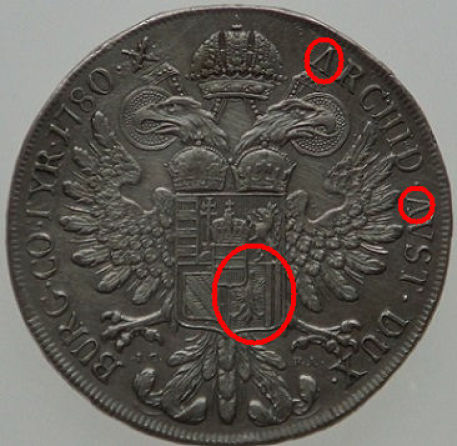 |
|
Pillar of the Community
2087 Posts |
As you have noted this is a very early re-strike: ignoring the Milan Possibility for now it dates to the period 1781-1788. Although most people when they think of MTT's think of the Guenzburg mint strike ( Often referred to as Burgau). However in actual fact Guenzburg was a provincial mint and Vienna was the main mint so the IC-FA MTTs should be regarded as the "superior" MTT.
From 1765 to 1780 Thalers were identified by a number of features First the mint signature, as in the case of this coin, was usually placed on the reverse( Only Guenzburg placed it on the obverse). The arms relating to the mint producing the coin were placed in the fourth quadrant of the Coat of arms. After 1780 MTT followed these conventions for a while. In the case of this coin ( where Henry has circled): because the coin was struck in Vienna and the heart shield is already Austria's rather than using the Austrian arms they placed the Arms of Upper Austria in the fourth quadrant (referred to Henry's post as 3rd). Krause incorrectly lists this type under "Burgau" it should be listed under Vienna! The mistake Krause has made is equivalent to listing a Philadelphia mint coin under Hawaii! Krause has been told several times but they haven't bothered correcting it!
As for the "A" Soon as I saw the photo I rushed back to the coin and checked: the cross bars are there they are just very faint.
Coins of this period have a very distinctive feel/look they were produced from hand cut dies using screw presses...
Edited by austrokiwi
03/25/2013 4:53 pm
|
|
Pillar of the Community
 United States
3499 Posts |
wonghinghi- Wonderful 1787 MTT variety! Thanks for sharing. I haven't come across any MTTs around my neck of the woods as of late, but I definitely have my eye out for them.
|
|
Pillar of the Community
Hong Kong
1270 Posts |
Thank you austrokiwi, your information. But, Quote:
The arms relating to the mint producing the coin were placed in the fourth quadrant For more latter MTT, the 4th quadrant is always the arms of Burgau, what is the importance of putting this arm here? We know that Burgau is a town of Gunzburg which was no longer the property of Habsburghs after 1805. |
|
Pillar of the Community
2087 Posts |
That is a huge question and one I have spent several years researching and it is not simple as the MTT was an exception to many of the standard Minting policies of the Austrian Habsburgs. So forgive the long winded reply: In 1741 Maria Theresa came to power and immediately hit a problem the Crown of the Holy Roman Empire could only be passed on to male heirs with the agreement of the electors. So her first Talers only bore the arms she was legal entitled to. Namely; Hungary, Bohemia, Burgund and Tyrol(upper Austria). This gave a four quadrant coat of arms with a heart shield of Austria. In 1745 her husband became Holy Roman Emperor and so her thalers' changed to bear the full arms of the Holy Roman Empire: this was a three row coat of arms with 13 separate arms and the heart shield was varied according to the mint. In 1765 her Husband died and she lost the right to the Holy Roman Empire arms so her coins reverted to the 1741 style of arms( with some decorative differences). Now the standard rule after 1765 was that the arms of the fourth quadrant would reflect the place of striking rather than the heart shield. However the MTT still varied slightly from that rule because of customer demand. Background Digression :
After the costly Austrian Succession wars the Austrian Habsburgs were struggling Financially. A Banker Count Von Fries ( the real Architect of the MTTs success) advised the Habsburgs(Maria Theresa) to change some monetary rules specifically the one banning the export of Silver coin. So, to redress the negative trade balance with the east, in 1752 the Austrian Department of Commerce lifted the restriction on exporting Silver coin and the free minting of Maria Theresa thalers was allowed. Count von Fries was awarded a patent giving him exclusive rights to the MTT for export to the Levant. In 1764 Guenzburg mint was set up. Prior to this time Bank houses in Augsburg had been buying Thalers from Hall(Tyrol) and then selling them onto French traders who exported the coins through Livorno, Genoa, and Marseilles to Egypt where they were used to buy coffee, pearls, silk, aromatic gums and even cotton. ( Note in Bahrain and Oman the MTT was known as the French Kurush). Trieste only became an important export port for MTT in the 19th century). Note Europeans traders were blocked from using the Red Sea by the Ottomans so trade from Egypt to the Persian gulf was conducted by Egyptian and Arabian Peninsula based traders
Guenzburg was much closer to Augsburg than Hall, from memory Hall closed around 1774. Soon after being set up Guenzburg became the main supplier of MTT to French traders. The markets for the MTT in the Red sea/Persian Gulf/East coast of Africa was quite demanding and would tolerate little change in the form of the coin. As time went on less and less variation in form was tolerated.
Back to answering the question: When Maria Theresa's husband died the obverse design was changed to a heavily veiled bust. Here is one variety of that type a 1770 Vienna mint strike ( this illustrates some of the resistance to any significant change in design): 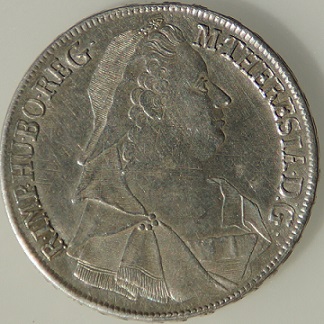 An important point to note is the brooch in this design is partially missing in some of the other heavily veiled varieties it was omitted completely. The importance of this: In the user markets (Particularly Red Sea/Persian Gulf/East Africa) the brooch had been used as a means to identify genuine MTT. Removing all or part of the brooch produced considerable consumer resistance. In 1772/73 following complaints about the change in design from banking houses the obverse was redesigned with a lighter veil and more importantly with a return to a full brooch. {Note this change to a lighter veil is used to support the soft-porn-myth of the MTT(thats another story).} So whats that got to do with the question? The MTTs form was shaped by market forces. Count von Fries bank controlled the supply to Turkey the coins generally came from Vienna, Karlsburg, and Kremnitz( however there is another exception here I will leave out for now). MTT controlled by von Fries were exported predominantly down the Danube to Turkey. These coins generally all followed the Vienna form of the coin. Which was the arms of Upper Austria in the fourth quadrant and the mint signature on the reverse. I believe the exceptional use of the Upper Austria arms by non-Vienna mints was to ensure consistency of the coins appearance. Guenzburg ( I suspect was outside of Von Fries influence) adhered to the usual convention so its arms were in the fourth quadrant and the mint signature was placed on the obverse as typical of that mint. Guenzburg produced far more MTT than the other Habsburg mints and those coins penetrated into initially resistant markets becoming the accepted type in those regions. So in time the demand for the Vienna type waned (especially as Turkey adopted European financial methods) while the demand for the Burgau form increased. Another factor is; as the Ottoman regions close to Islamasbul (Islamabad) became more economically advanced they became more tolerant to changes in the form of coin, While the markets penetrated by the Gunzburg coin remained largely primitive and highly resistant to change. By 1820 the economic forces were such it was expedient to focus on producing the Guenzburg MTT design as there was no resistance in Turkey to that form while the other markets only took the Vienna mint type at a discount. As an additional note I think the penetration of the Guenzburg type into the Oman trading empire guaranteed its continuation at the expense of the Vienna form. This is where the history of the MTT takes a dark turn as the coins predominant use by Omani traders was in the slave trade. I hope this long answer is understandable. Edited by austrokiwi
03/28/2013 11:04 am
|
| |
Replies: 416 / Views: 99,889 |








 First Page
 Previous Page


 Posted 03/17/2013 03:02 am